Apixaban to Prevent Covert Infarcts After Cryptogenic Stroke in Patients With Atrial Cardiopathy: A Secondary Analysis of the ARCADIA Randomized Clinical Trial
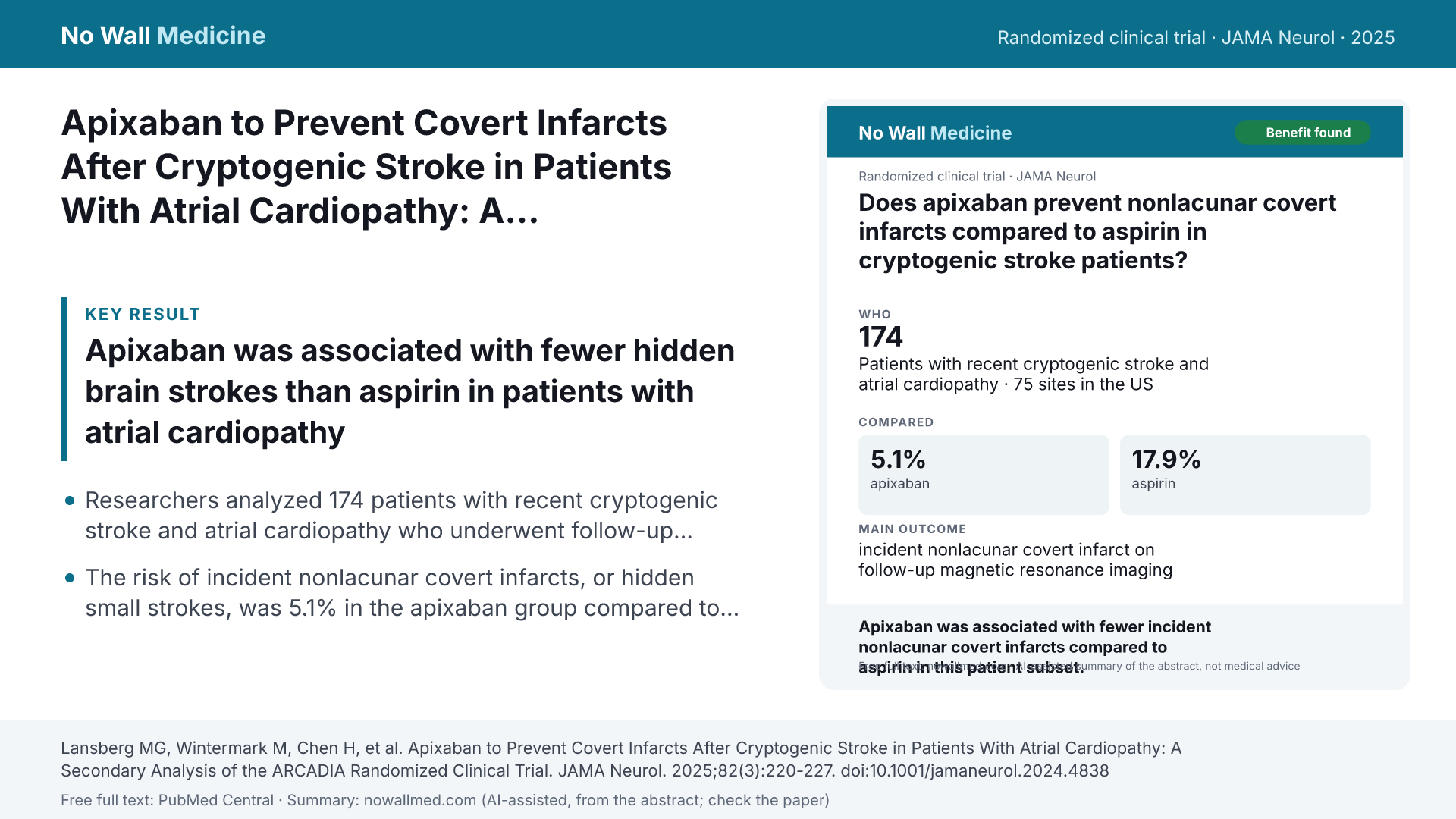
Key result: Apixaban was associated with fewer hidden brain strokes than aspirin in patients with atrial cardiopathy
Secondary analysis of a trialBenefit found
Does apixaban prevent nonlacunar covert infarcts compared to aspirin in cryptogenic stroke patients?
Who
174
Patients with recent cryptogenic stroke and atrial cardiopathy · 75 sites in the US
Compared
5.1%apixaban
17.9%aspirin
Main outcome
incident nonlacunar covert infarct on follow-up magnetic resonance imaging
Result: weighted relative risk 0.29 (95% CI 0.10-0.83)
Bottom line: Apixaban was associated with fewer incident nonlacunar covert infarcts compared to aspirin in this patient subset.
JAMA Neurol · 2025-01-27
Key points
- Researchers analyzed 174 patients with recent cryptogenic stroke and atrial cardiopathy who underwent follow-up magnetic resonance imaging.
- The risk of incident nonlacunar covert infarcts, or hidden small strokes, was 5.1% in the apixaban group compared to 17.9% in the aspirin group.
- The study observed a weighted relative risk of 0.29 with a 95% confidence interval of 0.10-0.83 over a median follow-up of 811 days.
Discussion prompts
- Would these patients look like yours? Who was left out?
- Is the main outcome one that matters to patients?
- Is the difference large enough to change what you do?
Cite: Lansberg MG, Wintermark M, Chen H, et al. Apixaban to Prevent Covert Infarcts After Cryptogenic Stroke in Patients With Atrial Cardiopathy: A Secondary Analysis of the ARCADIA Randomized Clinical Trial. JAMA Neurol. 2025;82(3):220-227. doi:10.1001/jamaneurol.2024.4838
Free full text: PubMed Central · Summary and visual abstract: nowallmed.com/a/apixaban-to-prevent-covert-infarcts-after-cryptogenic-stroke-in-1orz8hk/ (AI-assisted from the abstract; check the paper before relying on it).