Apolipoprotein E Mimetic Peptide CN-105 and Postoperative Delirium in Older Patients: The Phase 2 MARBLE Randomized Clinical Trial
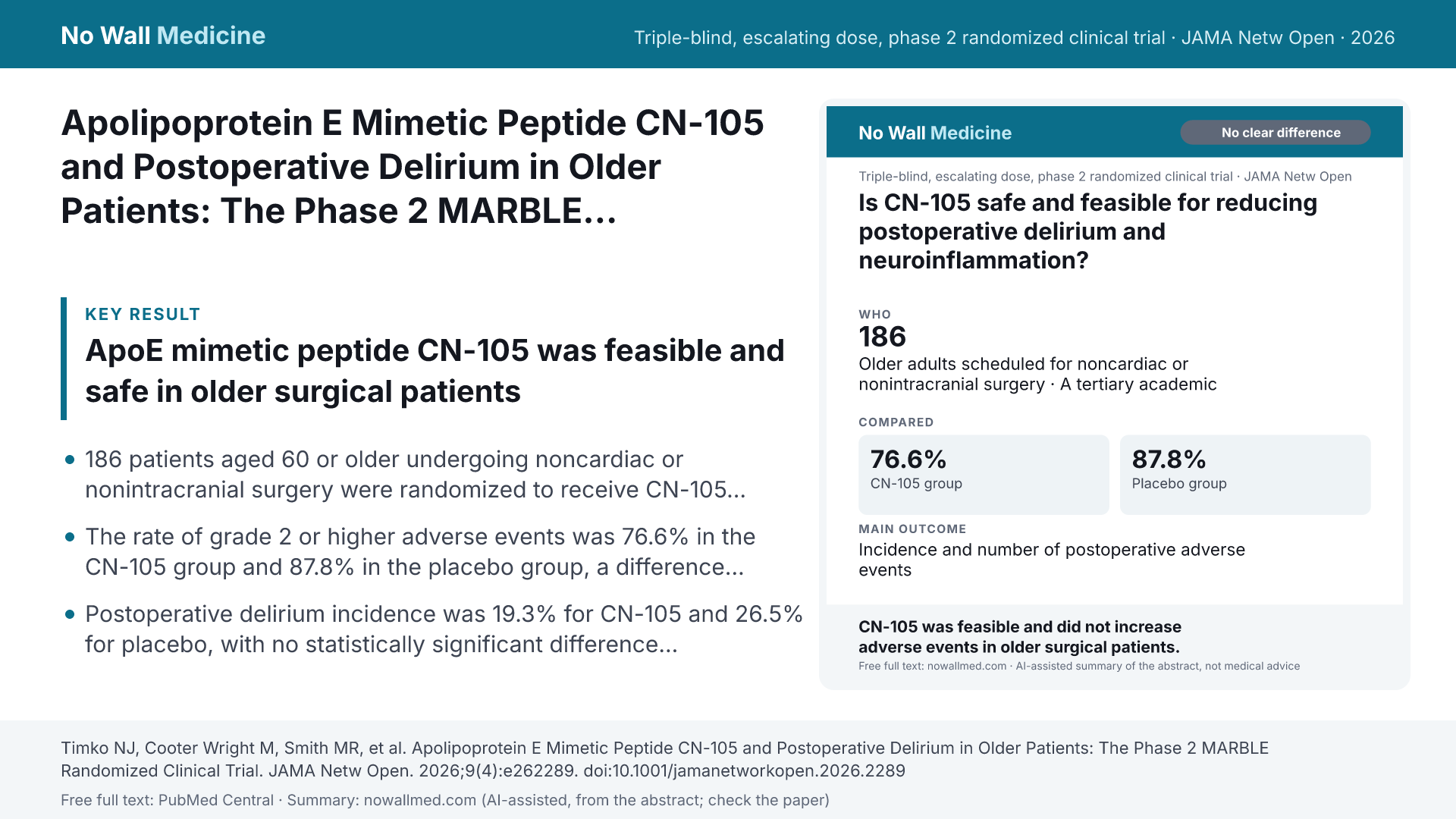
Key result: ApoE mimetic peptide CN-105 was feasible and safe in older surgical patients
Triple-blind, escalating dose, phase 2 randomized clinical trialNo clear difference
Is CN-105 safe and feasible for reducing postoperative delirium and neuroinflammation?
Who
186
Older adults scheduled for noncardiac or nonintracranial surgery · A tertiary academic medical center
Compared
76.6%CN-105 group
87.8%Placebo group
Main outcome
Incidence and number of postoperative adverse events
Result: relative risk 0.87 (95% CI, 0.76-1.00)
Bottom line: CN-105 was feasible and did not increase adverse events in older surgical patients.
Limitation: A phase 3 trial is warranted to further evaluate efficacy for reducing postoperative delirium.
JAMA Netw Open · 2026-04-01
Key points
- 186 patients aged 60 or older undergoing noncardiac or nonintracranial surgery were randomized to receive CN-105 or placebo.
- The rate of grade 2 or higher adverse events was 76.6% in the CN-105 group and 87.8% in the placebo group, a difference that was not statistically significant.
- Postoperative delirium incidence was 19.3% for CN-105 and 26.5% for placebo, with no statistically significant difference in delirium severity scores.
Discussion prompts
- Would these patients look like yours? Who was left out?
- Is the main outcome one that matters to patients?
- Is the difference large enough to change what you do?
Cite: Timko NJ, Cooter Wright M, Smith MR, et al. Apolipoprotein E Mimetic Peptide CN-105 and Postoperative Delirium in Older Patients: The Phase 2 MARBLE Randomized Clinical Trial. JAMA Netw Open. 2026;9(4):e262289. doi:10.1001/jamanetworkopen.2026.2289
Free full text: PubMed Central · Summary and visual abstract: nowallmed.com/a/apolipoprotein-e-mimetic-peptide-cn-105-and-postoperative-delirium-in-l8ncg9/ (AI-assisted from the abstract; check the paper before relying on it).