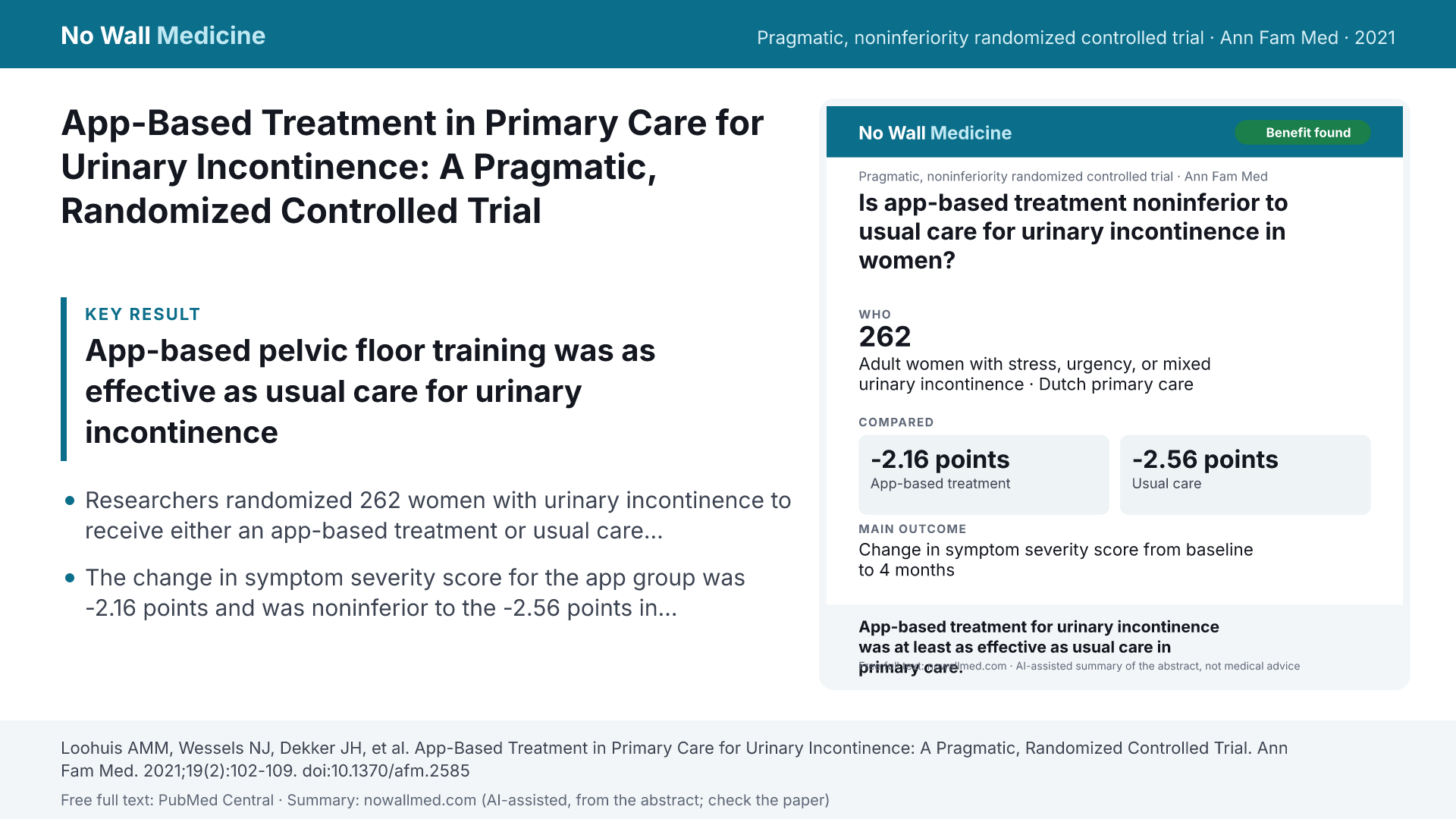
App-Based Treatment in Primary Care for Urinary Incontinence: A Pragmatic, Randomized Controlled Trial
Key result: App-based pelvic floor training was as effective as usual care for urinary incontinence
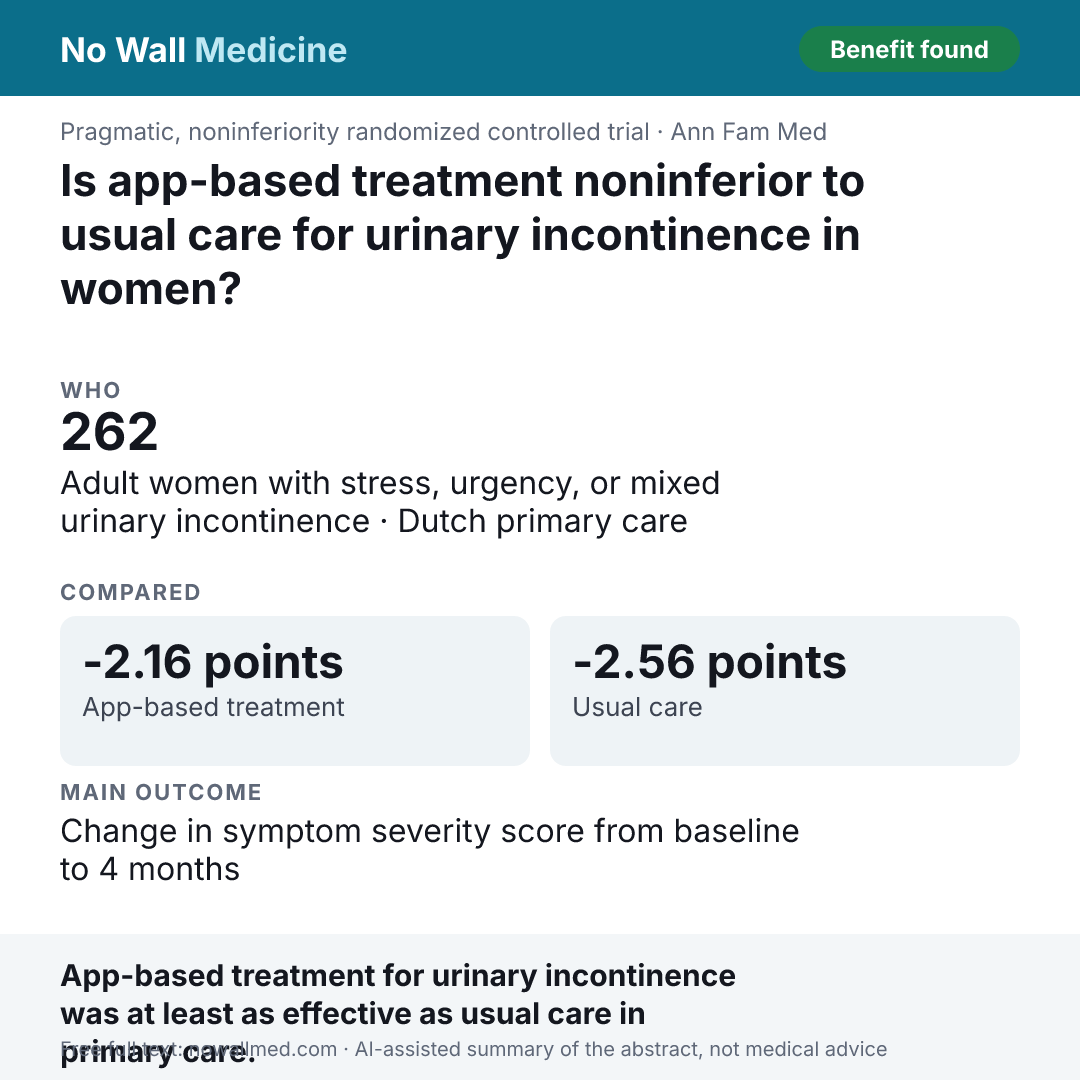
Pragmatic, noninferiority randomized controlled trialBenefit found
Is app-based treatment noninferior to usual care for urinary incontinence in women?
Who
262
Adult women with stress, urgency, or mixed urinary incontinence · Dutch primary care
Compared
-2.16 pointsApp-based treatment (95% CI, -2.67 to -1.65)
-2.56 pointsUsual care (95% CI, -3.28 to -1.84)
Main outcome
Change in symptom severity score from baseline to 4 months
Result: mean difference 0.058 points (95% CI, -0.776 to 0.891)
Bottom line: App-based treatment for urinary incontinence was at least as effective as usual care in primary care.
Ann Fam Med · 2021-03-09 · Save PNG
Key points
- Researchers randomized 262 women with urinary incontinence to receive either an app-based treatment or usual care according to general practitioner guidelines.
- The change in symptom severity score for the app group was -2.16 points and was noninferior to the -2.56 points in the usual care group.
- Both treatment groups showed improvements in outcome measures after 4 months of follow-up.
Discussion prompts
- Would these patients look like yours? Who was left out?
- Is the main outcome one that matters to patients?
- Is the difference large enough to change what you do?
Cite: Loohuis AMM, Wessels NJ, Dekker JH, et al. App-Based Treatment in Primary Care for Urinary Incontinence: A Pragmatic, Randomized Controlled Trial. Ann Fam Med. 2021;19(2):102-109. doi:10.1370/afm.2585
Free full text: PubMed Central · Summary and visual abstract: nowallmed.com/a/app-based-treatment-in-primary-care-for-urinary-incontinence-a-1mb4ivw/ (AI-assisted from the abstract; check the paper before relying on it).