Apparent diffusion coefficient is linked to Crohn's disease activity scores and bowel segment involvement
Apparent diffusion coefficient for assessing Crohn's disease activity: a meta-analysis
Meta-analysis of 21 studiesBenefit found
Does apparent diffusion coefficient correlate with Crohn's disease activity parameters?
Who
1053
Patients with Crohn's disease
Compared
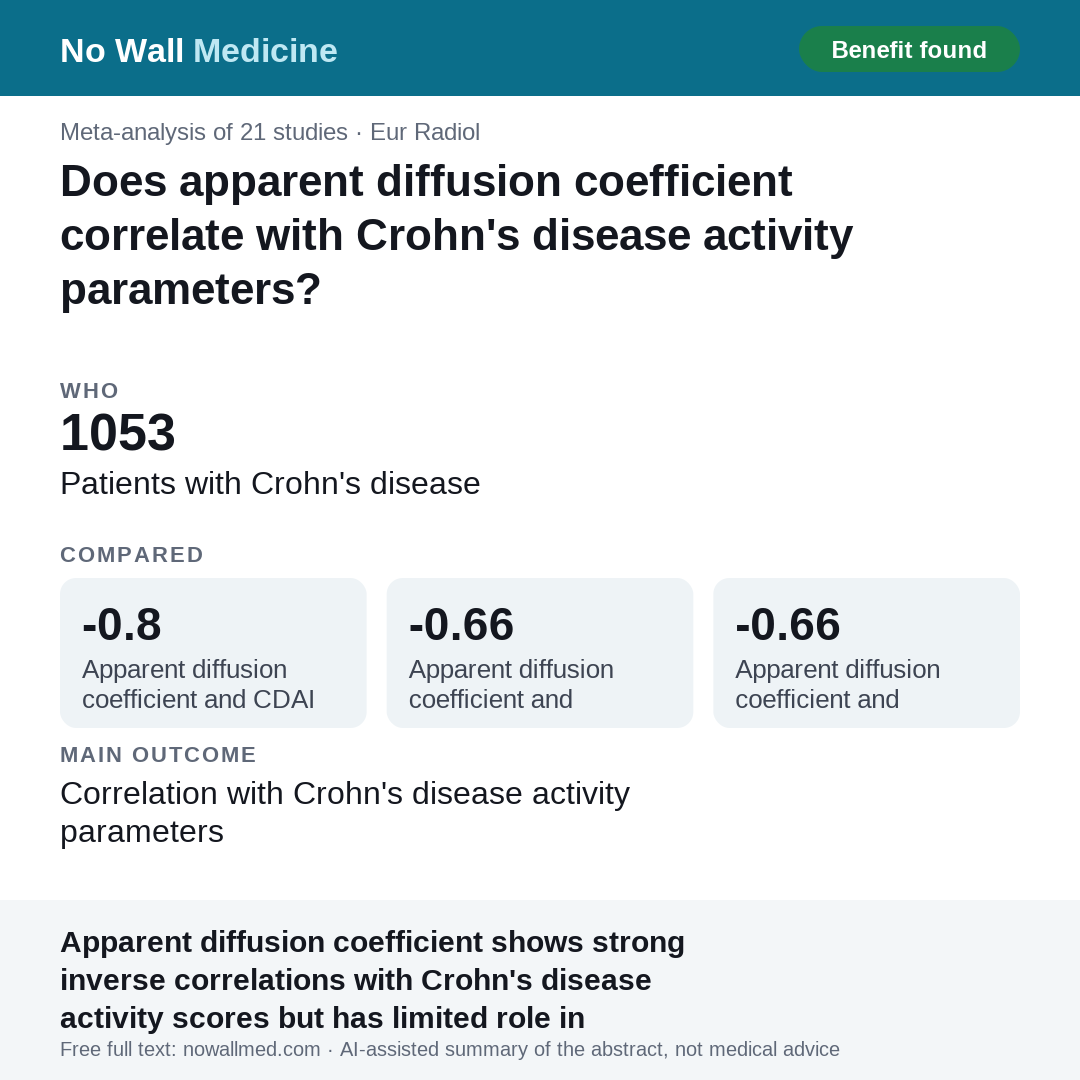
-0.8Apparent diffusion coefficient and CDAI (95% CI = [-0.94; -0.65])
-0.66Apparent diffusion coefficient and MaRIA (95% CI = [-0.79; -0.53])
-0.66Apparent diffusion coefficient and SES-CD (95% CI = [-0.87; -0.46])
Main outcome
Correlation with Crohn's disease activity parameters
Bottom line: Apparent diffusion coefficient shows strong inverse correlations with Crohn's disease activity scores but has limited role in assessing fibrotic changes.
Limitation: The role of apparent diffusion coefficient in assessing fibrotic changes in the bowel wall is limited.
Eur Radiol · 2022-09-28Download image
Clinical question: Does apparent diffusion coefficient correlate with Crohn's disease activity parameters?
Why it matters: It was unknown how the apparent diffusion coefficient relates to various clinical, endoscopic, and histological markers of Crohn's disease activity.
Key points
- Researchers analyzed 21 studies involving 1053 patients to examine the relationship between apparent diffusion coefficient, a measure from magnetic resonance imaging, and Crohn's disease activity.
- The apparent diffusion coefficient was linked to CDAI scores with a pooled correlation of -0.8, MaRIA scores at -0.66, and SES-CD scores at -0.66.
- The measure showed a pooled sensitivity of 0.89 for discriminating between involved and non-involved bowel segments with an area under the curve of 0.89.
Limitation the authors note: The role of the apparent diffusion coefficient in assessing fibrotic changes in the bowel wall is limited.
Headline and key points written with AI from the paper’s abstract, with every number checked against it. Read the paper before relying on them.
Was this summary helpful?
Subject terms
Cite this article
Thormann M, Melekh B, Bär C, Pech M, Omari J, Wienke A. Apparent diffusion coefficient for assessing Crohn's disease activity: a meta-analysis. Eur Radiol. 2022. doi:10.1007/s00330-022-09149-9
Spotted a mistake? Suggest a correction
Top studies every Monday
The week’s key trials and guidelines in your specialties, plus any topics you follow. By email, free.
Get the weekly digest