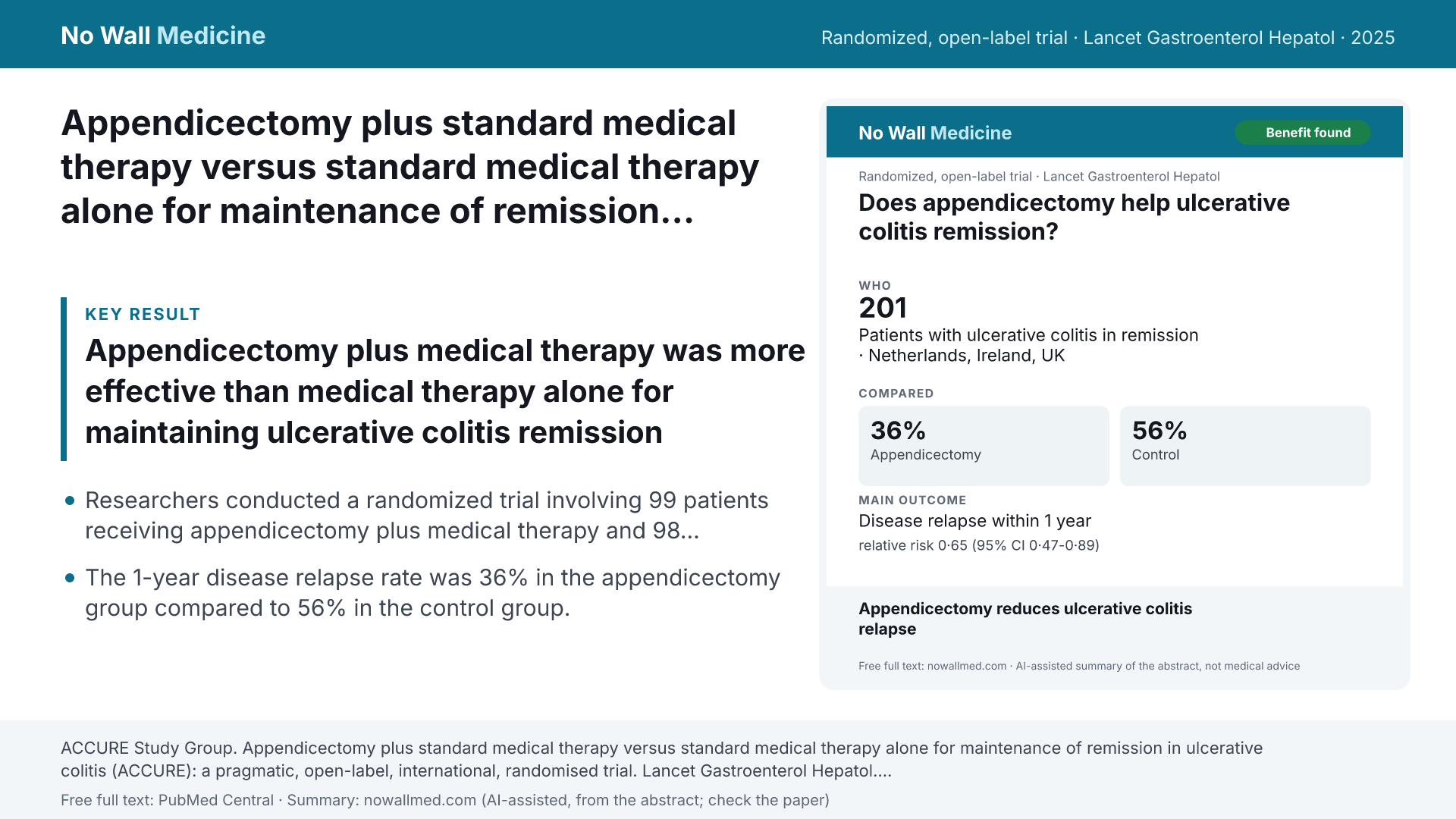
Appendicectomy plus medical therapy was more effective than medical therapy alone for maintaining ulcerative colitis remission
Appendicectomy plus standard medical therapy versus standard medical therapy alone for maintenance of remission in ulcerative colitis (ACCURE): a pragmatic, open-label, international, randomised trial
Randomized, open-label trialBenefit found
Does appendicectomy help ulcerative colitis remission?
Who
201
Patients with ulcerative colitis in remission · Netherlands, Ireland, UK
Compared
36%Appendicectomy (36/99)
56%Control (55/98)
Main outcome
Disease relapse within 1 year
Result: relative risk 0·65 (95% CI 0·47-0·89)
Bottom line: Appendicectomy reduces ulcerative colitis relapse
Funded by: Fonds Nuts-Ohra and National Institute
Lancet Gastroenterol Hepatol · 2025-04-11Download image
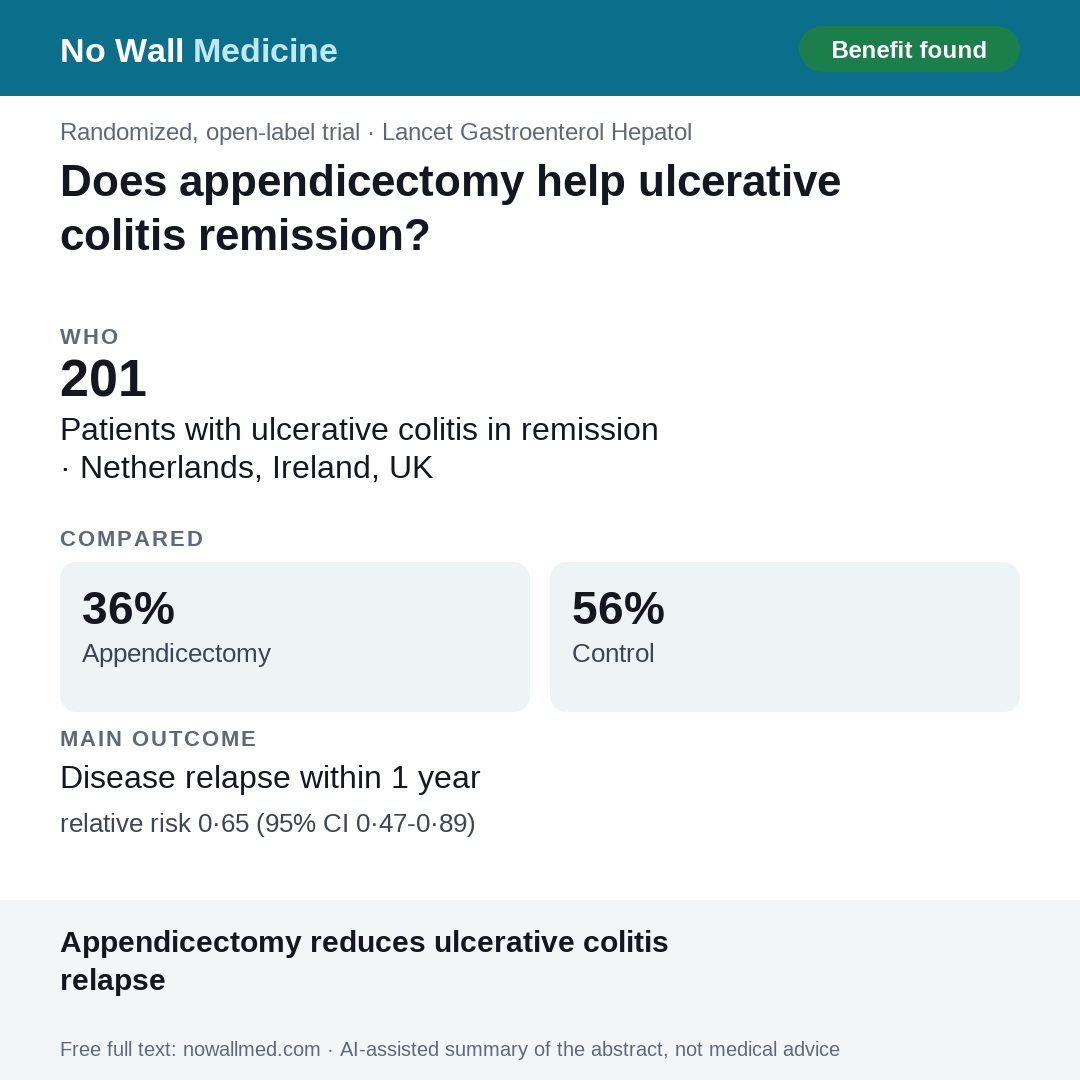
Clinical question: Does appendicectomy help ulcerative colitis remission?
Why it matters: It is unclear if removing the appendix can help maintain remission in patients with ulcerative colitis who have recently experienced a disease relapse.
Key points
- Researchers conducted a randomized trial involving 99 patients receiving appendicectomy plus medical therapy and 98 patients receiving medical therapy alone for ulcerative colitis.
- The 1-year disease relapse rate was 36% in the appendicectomy group compared to 56% in the control group.
- Serious adverse events occurred in 2% of the appendicectomy group, while no serious adverse events were reported in the control group.
Headline and key points written with AI from the paper’s abstract, with every number checked against it. Read the paper before relying on them.
Was this summary helpful?
Abstract
Background
The appendix might have an immunomodulatory role in ulcerative colitis. Appendicectomy has been suggested as a potentially therapeutic intervention to maintain remission in ulcerative colitis. We aimed to evaluate the clinical effectiveness of laparoscopic appendicectomy in maintaining remission in patients with ulcerative colitis. Methods
We did a pragmatic, open-label, international, randomised controlled superiority trial in 22 centres across the Netherlands, Ireland, and the UK. Patients with established ulcerative colitis who were in remission but had been treated for disease relapse within the preceding 12 months were randomly assigned (1:1) to undergo appendicectomy plus continued maintenance medical therapy (intervention group) or to continue maintenance medical therapy alone (control group). Randomisation was done with a central, computer-generated allocation concealment, stratified by disease extent. Patients and treating physicians were unmasked to group allocation. The prespecified primary outcome was the proportion of patients with a disease relapse within 1 year, predefined as a total Mayo score of 5 or higher with an endoscopic subscore of 2 or 3, or, in absence of endoscopy, based on a centrally independent masked review by a critical event committee as an exacerbation of abdominal symptoms (eg, elevated stool frequency subscore of ≥1 point from baseline) with a rectal bleeding subscore of ≥1 or faecal calprotectin level above 150 μg/g or necessitating treatment intensification other than mesalazine. Analyses were done on an intention-to-treat principle. This trial is complete and was registered with the Netherlands Trial Register (NTR2883) and ISRCTN (ISRCTN60945764). Findings
Between Sept 20, 2012, and Sept 21, 2022, 1386 patients were screened. 201 patients were randomly assigned to the appendicectomy group (n=101) or the control group (n=100). After exclusion of four patients due to eligibility violations (three had active disease and one received biological agents at time of randomisation), 99 patients in the appendicectomy group and 98 patients in the control group were included in the intention-to-treat analyses. The 1-year relapse rate was significantly lower in the appendicectomy group than in the control group (36 [36%] of 99 patients vs 55 [56%] of 98 patients; relative risk 0·65 [95% CI 0·47-0·89]; p=0·005; adjusted p=0·002). Adverse events occurred in 11 (11%) of 96 patients in the appendicectomy group and 10 (10%) of 101 patients in the control group. The most frequently reported adverse events were postoperative temporary self-limiting abdominal pain in the appendicectomy group (three [3%] patients) and skin rash in the control group (three [3%] patients). Two cases (2%) of low-grade appendiceal mucinous neoplasm were incidentally found in resected appendix specimens in the appendicectomy group. Serious adverse events occurred in two (2%) of 96 patients who underwent appendicectomy and none in the control group. There were no deaths. Interpretation
Appendicectomy is superior to standard medical therapy alone in maintaining remission in patients with ulcerative colitis. Funding
Fonds Nuts-Ohra and National Institute for Health Research Efficacy and Mechanism Evaluation.
Abstract reproduced under the article’s CC BY NC ND licence.
Subject terms
Cite this article
ACCURE Study Group. Appendicectomy plus standard medical therapy versus standard medical therapy alone for maintenance of remission in ulcerative colitis (ACCURE): a pragmatic, open-label, international, randomised trial. Lancet Gastroenterol Hepatol. 2025. doi:10.1016/S2468-1253(25)00026-3
Spotted a mistake? Suggest a correction
Top studies every Monday
The week’s key trials and guidelines in your specialties, plus any topics you follow. By email, free.
Get the weekly digest