Deep learning models showed promising results for diagnosing cervical central spinal stenosis on MRI
Application and performance of deep learning models for the automated diagnosis of cervical central spinal stenosis on MRI: a systematic review
Systematic reviewUnclear result
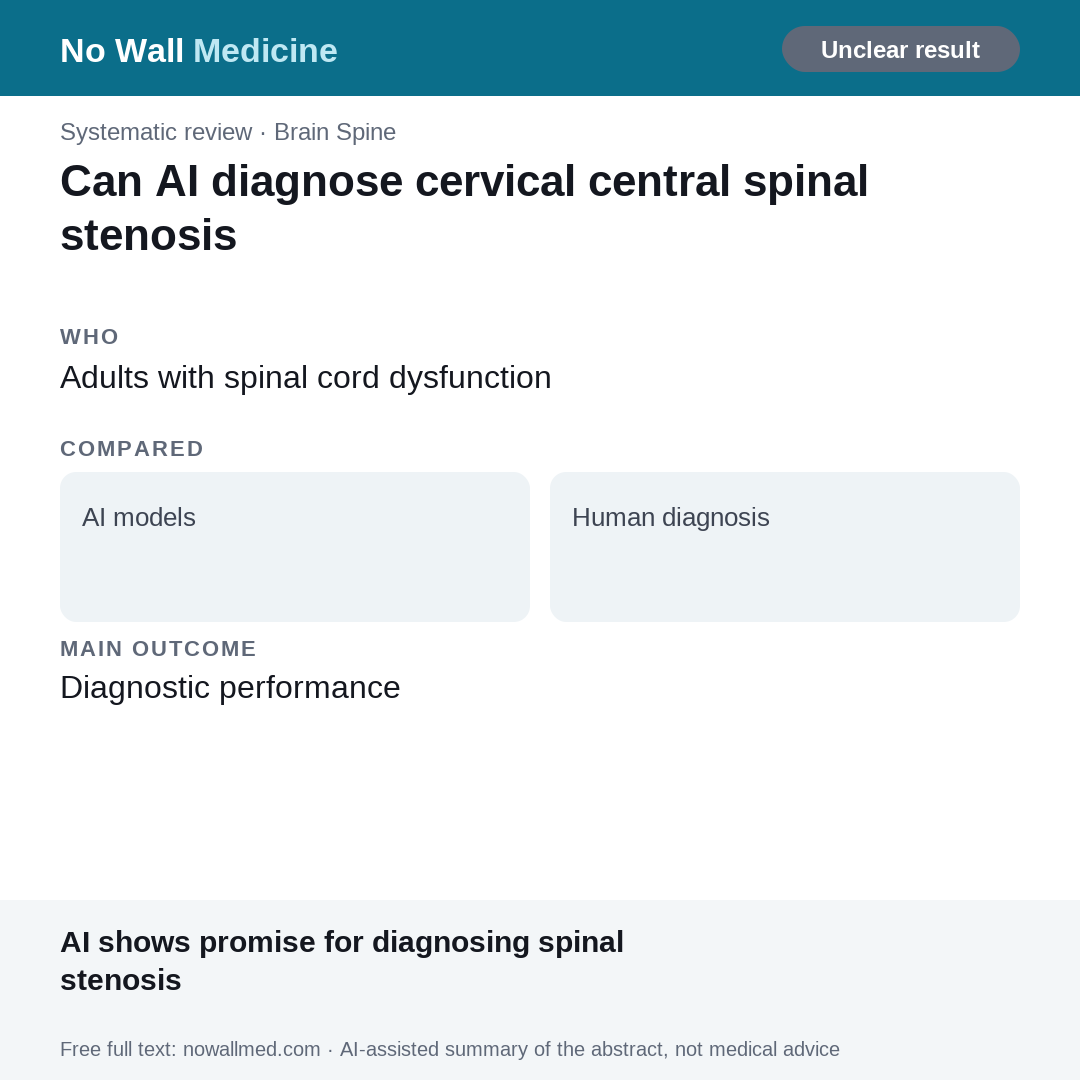
Can AI diagnose cervical central spinal stenosis
Who
Adults with spinal cord dysfunction
Compared
AI models
Human diagnosis
Main outcome
Diagnostic performance
Bottom line: AI shows promise for diagnosing spinal stenosis
Limitation: Small, single-centre cohorts
Brain Spine · 2025-12-18Download image
Why it matters: Automated diagnosis of cervical central spinal stenosis is needed to reduce inter-observer variability in MRI reporting
Key points
- Ten studies with various deep learning models were reviewed for diagnosing cervical central spinal stenosis.
- Sensitivities ranged from 0.67 to 1.00 and specificities from 0.42 to 0.97 across models.
- Most models reported areas under the curve ≥0.90 and accuracies ≥0.85.
Limitation the authors note: Generalisability remains uncertain due to small, retrospective, largely single-centre cohorts and scarce external validation
Headline and key points written with AI from the paper’s abstract, with every number checked against it. Read the paper before relying on them.
Cite this article
Mougios V, Peretzke R, Ertl A, Dugas M, Maier Hein K, Neher P. Application and performance of deep learning models for the automated diagnosis of cervical central spinal stenosis on MRI: a systematic review. Brain Spine. 2025. doi:10.1016/j.bas.2025.105902
Spotted a mistake? Suggest a correction