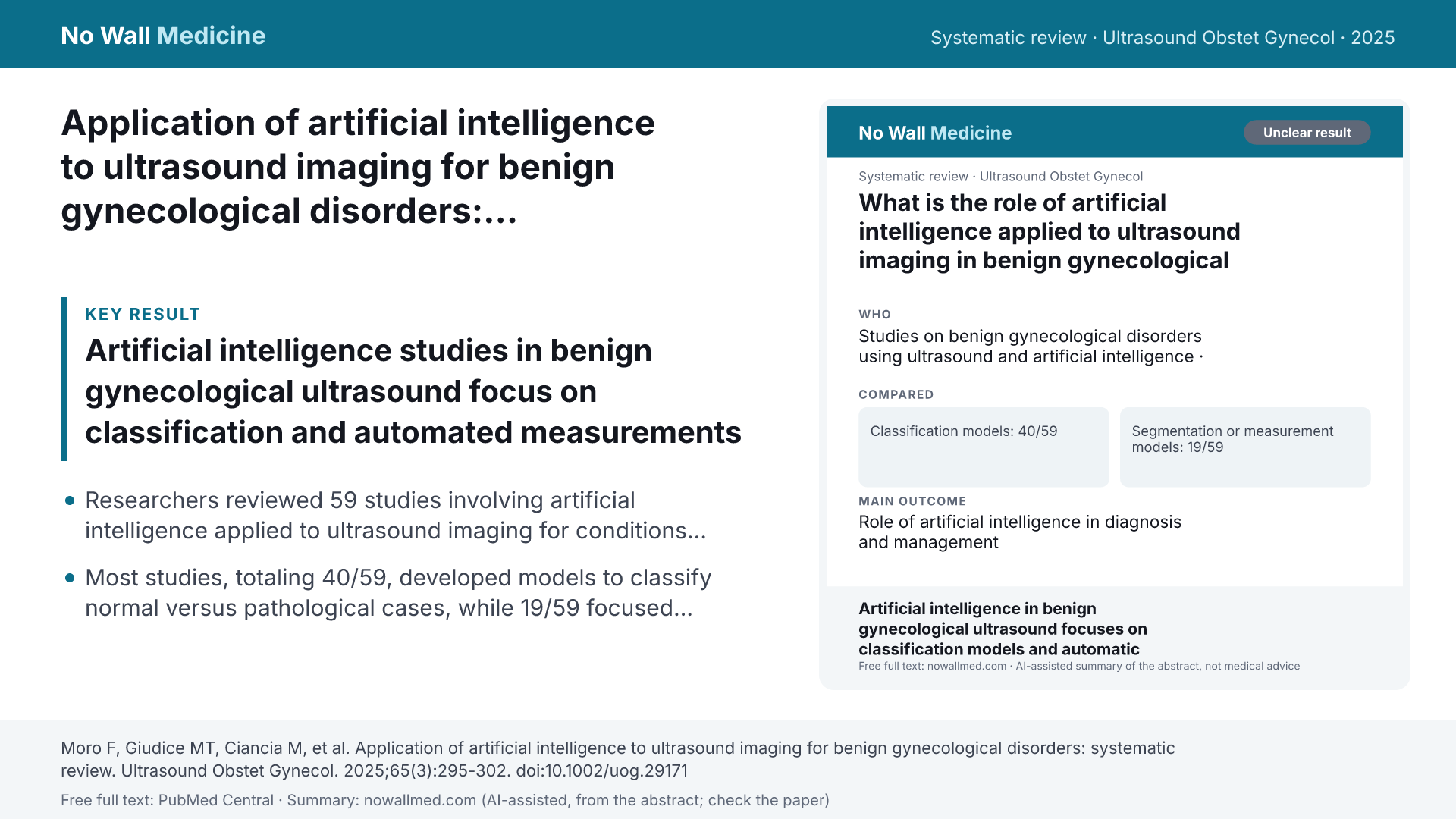
Artificial intelligence studies in benign gynecological ultrasound focus on classification and automated measurements
Application of artificial intelligence to ultrasound imaging for benign gynecological disorders: systematic review
Systematic reviewUnclear result
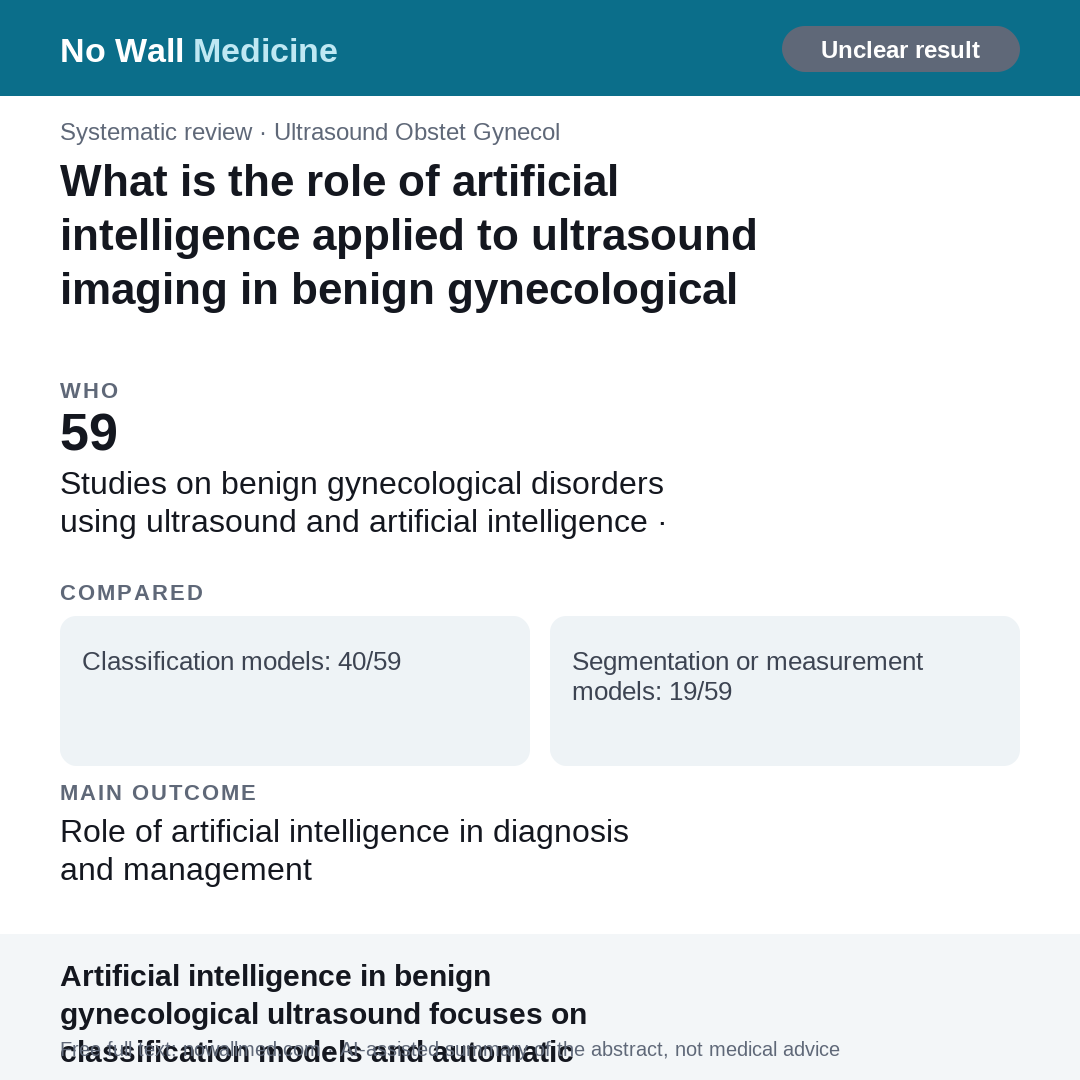
What is the role of artificial intelligence applied to ultrasound imaging in benign gynecological disorders?
Who
59
Studies on benign gynecological disorders using ultrasound and artificial intelligence · Global, most studies from China
Compared
Classification models: 40/59
Segmentation or measurement models: 19/59
Main outcome
Role of artificial intelligence in diagnosis and management
Bottom line: Artificial intelligence in benign gynecological ultrasound focuses on classification models and automatic segmentation or measurement.
Limitation: Most studies had high risk of bias for subject selection and index test domains.
Ultrasound Obstet Gynecol · 2025-01-31Download image
Clinical question: What is the role of artificial intelligence applied to ultrasound imaging in benign gynecological disorders?
Why it matters: Evidence has not been synthesized regarding how artificial intelligence is currently applied to ultrasound imaging for benign gynecological disorders.
Key points
- Researchers reviewed 59 studies involving artificial intelligence applied to ultrasound imaging for conditions like polycystic ovary syndrome and infertility.
- Most studies, totaling 40/59, developed models to classify normal versus pathological cases, while 19/59 focused on automatic segmentation or measurement.
- China was the most represented country in the reviewed literature, accounting for 22/59 (37.3%) of the studies.
Limitation the authors note: Most studies were at high risk of bias for subject selection and the index test domain because models were not validated externally.
Headline and key points written with AI from the paper’s abstract, with every number checked against it. Read the paper before relying on them.
Was this summary helpful?
Subject terms
Cite this article
Moro F, Giudice MT, Ciancia M, Zace D, Baldassari G, Vagni M. Application of artificial intelligence to ultrasound imaging for benign gynecological disorders: systematic review. Ultrasound Obstet Gynecol. 2025. doi:10.1002/uog.29171
Spotted a mistake? Suggest a correction
Top studies every Monday
The week’s key trials and guidelines in your specialties, plus any topics you follow. By email, free.
Get the weekly digest