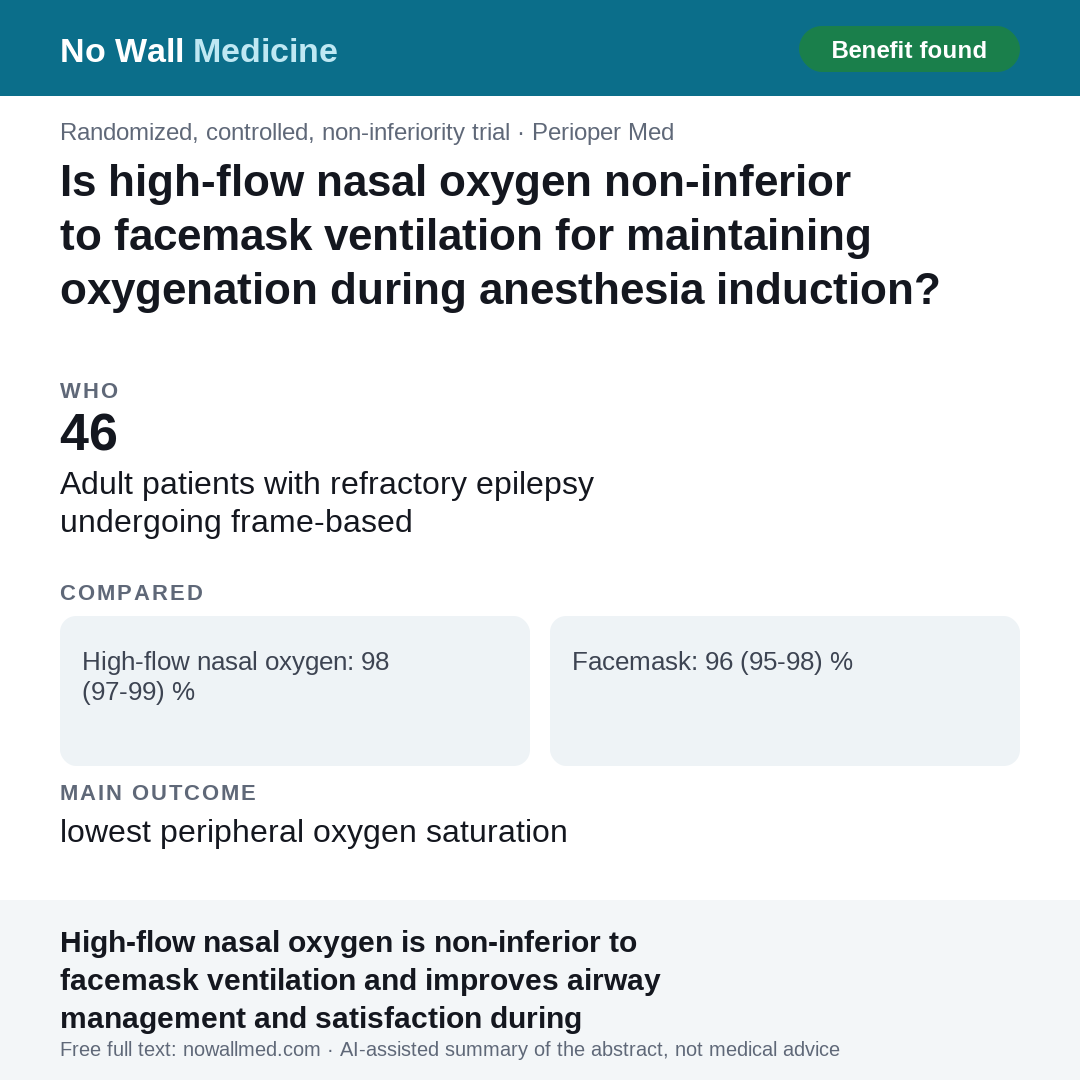
High-flow nasal oxygen was non-inferior to facemask ventilation for oxygenation during anesthesia induction
Application of high-flow nasal oxygen during anesthesia induction for frame-based stereoelectroencephalography: a randomized controlled non-inferiority trial
Randomized, controlled, non-inferiority trialBenefit found
Is high-flow nasal oxygen non-inferior to facemask ventilation for maintaining oxygenation during anesthesia induction?
Who
46
Adult patients with refractory epilepsy undergoing frame-based stereoelectroencephalography
Compared
High-flow nasal oxygen: 98 (97-99) %
Facemask: 96 (95-98) %
Main outcome
lowest peripheral oxygen saturation
Result: median difference of 1% (95% confidence interval 0-2%)
Bottom line: High-flow nasal oxygen is non-inferior to facemask ventilation and improves airway management and satisfaction during anesthesia induction.
Perioper Med · 2025-11-05Download image
Clinical question: Is high-flow nasal oxygen non-inferior to facemask ventilation for maintaining oxygenation during anesthesia induction?
Why it matters: The efficacy of high-flow nasal oxygen for maintaining oxygenation during anesthesia induction for frame-based stereoelectroencephalography remains uncertain.
Key points
- Researchers conducted a randomized trial with 46 adult patients with refractory epilepsy undergoing frame-based stereoelectroencephalography, comparing high-flow nasal oxygen to facemask ventilation.
- The median lowest peripheral oxygen saturation was 98 (97-99)% in the high-flow nasal oxygen group versus 96 (95-98)% in the facemask group.
- High-flow nasal oxygen was associated with less use of airway adjuncts, shorter time to secure the airway, and higher anesthesiologist and patient satisfaction.
Headline and key points written with AI from the paper’s abstract, with every number checked against it. Read the paper before relying on them.
Was this summary helpful?
Cite this article
Sun X, Han M, Fan Z, Huang X, Kang F, Li J. Application of high-flow nasal oxygen during anesthesia induction for frame-based stereoelectroencephalography: a randomized controlled non-inferiority trial. Perioper Med. 2025. doi:10.1186/s13741-025-00619-4
Spotted a mistake? Suggest a correction
Top studies every Monday
The week’s key trials and guidelines in your specialties, plus any topics you follow. By email, free.
Get the weekly digest