ClinicalAge biomarker associated with mortality and disease risk in UK datasets
ClinicalAge, a framework for modelling ageing trajectories from longitudinal electronic health records in the UK: a model development and validation study
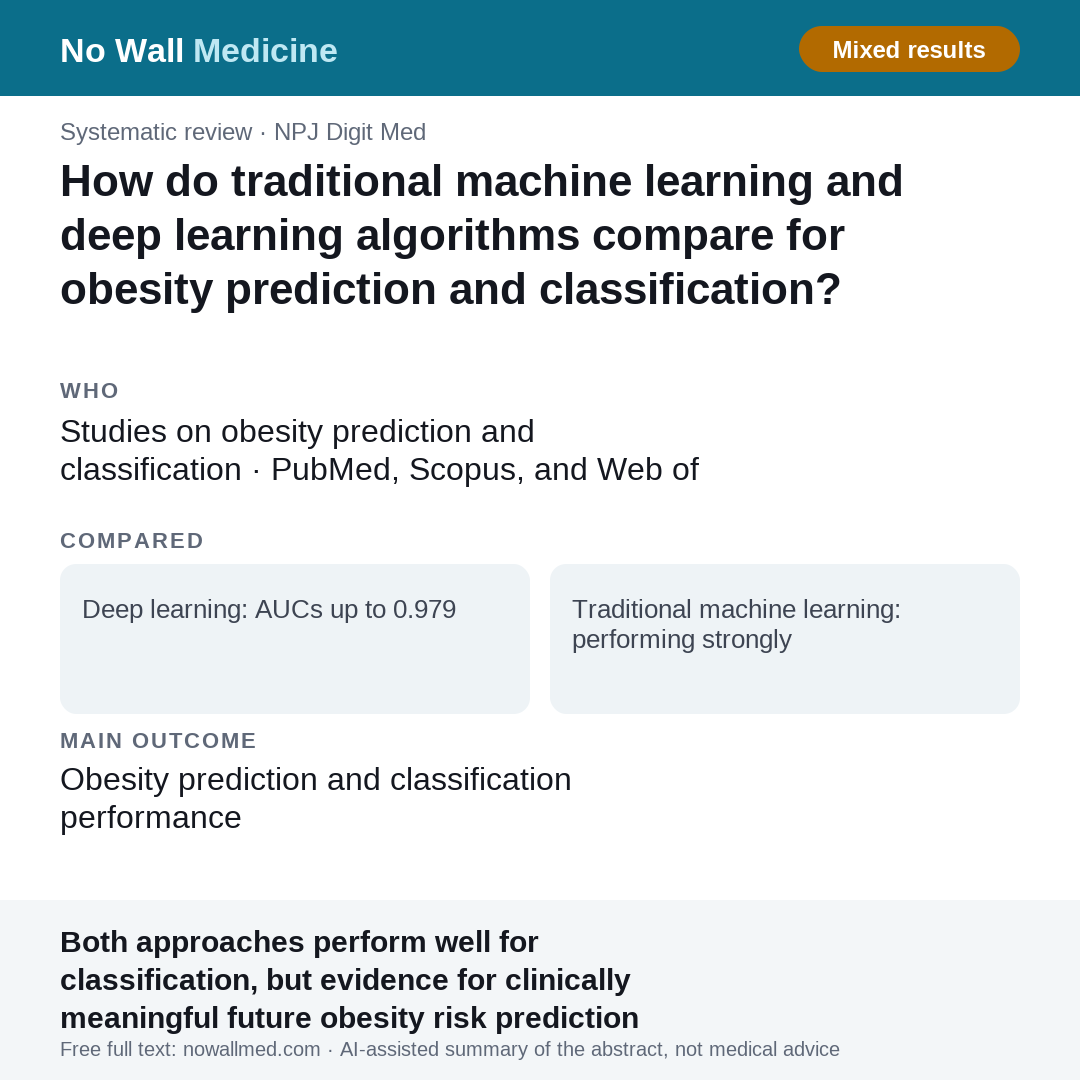
Applications of traditional machine learning and deep learning algorithms in obesity prediction or classification: a systematic review of comparative performance
Clinical question: How do traditional machine learning and deep learning algorithms compare for obesity prediction and classification?
Why it matters: There is limited evidence regarding how well these algorithms can predict future obesity risk in a clinically meaningful way.
Limitation the authors note: The authors state that only one study performed independent external validation and many studies had methodological limitations like incomplete performance reporting.
Headline and key points written with AI from the paper’s abstract, with every number checked against it. Read the paper before relying on them.
Spotted a mistake? Suggest a correction
ClinicalAge, a framework for modelling ageing trajectories from longitudinal electronic health records in the UK: a model development and validation study
Foundation artificial intelligence models for health recognition by use of face photographs (FAHR-Face): a model development and validation study
A prognostic model for use at labour onset to estimate the risk of severe fetal compromise at birth: a retrospective, model development and validation study
ECG foundation models for cardiovascular screening in a cohort of young competitive athletes
Medical Reasoning in Large Language Models: Development and Evaluation of the MedEvalArena Benchmark