Applying a physiotherapy protocol to women during the active phase of labor improves obstetrical outcomes: a randomized clinical trial
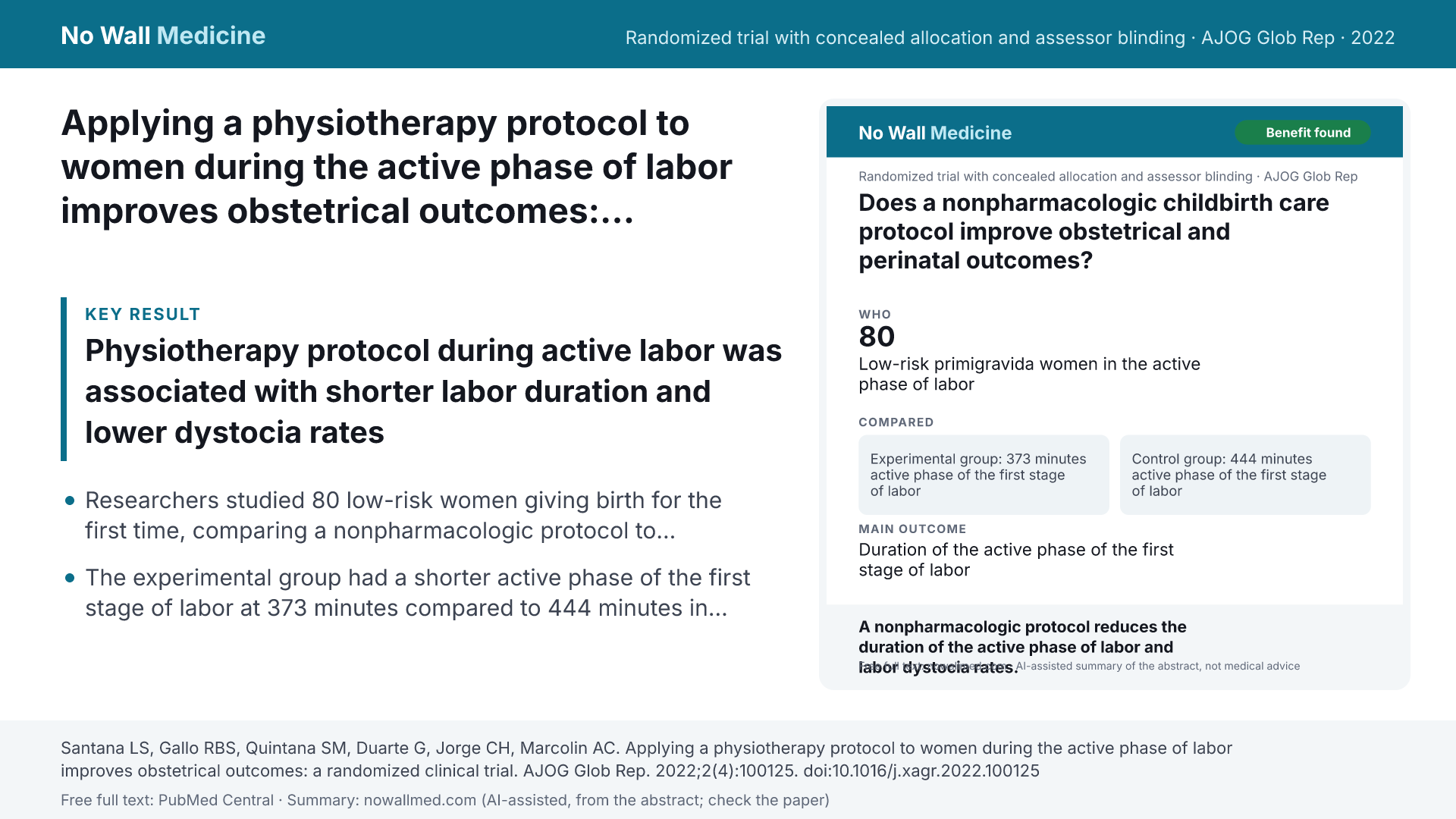
Key result: Physiotherapy protocol during active labor was associated with shorter labor duration and lower dystocia rates
Randomized trial with concealed allocation and assessor blindingBenefit found
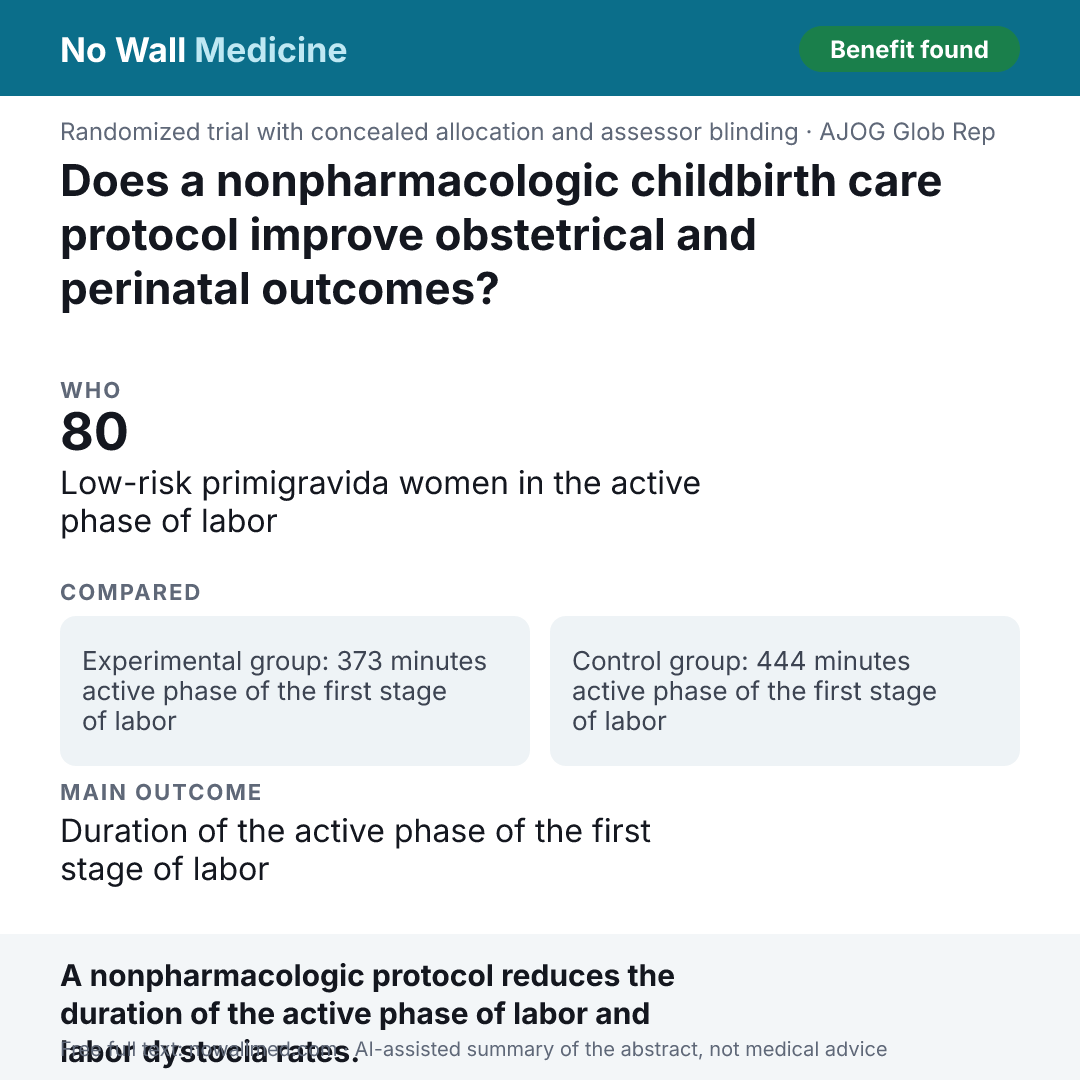
Does a nonpharmacologic childbirth care protocol improve obstetrical and perinatal outcomes?
Who
80
Low-risk primigravida women in the active phase of labor
Compared
Experimental group: 373 minutes active phase of the first stage of labor
Control group: 444 minutes active phase of the first stage of labor
Main outcome
Duration of the active phase of the first stage of labor
Bottom line: A nonpharmacologic protocol reduces the duration of the active phase of labor and labor dystocia rates.
AJOG Glob Rep · 2022-11-10 · Save PNG
Key points
- Researchers studied 80 low-risk women giving birth for the first time, comparing a nonpharmacologic protocol to routine care.
- The experimental group had a shorter active phase of the first stage of labor at 373 minutes compared to 444 minutes in the control group.
- Women receiving the protocol requested pain medication at 8 cm of cervical dilation compared to 5 cm in the control group.
Discussion prompts
- Would these patients look like yours? Who was left out?
- Is the main outcome one that matters to patients?
- Is the difference large enough to change what you do?
Cite: Santana LS, Gallo RBS, Quintana SM, Duarte G, Jorge CH, Marcolin AC. Applying a physiotherapy protocol to women during the active phase of labor improves obstetrical outcomes: a randomized clinical trial. AJOG Glob Rep. 2022;2(4):100125. doi:10.1016/j.xagr.2022.100125
Free full text: PubMed Central · Summary and visual abstract: nowallmed.com/a/applying-a-physiotherapy-protocol-to-women-during-the-active-phase-of-ss0m86/ (AI-assisted from the abstract; check the paper before relying on it).