Quality improvement methods were associated with lower antibiotic use and lower mortality in neonates
Applying quality improvement methods to reduce antibiotic use in neonates: a systematic review and meta-analysis
Systematic review and meta-analysisBenefit found
Do quality improvement methods effectively reduce antibiotic use in neonates without increasing mortality?
Who
Neonates · United States of America
Compared
Intervention group: mortality rate decreased by 30%
Control group
Main outcome
mortality rate and serious adverse outcomes
Result: RR = 0.7 (95% CI: 0.604-0.81)
Bottom line: Quality improvement methods can safely and effectively reduce antibiotic use in neonates.
J Antimicrob Chemother · 2025-03-14Download image
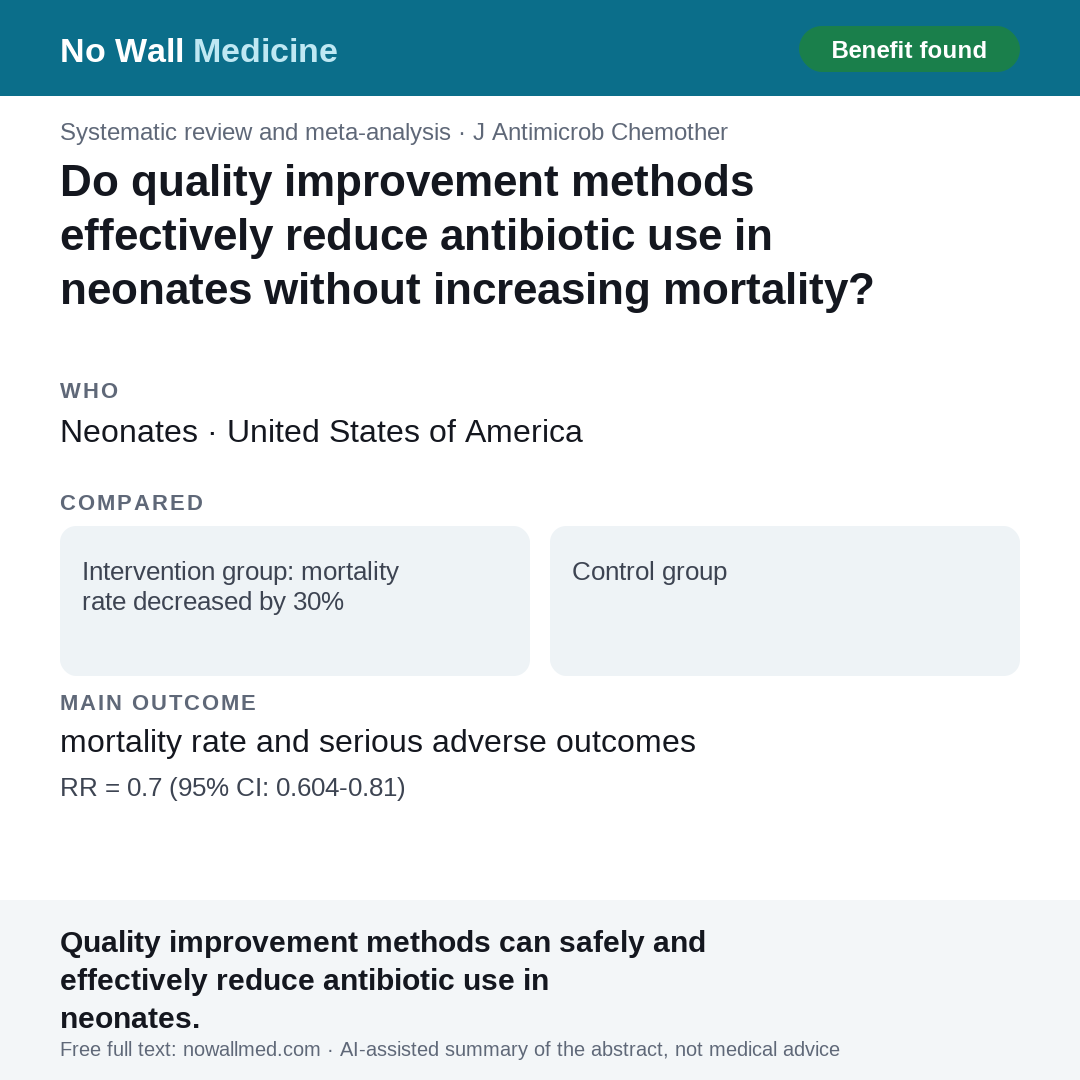
Clinical question: Do quality improvement methods effectively reduce antibiotic use in neonates without increasing mortality?
Why it matters: It was unknown which quality improvement interventions and indicators are effective for reducing antibiotic use in neonates without increasing mortality or serious adverse outcomes.
Key points
- Researchers analyzed 57 uncontrolled before-and-after studies published between 2016 and 2024 to evaluate quality improvement methods for reducing antibiotic use in newborns.
- The mortality rate in the group using quality improvement interventions was 30% lower than the control group (RR = 0.7; 95% CI: 0.604-0.81; P < 0.001).
- There was no statistically significant difference in the risk of serious adverse outcomes between the intervention and control groups.
Headline and key points written with AI from the paper’s abstract, with every number checked against it. Read the paper before relying on them.
Topics
Cite this article
Wang B, Wang N, Yu Z, Zhang J. Applying quality improvement methods to reduce antibiotic use in neonates: a systematic review and meta-analysis. J Antimicrob Chemother. 2025. doi:10.1093/jac/dkaf078
Spotted a mistake? Suggest a correction