Aroxybutynin and atomoxetine (AD109) for obstructive sleep apnea: a randomized phase 3 trial (SynAIRgy)
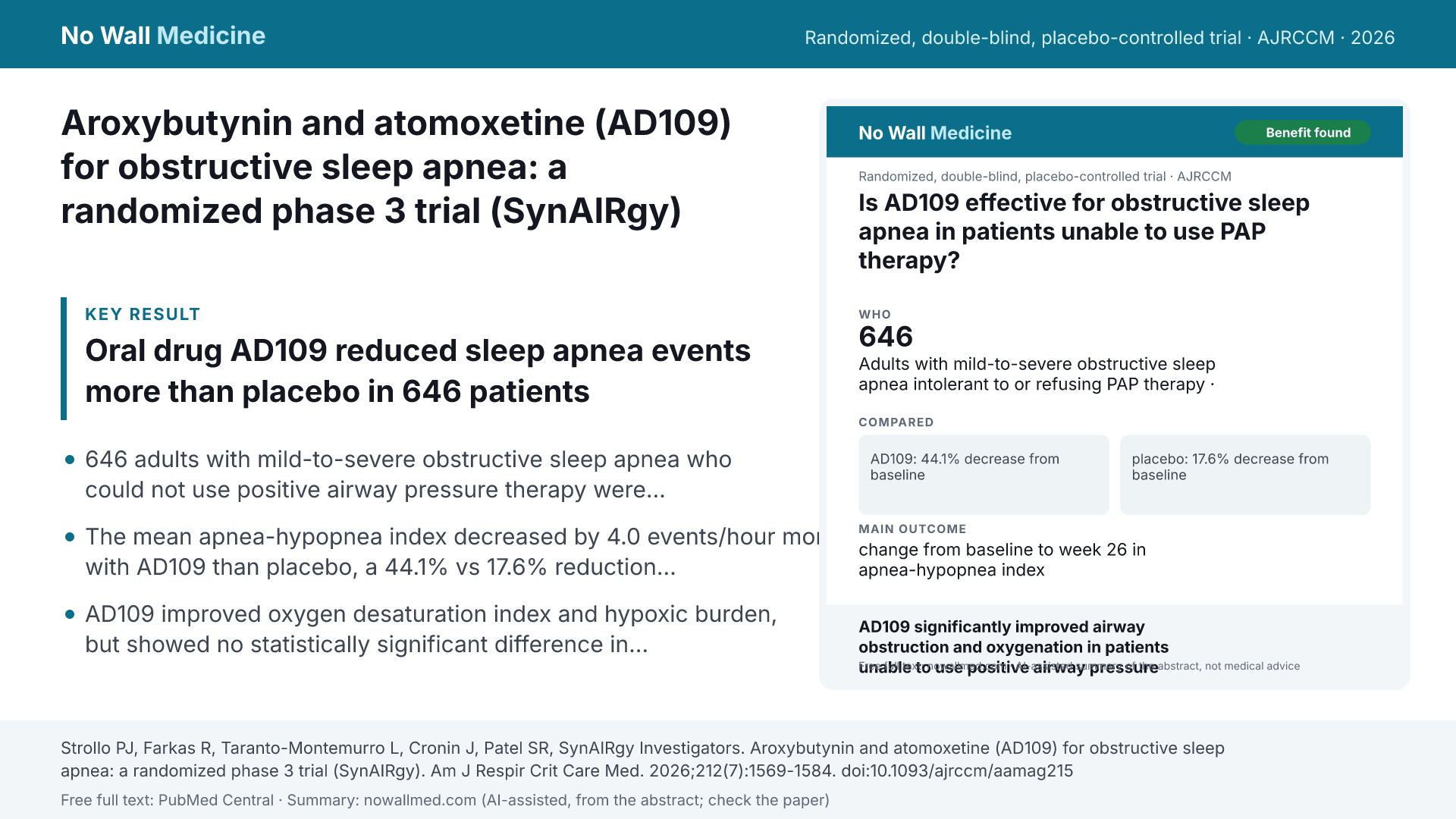
Key result: Oral drug AD109 reduced sleep apnea events more than placebo in 646 patients
Key points
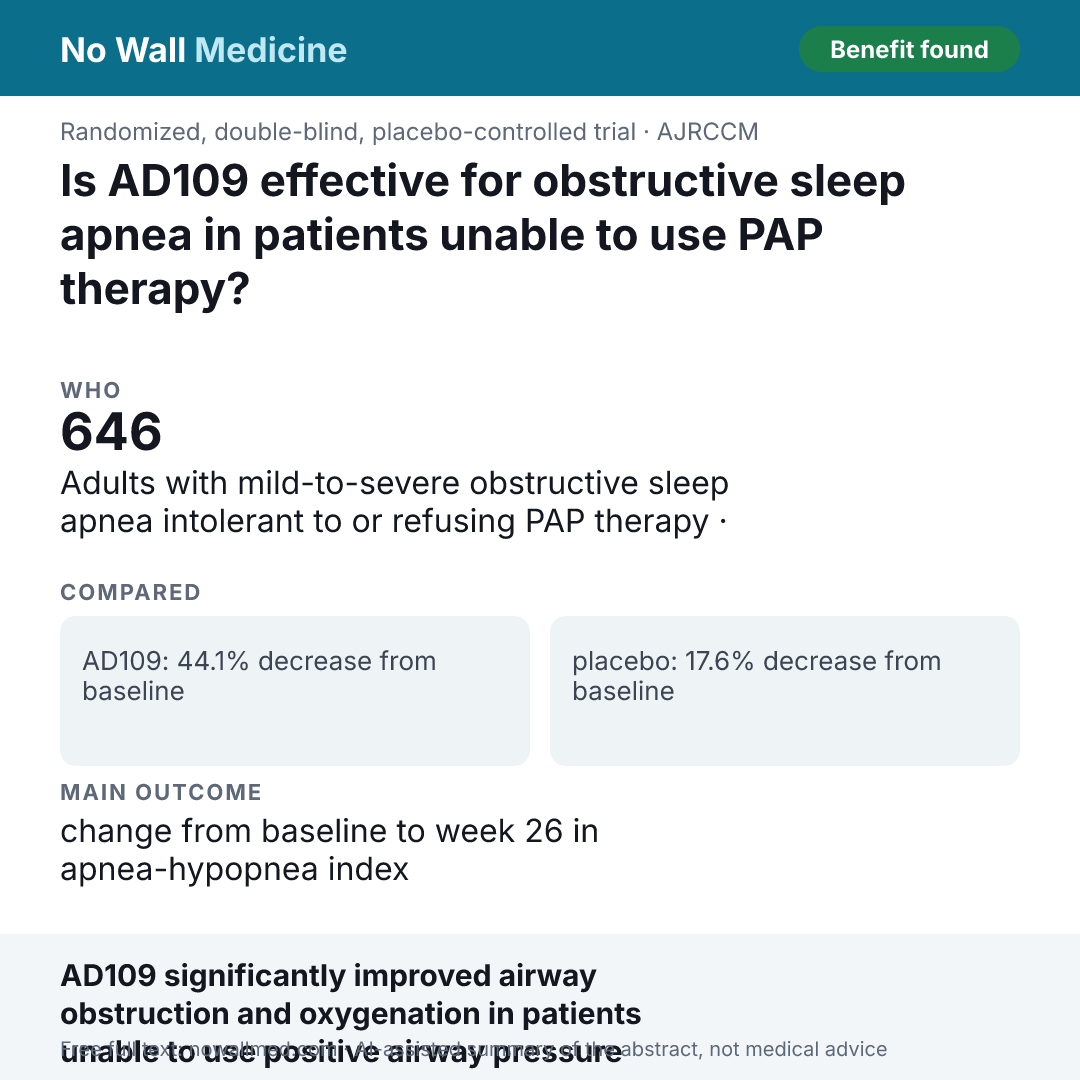
- 646 adults with mild-to-severe obstructive sleep apnea who could not use positive airway pressure therapy were randomized to AD109 or placebo.
- The mean apnea-hypopnea index decreased by 4.0 events/hour more with AD109 than placebo, a 44.1% vs 17.6% reduction from baseline.
- AD109 improved oxygen desaturation index and hypoxic burden, but showed no statistically significant difference in fatigue scores compared to placebo.
Why it matters: Many patients with obstructive sleep apnea cannot tolerate long-term positive airway pressure therapy, highlighting the need for alternative treatments.
Discussion prompts
- Would these patients look like yours? Who was left out?
- Is the main outcome one that matters to patients?
- Is the difference large enough to change what you do?
Cite: Strollo PJ, Farkas R, Taranto-Montemurro L, Cronin J, Patel SR, SynAIRgy Investigators. Aroxybutynin and atomoxetine (AD109) for obstructive sleep apnea: a randomized phase 3 trial (SynAIRgy). Am J Respir Crit Care Med. 2026;212(7):1569-1584. doi:10.1093/ajrccm/aamag215
Free full text: PubMed Central · Summary and visual abstract: nowallmed.com/a/aroxybutynin-and-atomoxetine-ad109-for-obstructive-sleep-apnea-a-t011mm/ (AI-assisted from the abstract; check the paper before relying on it).