Adding primaquine or tafenoquine affects mosquito infection rates after malaria drug treatments
Artemether-lumefantrine with or without single-dose primaquine and sulfadoxine-pyrimethamine plus amodiaquine with or without single-dose tafenoquine to reduce Plasmodium falciparum transmission: a phase 2, single-blind, randomised clinical trial in Ouelessebougou, Mali
Infectious DiseaseAdult and pediatric
Phase 2, single-blind, randomised clinical trialMixed results
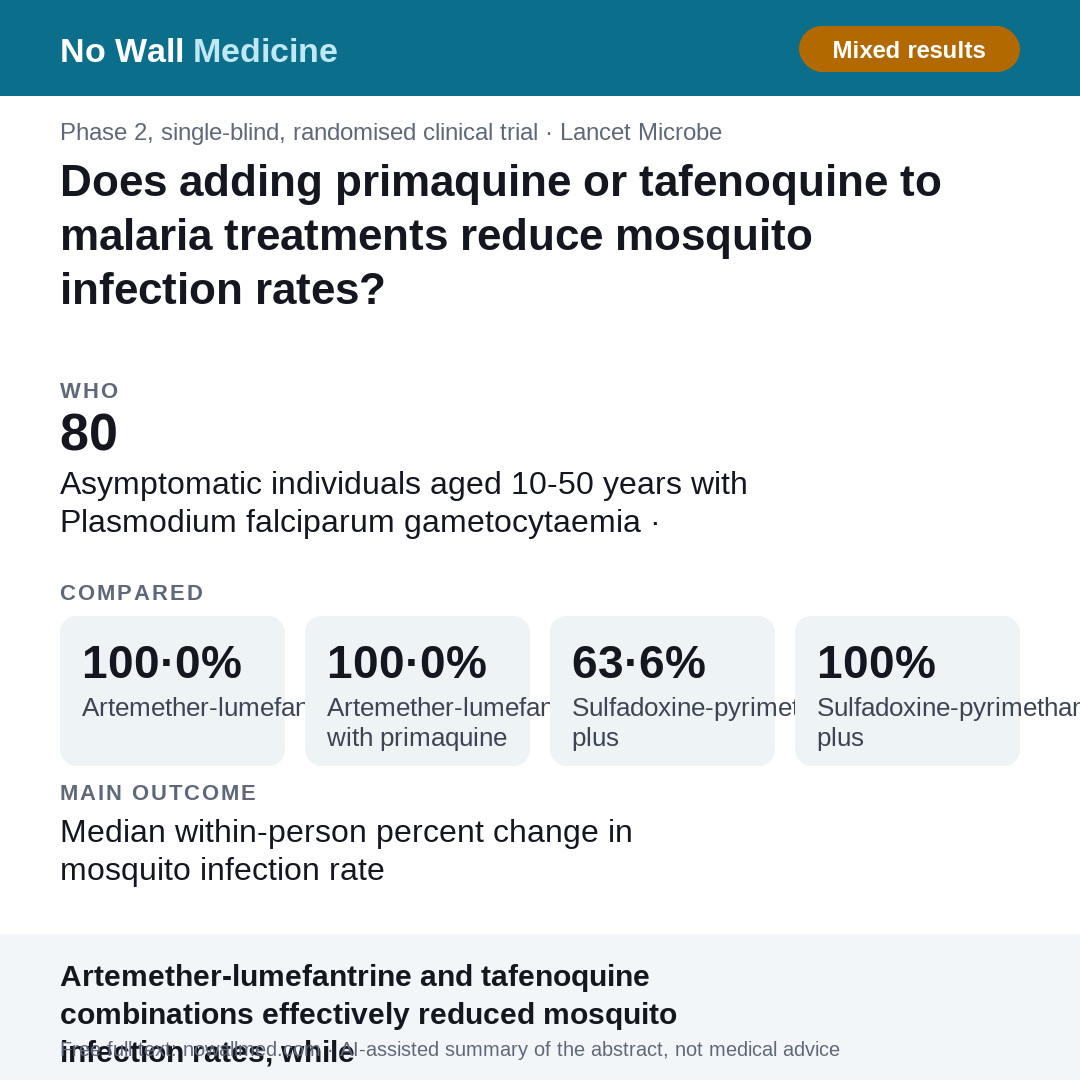
Does adding primaquine or tafenoquine to malaria treatments reduce mosquito infection rates?
Who
80
Asymptomatic individuals aged 10-50 years with Plasmodium falciparum gametocytaemia · Ouelessebougou, Mali
Compared
100·0%Artemether-lumefantrine
100·0%Artemether-lumefantrine with primaquine
63·6%Sulfadoxine-pyrimethamine plus amodiaquine
100%Sulfadoxine-pyrimethamine plus amodiaquine with tafenoquine
Main outcome
Median within-person percent change in mosquito infection rate
Bottom line: Artemether-lumefantrine and tafenoquine combinations effectively reduced mosquito infection rates, while sulfadoxine-pyrimethamine plus amodiaquine alone showed considerable post-treatment transmission.
Funded by: Bill & Melinda Gates Foundation
Lancet Microbe · 2024-05-02Download image
Clinical question: Does adding primaquine or tafenoquine to malaria treatments reduce mosquito infection rates?
Why it matters: It is unknown if adding transmission-blocking drugs to standard malaria treatments can effectively reduce the ability of malaria parasites to infect mosquitoes.
Key points
- In a trial of 80 asymptomatic people in Mali, researchers compared four malaria drug combinations to see how they affected mosquito infection rates.
- Artemether-lumefantrine and artemether-lumefantrine with 0.25 mg/kg primaquine both showed a 100.0% median reduction in mosquito infection rates after 2 days.
- Sulfadoxine-pyrimethamine plus amodiaquine had a 63.6% median reduction in mosquito infection rates at 7 days, while adding 1.66 mg/kg tafenoquine resulted in a 100% median reduction.
Headline and key points written with AI from the paper’s abstract, with every number checked against it. Read the paper before relying on them.
Topics
Cite this article
Mahamar A, Smit MJ, Sanogo K, Sinaba Y, Niambele SM, Sacko A. Artemether-lumefantrine with or without single-dose primaquine and sulfadoxine-pyrimethamine plus amodiaquine with or without single-dose tafenoquine to reduce Plasmodium falciparum transmission: a phase 2, single-blind, randomised clinical trial in Ouelessebougou, Mali. Lancet Microbe. 2024. doi:10.1016/S2666-5247(24)00023-5
Spotted a mistake? Suggest a correction
Top studies every Monday
The week’s key trials and guidelines in your specialties, plus any topics you follow. By email, free.
Get the weekly digest