Arterial spin labeling MRI in patients undergoing carotid artery revascularization: a systematic review of the hemodynamic changes and clinical implications
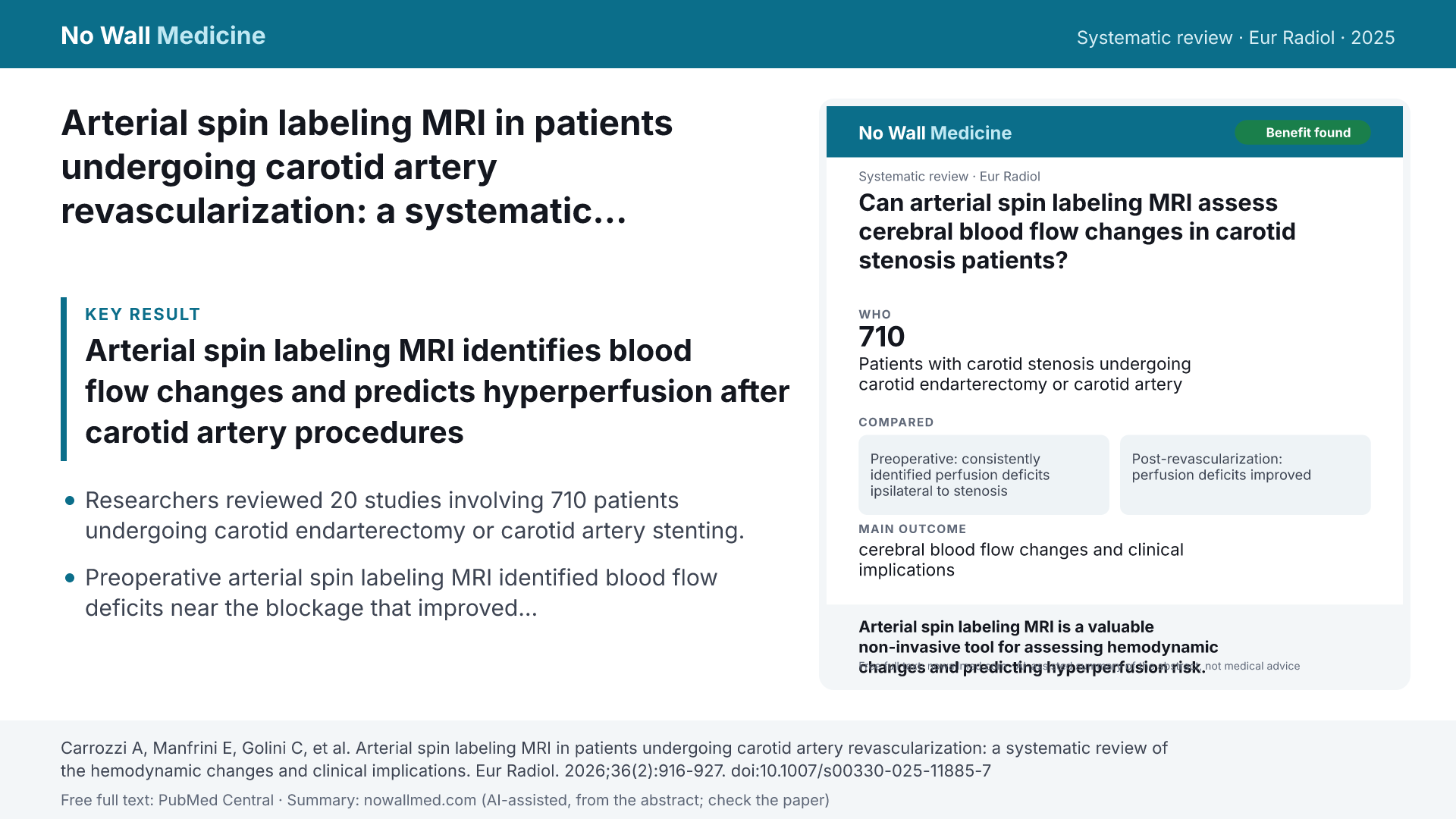
Key result: Arterial spin labeling MRI identifies blood flow changes and predicts hyperperfusion after carotid artery procedures
Systematic reviewBenefit found
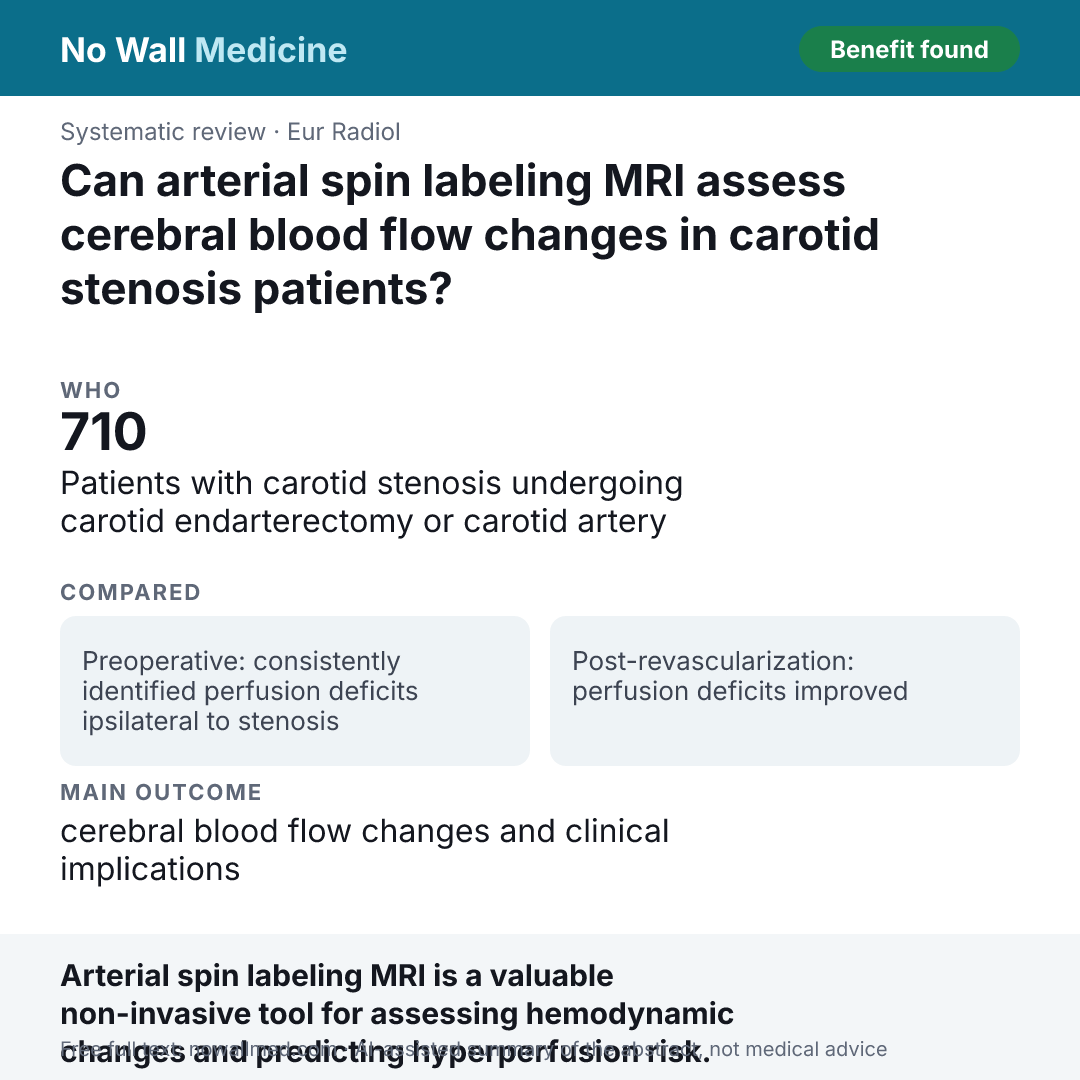
Can arterial spin labeling MRI assess cerebral blood flow changes in carotid stenosis patients?
Who
710
Patients with carotid stenosis undergoing carotid endarterectomy or carotid artery stenting
Compared
Preoperative: consistently identified perfusion deficits ipsilateral to stenosis
Post-revascularization: perfusion deficits improved
Main outcome
cerebral blood flow changes and clinical implications
Bottom line: Arterial spin labeling MRI is a valuable non-invasive tool for assessing hemodynamic changes and predicting hyperperfusion risk.
Eur Radiol · 2025-08-06 · Save PNG
Key points
- Researchers reviewed 20 studies involving 710 patients undergoing carotid endarterectomy or carotid artery stenting.
- Preoperative arterial spin labeling MRI identified blood flow deficits near the blockage that improved after revascularization.
- The imaging metrics were associated with predicting post-procedural cerebral hyperperfusion, which is excessive blood flow to the brain.
Discussion prompts
- Would these patients look like yours? Who was left out?
- Is the main outcome one that matters to patients?
- Is the difference large enough to change what you do?
Cite: Carrozzi A, Manfrini E, Golini C, et al. Arterial spin labeling MRI in patients undergoing carotid artery revascularization: a systematic review of the hemodynamic changes and clinical implications. Eur Radiol. 2026;36(2):916-927. doi:10.1007/s00330-025-11885-7
Free full text: PubMed Central · Summary and visual abstract: nowallmed.com/a/arterial-spin-labeling-mri-in-patients-undergoing-carotid-artery-tpru8e/ (AI-assisted from the abstract; check the paper before relying on it).