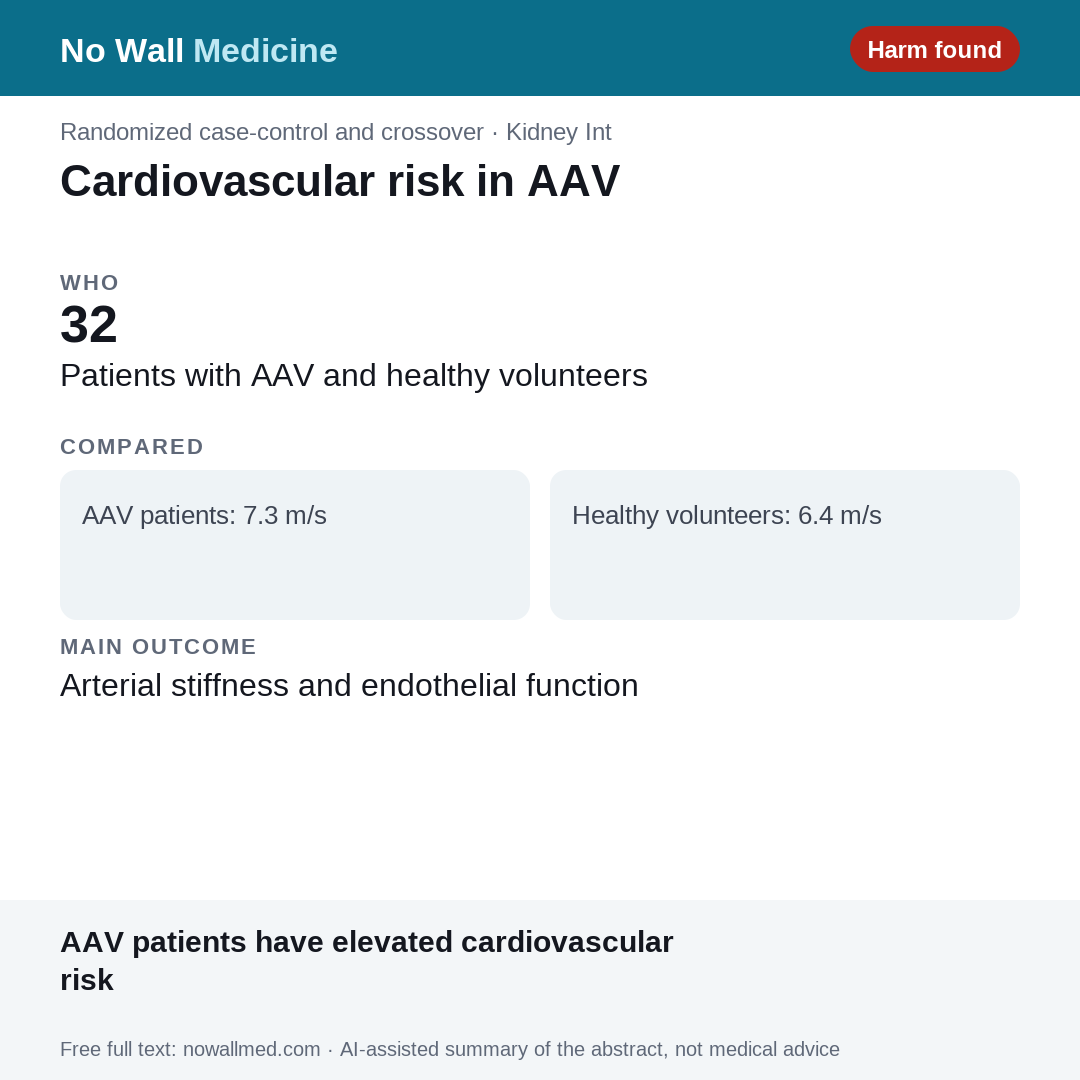
Patients with vasculitis show increased arterial stiffness and reduced blood vessel function compared to healthy volunteers
Arterial stiffness, endothelial dysfunction and impaired fibrinolysis are pathogenic mechanisms contributing to cardiovascular risk in ANCA-associated vasculitis
Randomized case-control and crossoverHarm found
Cardiovascular risk in AAV
Who
32
Patients with AAV and healthy volunteers
Compared
AAV patients: 7.3 m/s
Healthy volunteers: 6.4 m/s
Main outcome
Arterial stiffness and endothelial function
Bottom line: AAV patients have elevated cardiovascular risk
Kidney Int · 2022-08-20Download image
Why it matters: The mechanisms that contribute to cardiovascular morbidity in patients with anti-neutrophil cytoplasm antibody-associated vasculitis are poorly understood.
Key points
- Researchers compared 32 patients in long-term remission from anti-neutrophil cytoplasm antibody-associated vasculitis to 32 healthy volunteers.
- Patients with vasculitis had 30% reduced endothelium-dependent vasodilation, 50% reduced acute release of tissue plasminogen activator, and higher arterial stiffness with a pulse wave velocity of 7.3 m/s versus 6.4 m/s.
- In a crossover study, selective endothelin-A receptor antagonism and dual endothelin-A/B receptor blockade reduced pulse wave velocity and increased tissue plasminogen activator release in patients.
Headline and key points written with AI from the paper’s abstract, with every number checked against it. Read the paper before relying on them.
Was this summary helpful?
Subject terms
Cite this article
Farrah TE, Melville V, Czopek A, Fok H, Bruce L, Mills NL. Arterial stiffness, endothelial dysfunction and impaired fibrinolysis are pathogenic mechanisms contributing to cardiovascular risk in ANCA-associated vasculitis. Kidney Int. 2022. doi:10.1016/j.kint.2022.07.026
Spotted a mistake? Suggest a correction
Top studies every Monday
The week’s key trials and guidelines in your specialties, plus any topics you follow. By email, free.
Get the weekly digest