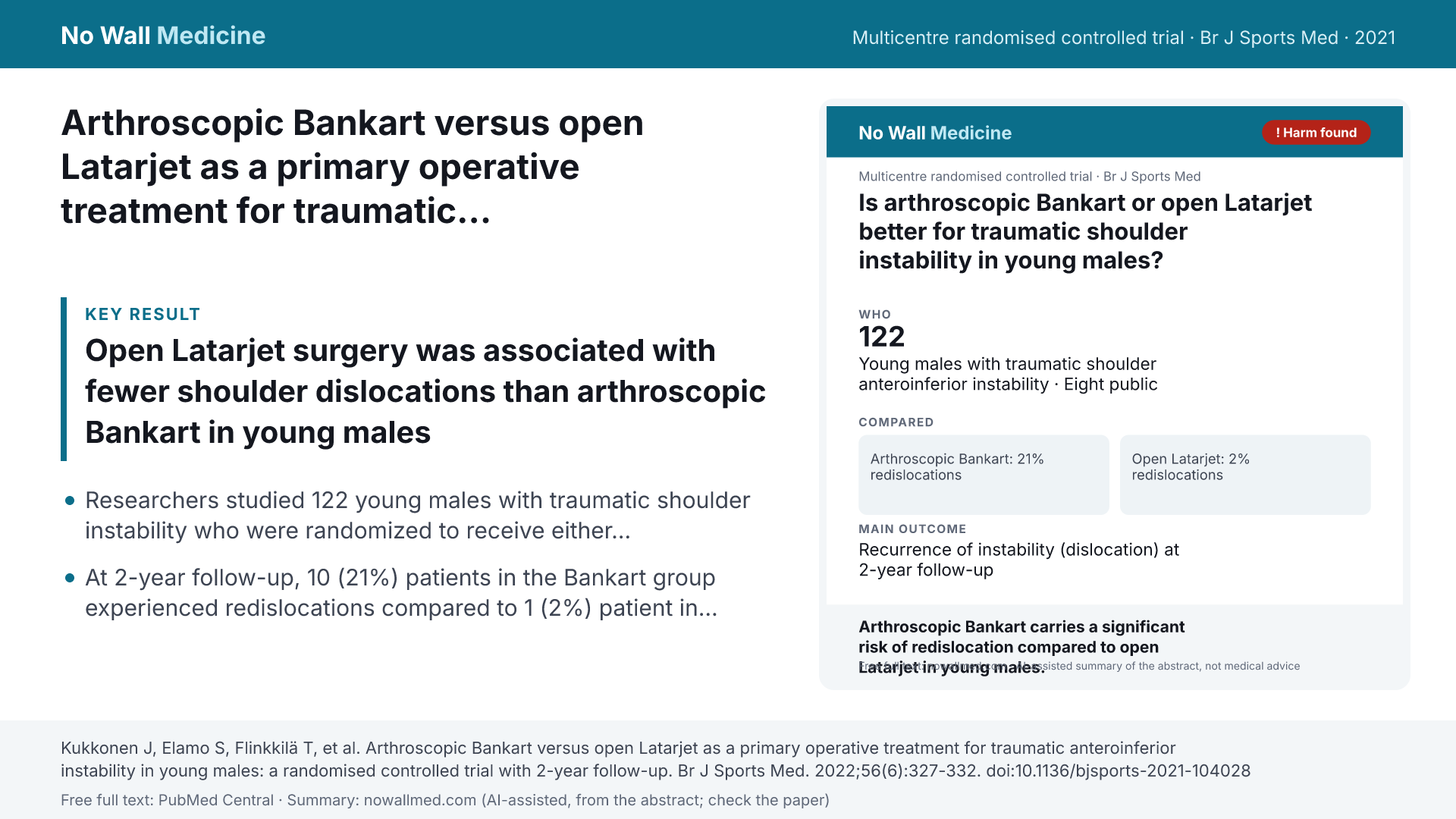
Open Latarjet surgery was associated with fewer shoulder dislocations than arthroscopic Bankart in young males
Arthroscopic Bankart versus open Latarjet as a primary operative treatment for traumatic anteroinferior instability in young males: a randomised controlled trial with 2-year follow-up
Multicentre randomised controlled trialHarm found
Is arthroscopic Bankart or open Latarjet better for traumatic shoulder instability in young males?
Who
122
Young males with traumatic shoulder anteroinferior instability · Eight public hospitals in Finland
Compared
Arthroscopic Bankart: 21% redislocations
Open Latarjet: 2% redislocations
Main outcome
Recurrence of instability (dislocation) at 2-year follow-up
Bottom line: Arthroscopic Bankart carries a significant risk of redislocation compared to open Latarjet in young males.
Br J Sports Med · 2021-09-22Download image
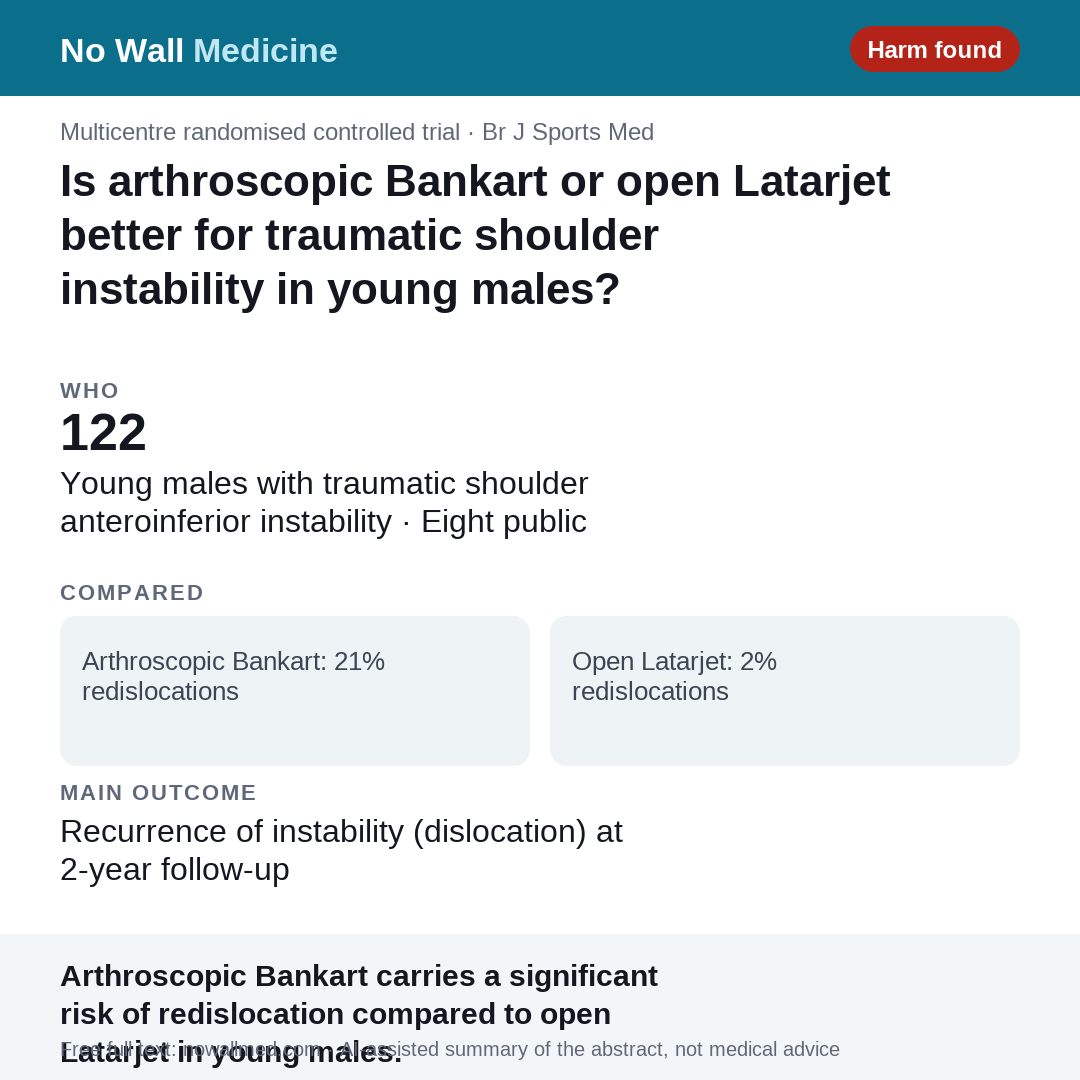
Clinical question: Is arthroscopic Bankart or open Latarjet better for traumatic shoulder instability in young males?
Why it matters: It is unknown whether arthroscopic Bankart or open Latarjet surgery is more successful at preventing shoulder dislocations in young males with traumatic instability.
Key points
- Researchers studied 122 young males with traumatic shoulder instability who were randomized to receive either arthroscopic Bankart or open Latarjet surgery.
- At 2-year follow-up, 10 (21%) patients in the Bankart group experienced redislocations compared to 1 (2%) patient in the Latarjet group.
- While the Latarjet group had fewer dislocations, 9% of Bankart patients and 56% of Latarjet patients returned to their previous top level of competitive sports.
Limitation the authors note: The study had a 25% drop-out rate with 91 patients available for analysis at the 2-year follow-up.
Headline and key points written with AI from the paper’s abstract, with every number checked against it. Read the paper before relying on them.
Was this summary helpful?
Abstract
Objectives
To compare the success rates of arthroscopic Bankart and open Latarjet procedure in the treatment of traumatic shoulder instability in young males. Design
Multicentre randomised controlled trial. Setting
Orthopaedic departments in eight public hospitals in Finland. Participants
122 young males, mean age 21 years (range 16-25 years) with traumatic shoulder anteroinferior instability were randomised. Interventions
Arthroscopic Bankart (group B) or open Latarjet (group L) procedure. Main outcome measures
The primary outcome measure was the reported recurrence of instability, that is, dislocation at 2-year follow-up. The secondary outcome measures included clinical apprehension, sports activity level, the Western Ontario Shoulder Instability Index, the pain Visual Analogue Scale, the Oxford Shoulder Instability Score, the Constant Score and the Subjective Shoulder Value scores and the progression of osteoarthritic changes in plain films and MRI. Results
91 patients were available for analyses at 2-year follow-up (drop-out rate 25%). There were 10 (21%) patients with redislocations in group B and 1 (2%) in group L, p=0.006. One (9%) patient in group B and five (56%) patients in group L returned to their previous top level of competitive sports (p=0.004) at follow-up. There was no statistically significant between group differences in any of the other secondary outcome measures. Conclusions
Arthroscopic Bankart operation carries a significant risk for short-term postoperative redislocations compared with open Latarjet operation, in the treatment of traumatic anteroinferior instability in young males. Patients should be counselled accordingly before deciding the surgical treatment. Trial registration number
NCT01998048.
Abstract reproduced under the article’s CC BY licence.
Subject terms
Cite this article
Kukkonen J, Elamo S, Flinkkilä T, et al. Arthroscopic Bankart versus open Latarjet as a primary operative treatment for traumatic anteroinferior instability in young males: a randomised controlled trial with 2-year follow-up. Br J Sports Med. 2021. doi:10.1136/bjsports-2021-104028
Spotted a mistake? Suggest a correction