Arthroscopic partial meniscectomy versus sham surgery for a degenerative meniscal tear
Why it matters: In degenerative meniscal tears without osteoarthritis, partial meniscectomy was no better than sham surgery at one year.
Related landmark trials: Arthroscopic knee surgery for osteoarthritis
Context written by the No Wall Medicine team.
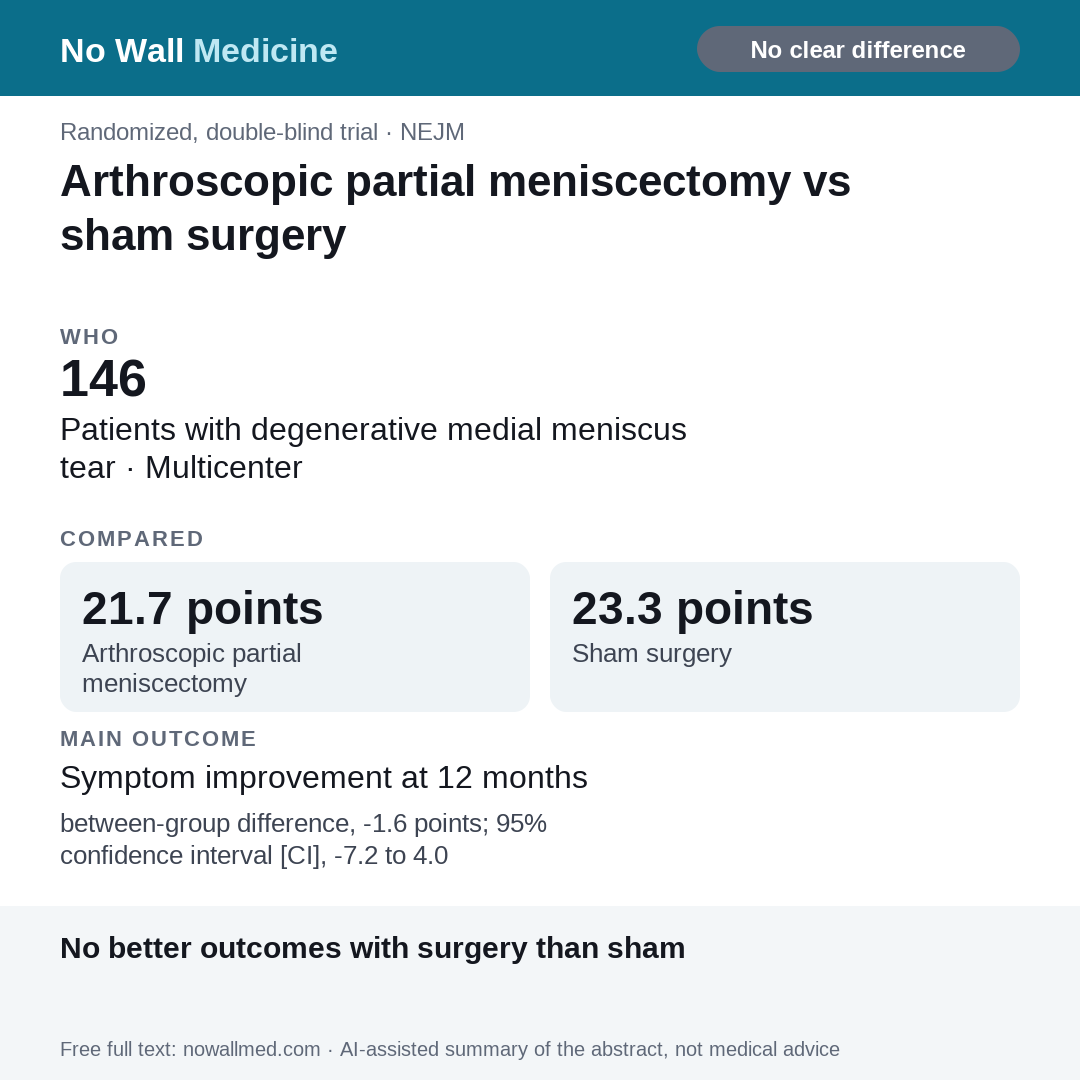
Randomized, double-blind trialNo clear difference
Arthroscopic partial meniscectomy vs sham surgery
Who
146
Patients with degenerative medial meniscus tear · Multicenter
Compared
21.7 pointsArthroscopic partial meniscectomy
23.3 pointsSham surgery
Main outcome
Symptom improvement at 12 months
Result: between-group difference, -1.6 points; 95% confidence interval [CI], -7.2 to 4.0
Bottom line: No better outcomes with surgery than sham
Funded by: Sigrid Juselius Foundation and others
NEJM · 2013-12-27Download image
Trial at a glance
Bottom line: Arthroscopic partial meniscectomy outcomes were no better than sham surgery outcomes
Clinical question
Is arthroscopic partial meniscectomy effective for degenerative meniscal tear?
Design
Multicenter, randomized, double-blind, sham-controlled trial. Multiple centers, 146 patients, no specific years
Who was studied
146 patients, 35 to 65 years of age, with degenerative medial meniscus tear
Key inclusion criteria
- 35 to 65 years of age
- knee symptoms consistent with degenerative medial meniscus tear
- no knee osteoarthritis
Interventions
- partial-meniscectomy: arthroscopic partial meniscectomy
- sham-surgery: sham surgery
Primary outcome
changes in Lysholm, Western Ontario Meniscal Evaluation Tool scores, and knee pain after exercise. no significant between-group differences at 12 months
Secondary outcomes
- subsequent knee surgery: two in partial-meniscectomy group, five in sham-surgery group
- serious adverse events: one in partial-meniscectomy group, zero in sham-surgery group
Harms
one serious adverse event in partial-meniscectomy group, none in sham-surgery group
Funding
Sigrid Juselius Foundation and others
Written with AI from the abstract; every number was checked against it. Details such as eligibility criteria may be missing because the abstract does not give them. Read the paper before relying on it.
Abstract
Background
Arthroscopic partial meniscectomy is one of the most common orthopedic procedures, yet rigorous evidence of its efficacy is lacking. Methods
We conducted a multicenter, randomized, double-blind, sham-controlled trial in 146 patients 35 to 65 years of age who had knee symptoms consistent with a degenerative medial meniscus tear and no knee osteoarthritis. Patients were randomly assigned to arthroscopic partial meniscectomy or sham surgery. The primary outcomes were changes in the Lysholm and Western Ontario Meniscal Evaluation Tool (WOMET) scores (each ranging from 0 to 100, with lower scores indicating more severe symptoms) and in knee pain after exercise (rated on a scale from 0 to 10, with 0 denoting no pain) at 12 months after the procedure. Results
In the intention-to-treat analysis, there were no significant between-group differences in the change from baseline to 12 months in any primary outcome. The mean changes (improvements) in the primary outcome measures were as follows: Lysholm score, 21.7 points in the partial-meniscectomy group as compared with 23.3 points in the sham-surgery group (between-group difference, -1.6 points; 95% confidence interval [CI], -7.2 to 4.0); WOMET score, 24.6 and 27.1 points, respectively (between-group difference, -2.5 points; 95% CI, -9.2 to 4.1); and score for knee pain after exercise, 3.1 and 3.3 points, respectively (between-group difference, -0.1; 95% CI, -0.9 to 0.7). There were no significant differences between groups in the number of patients who required subsequent knee surgery (two in the partial-meniscectomy group and five in the sham-surgery group) or serious adverse events (one and zero, respectively). Conclusions
In this trial involving patients without knee osteoarthritis but with symptoms of a degenerative medial meniscus tear, the outcomes after arthroscopic partial meniscectomy were no better than those after a sham surgical procedure. (Funded by the Sigrid Juselius Foundation and others; ClinicalTrials.gov number, NCT00549172.).
Topics
Cite this article
Sihvonen R, Paavola M, Malmivaara A, Itälä A, Joukainen A, Nurmi H. Arthroscopic partial meniscectomy versus sham surgery for a degenerative meniscal tear. NEJM. 2013. doi:10.1056/NEJMoa1305189
Spotted a mistake? Suggest a correction