Artificial intelligence weighting provides larger treatment effect estimates in major depressive disorder trials
Artificial intelligence approach for the analysis of placebo-controlled clinical trials in major depressive disorders accounting for individual propensity to respond to placebo
Randomized, double-blind, placebo-controlled, three-arm studyBenefit found
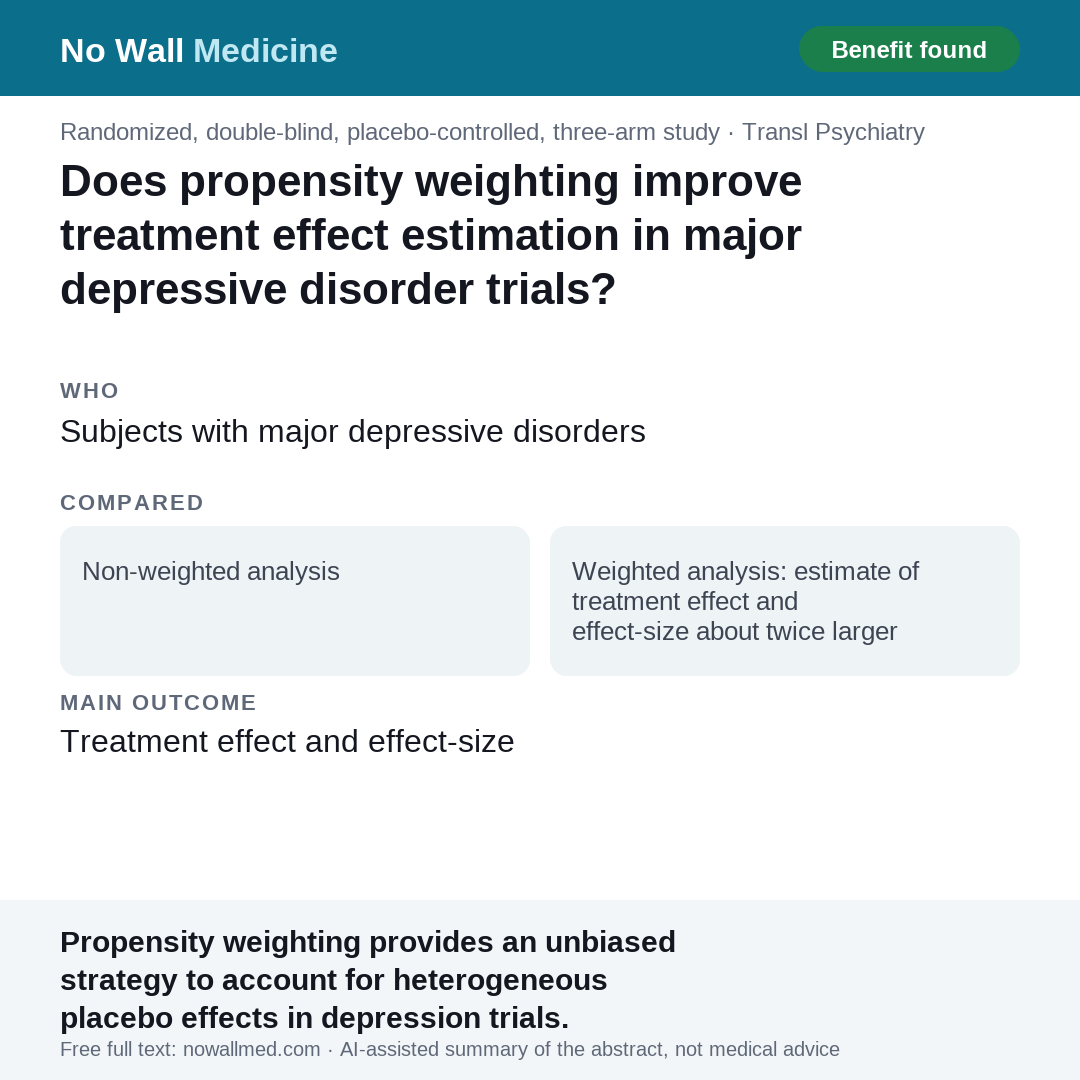
Does propensity weighting improve treatment effect estimation in major depressive disorder trials?
Who
Subjects with major depressive disorders
Compared
Non-weighted analysis
Weighted analysis: estimate of treatment effect and effect-size about twice larger
Main outcome
Treatment effect and effect-size
Bottom line: Propensity weighting provides an unbiased strategy to account for heterogeneous placebo effects in depression trials.
Limitation: The study is presented as a case study.
Transl Psychiatry · 2023-04-29Download image
Clinical question: Does propensity weighting improve treatment effect estimation in major depressive disorder trials?
Why it matters: Current statistical methods for randomized controlled trials may not account for imbalances in how different patients respond to placebos.
Key points
- Researchers used a case study of a randomized, double-blind, placebo-controlled trial evaluating paroxetine controlled-release at 12.5 and 25 mg/day over 8 weeks.
- An artificial intelligence model predicted placebo response using changes in Hamilton Depression Rating Scale items to create weights for analysis.
- The weighted analysis provided an estimate of treatment effect and effect-size about twice larger than the non-weighted analysis.
Headline and key points written with AI from the paper’s abstract, with every number checked against it. Read the paper before relying on them.
Was this summary helpful?
Subject terms
Cite this article
Gomeni R, Bressolle-Gomeni F, Fava M. Artificial intelligence approach for the analysis of placebo-controlled clinical trials in major depressive disorders accounting for individual propensity to respond to placebo. Transl Psychiatry. 2023. doi:10.1038/s41398-023-02443-0
Spotted a mistake? Suggest a correction
Top studies every Monday
The week’s key trials and guidelines in your specialties, plus any topics you follow. By email, free.
Get the weekly digest