Artificial intelligence electrocardiogram models show high accuracy for detecting pregnancy-related cardiomyopathy in a meta-analysis
Artificial Intelligence-Enabled Electrocardiograms and Pregnancy-Related Cardiomyopathy: A Systematic Review and Diagnostic Meta-Analysis
Systematic review and diagnostic meta-analysisBenefit found
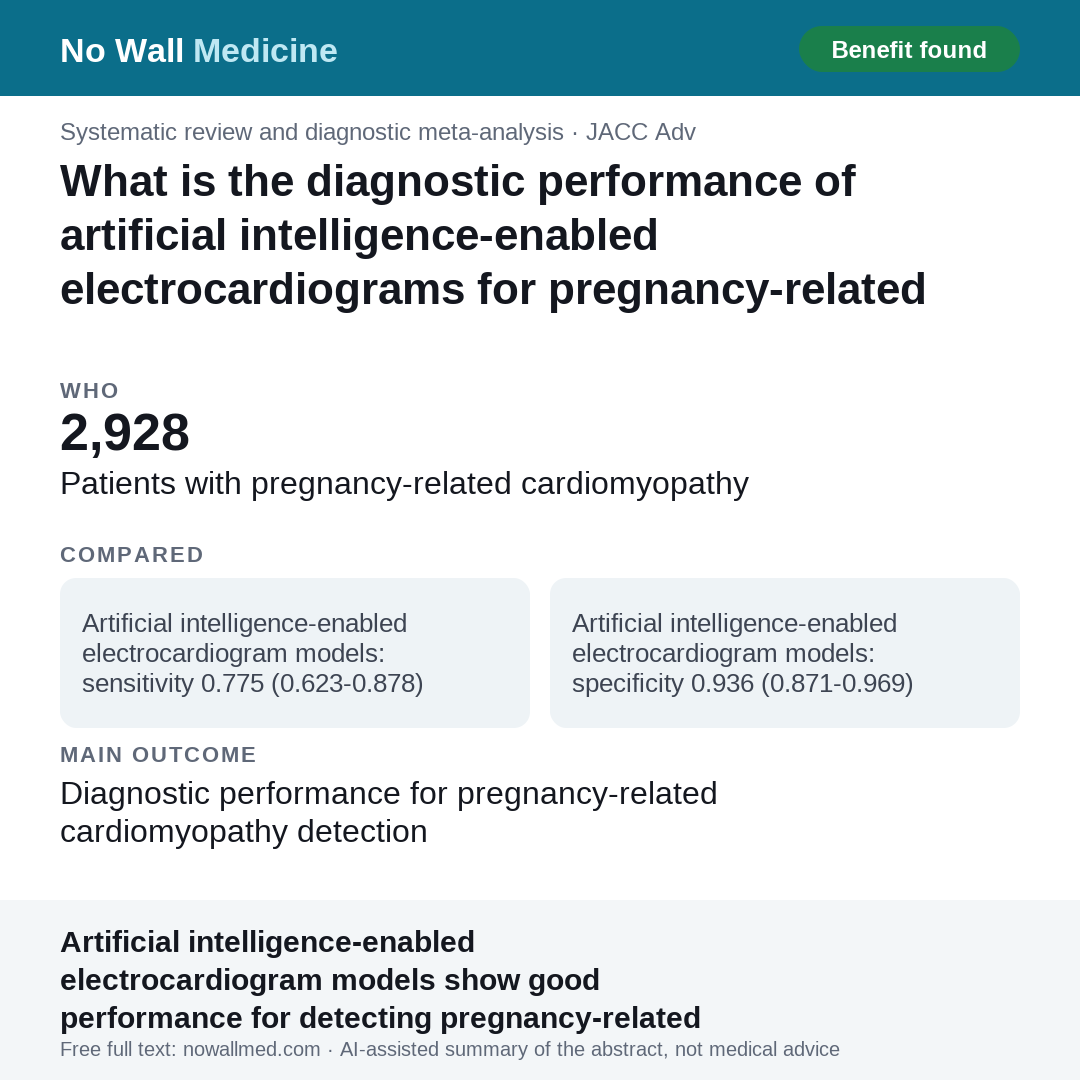
What is the diagnostic performance of artificial intelligence-enabled electrocardiograms for pregnancy-related cardiomyopathy detection?
Who
2,928
Patients with pregnancy-related cardiomyopathy
Compared
Artificial intelligence-enabled electrocardiogram models: sensitivity 0.775 (0.623-0.878)
Artificial intelligence-enabled electrocardiogram models: specificity 0.936 (0.871-0.969)
Main outcome
Diagnostic performance for pregnancy-related cardiomyopathy detection
Result: area under the curve 0.932 (0.813-0.953)
Bottom line: Artificial intelligence-enabled electrocardiogram models show good performance for detecting pregnancy-related cardiomyopathy.
JACC Adv · 2026-09-09Download image
Clinical question: What is the diagnostic performance of artificial intelligence-enabled electrocardiograms for pregnancy-related cardiomyopathy detection?
Why it matters: The lack of validated screening tools for pregnancy-related cardiomyopathy limits early recognition and contributes to diagnostic delays in a leading cause of maternal death.
Key points
- Researchers analyzed 6 studies involving 2,928 patients to evaluate how well artificial intelligence-enabled electrocardiograms, or heart rhythm tests using computer algorithms, detect pregnancy-related cardiomyopathy.
- The pooled analysis showed a sensitivity of 0.775 and a specificity of 0.936, with an area under the curve of 0.932 for detecting the condition.
- A univariate random effects model reported a pooled sensitivity of 0.808 and a specificity of 0.944 for the diagnostic models.
Headline and key points written with AI from the paper’s abstract, with every number checked against it. Read the paper before relying on them.
Spotted a mistake? Suggest a correction
More in Cardiology
Clonal hematopoiesis mutations linked to higher atrial fibrillation risk in cancer populations
Association of Clonal Hematopoiesis Mutations With Incident Atrial Fibrillation: A Systematic Review and Meta-Analysis
Deep learning model detects aortic stenosis from finger-cuff pressure waveforms accurately
Aortic Valve Stenosis Screening Using Deep Learning on Noninvasive Arterial Pressure Waveforms
Spontaneous coronary artery dissection affects younger women more often than expected
Spontaneous coronary artery dissection: implications for women's health, clinical care, and future research
Early lipid-lowering strategies may reduce atherosclerotic cardiovascular disease risk
Lipid-Lowering Strategies in the Era of Early Atherosclerosis Detection: 2026 ACC Scientific Statement: A Report of the American College of Cardiology