Artificial intelligence management system improved cholesterol and blood pressure control in coronary heart disease patients
Artificial intelligence-enhanced management system for secondary prevention of coronary heart disease: a randomized clinical trial
Single-center, open-label, parallel-group, randomized clinical trialBenefit found
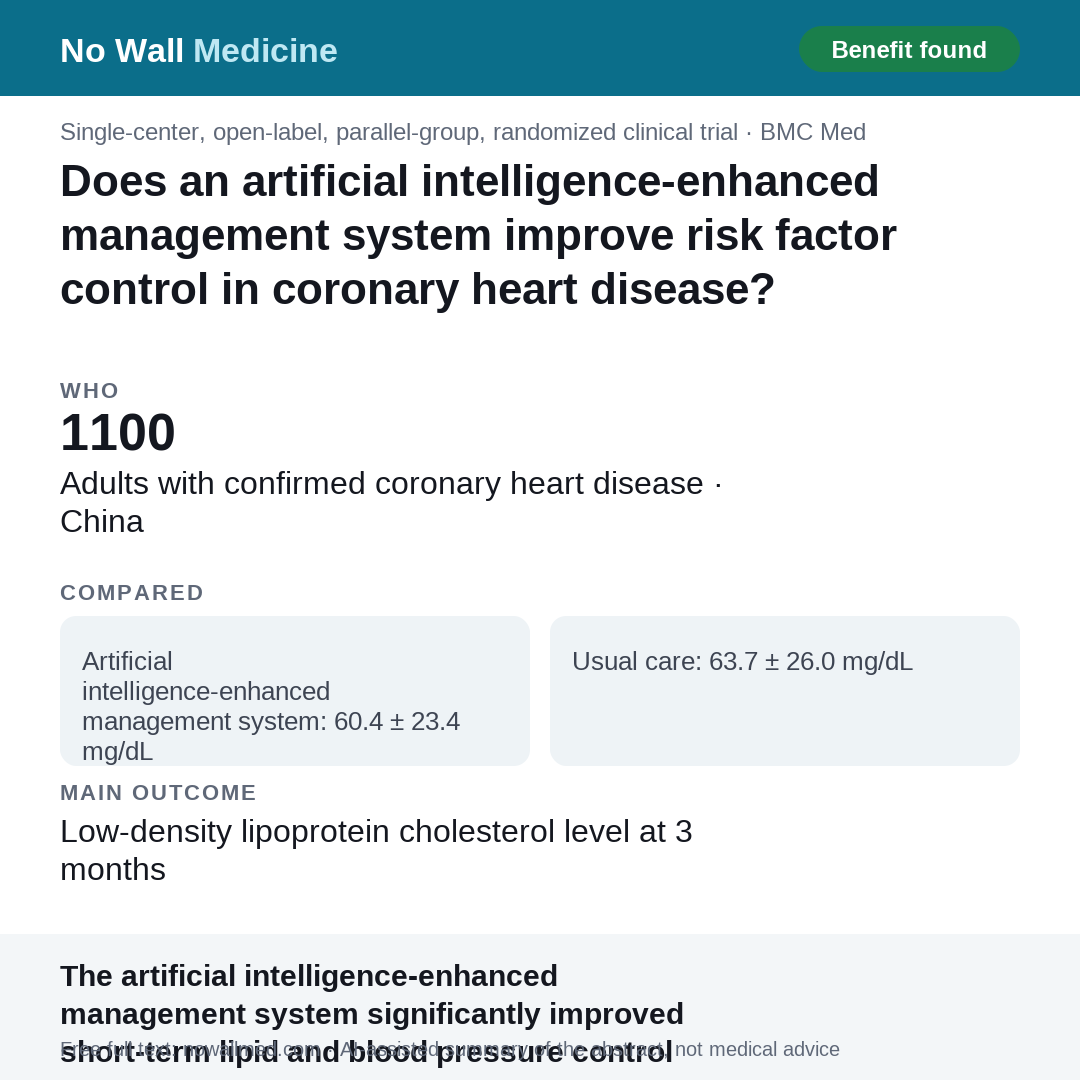
Does an artificial intelligence-enhanced management system improve risk factor control in coronary heart disease?
Who
1100
Adults with confirmed coronary heart disease · China
Compared
Artificial intelligence-enhanced management system: 60.4 ± 23.4 mg/dL
Usual care: 63.7 ± 26.0 mg/dL
Main outcome
Low-density lipoprotein cholesterol level at 3 months
Result: adjusted mean difference of - 3.2 mg/dL (95% CI, - 6.2 to - 0.3)
Bottom line: The artificial intelligence-enhanced management system significantly improved short-term lipid and blood pressure control compared with usual care.
BMC Med · 2026-08-18Download image
Clinical question: Does an artificial intelligence-enhanced management system improve risk factor control in coronary heart disease?
Why it matters: Secondary prevention for coronary heart disease is often suboptimal due to fragmented care and therapeutic inertia.
Key points
- Researchers studied 1100 adults with coronary heart disease, comparing an artificial intelligence management system to usual care over 3 months.
- The artificial intelligence group had a lower mean low-density lipoprotein cholesterol level of 60.4 ± 23.4 mg/dL compared to 63.7 ± 26.0 mg/dL in the control group.
- Patients using the system were more likely to reach blood pressure targets (45% vs. 35%) but showed no significant differences in blood sugar or medication adherence.
Limitation the authors note: This was a single-center, open-label, parallel-group, randomized clinical trial.
Headline and key points written with AI from the paper’s abstract, with every number checked against it. Read the paper before relying on them.
Topics
Spotted a mistake? Suggest a correction
More in Cardiology
Clonal hematopoiesis mutations linked to higher atrial fibrillation risk in cancer populations
Association of Clonal Hematopoiesis Mutations With Incident Atrial Fibrillation: A Systematic Review and Meta-Analysis
Deep learning model detects aortic stenosis from finger-cuff pressure waveforms accurately
Aortic Valve Stenosis Screening Using Deep Learning on Noninvasive Arterial Pressure Waveforms
Spontaneous coronary artery dissection affects younger women more often than expected
Spontaneous coronary artery dissection: implications for women's health, clinical care, and future research
Early lipid-lowering strategies may reduce atherosclerotic cardiovascular disease risk
Lipid-Lowering Strategies in the Era of Early Atherosclerosis Detection: 2026 ACC Scientific Statement: A Report of the American College of Cardiology