Artificial intelligence shows high accuracy for distinguishing benign from malignant lung cancer cells in cytology
Artificial intelligence for lung cancer classification in cytology specimens: A systematic review and diagnostic test accuracy meta-analysis of benign-malignant diagnosis and ADC/SCC/SCLC subtyping
Systematic review and diagnostic test accuracy meta-analysisBenefit found
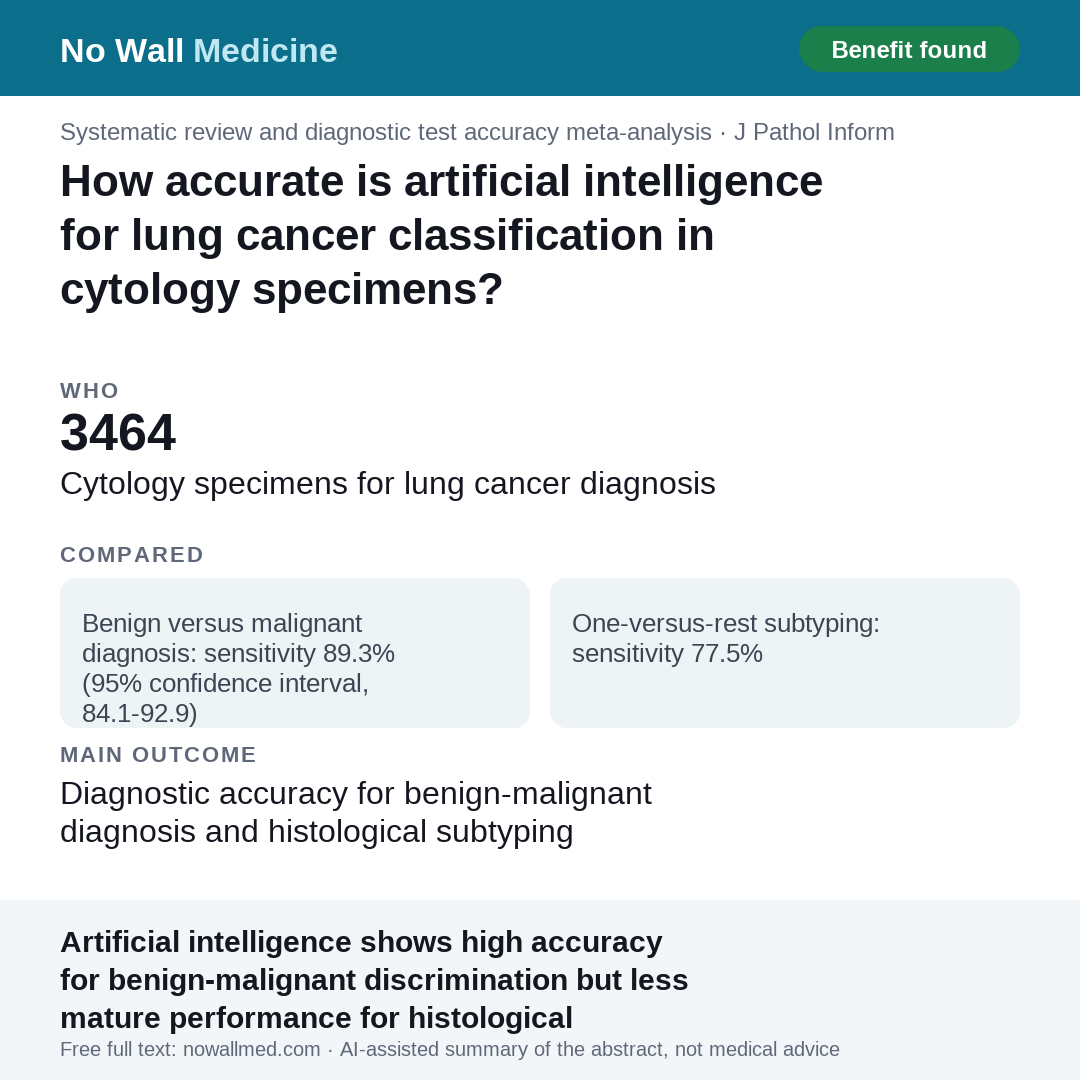
How accurate is artificial intelligence for lung cancer classification in cytology specimens?
Who
3464
Cytology specimens for lung cancer diagnosis
Compared
Benign versus malignant diagnosis: sensitivity 89.3% (95% confidence interval, 84.1-92.9)
One-versus-rest subtyping: sensitivity 77.5%
Main outcome
Diagnostic accuracy for benign-malignant diagnosis and histological subtyping
Result: area under the curve 0.952 for benign-malignant diagnosis
Bottom line: Artificial intelligence shows high accuracy for benign-malignant discrimination but less mature performance for histological subtyping.
Limitation: High risk of bias in all included studies and substantial heterogeneity.
J Pathol Inform · 2026-08-03Download image
Clinical question: How accurate is artificial intelligence for lung cancer classification in cytology specimens?
Why it matters: Distinguishing benign from malignant cells and subtyping different lung cancer types is challenging in cytology specimens due to limited cellular material.
Key points
- Researchers analyzed 32 studies, including 3464 observations for benign versus malignant diagnosis and 2687 observations for cancer subtyping.
- For distinguishing benign from malignant cells, artificial intelligence had a pooled sensitivity of 89.3% and a specificity of 88.5%.
- In cancer subtyping, small-cell lung cancer had a specificity of 93.2%, while squamous cell carcinoma had a lower sensitivity of 67.0%.
Limitation the authors note: The risk of bias was high in all included studies and substantial heterogeneity was observed across studies.
Headline and key points written with AI from the paper’s abstract, with every number checked against it. Read the paper before relying on them.
Cite this article
Myssayev A, Tamadon A, Mussin NM, Shirazi R, Zare A. Artificial intelligence for lung cancer classification in cytology specimens: A systematic review and diagnostic test accuracy meta-analysis of benign-malignant diagnosis and ADC/SCC/SCLC subtyping. J Pathol Inform. 2026. doi:10.1016/j.jpi.2026.100704
Spotted a mistake? Suggest a correction