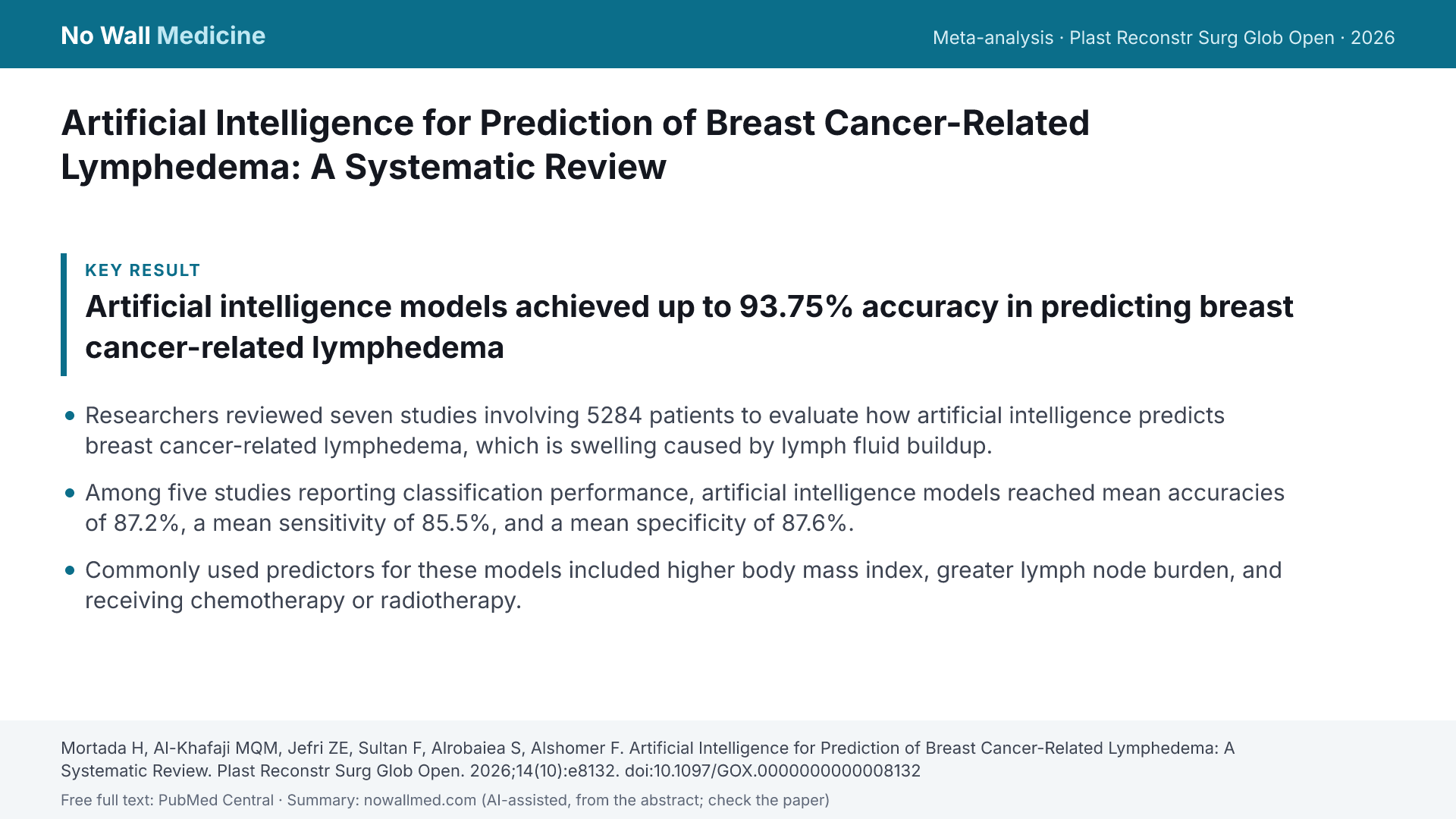
Artificial intelligence models achieved up to 93.75% accuracy in predicting breast cancer-related lymphedema
Artificial Intelligence for Prediction of Breast Cancer-Related Lymphedema: A Systematic Review
Why it matters: Early detection of breast cancer-related lymphedema is crucial for preventive intervention, but clinicians need better tools for personalized risk stratification.
Key points
- Researchers reviewed seven studies involving 5284 patients to evaluate how artificial intelligence predicts breast cancer-related lymphedema, which is swelling caused by lymph fluid buildup.
- Among five studies reporting classification performance, artificial intelligence models reached mean accuracies of 87.2%, a mean sensitivity of 85.5%, and a mean specificity of 87.6%.
- Commonly used predictors for these models included higher body mass index, greater lymph node burden, and receiving chemotherapy or radiotherapy.
Limitation the authors note: The authors noted small sample sizes, data heterogeneity, a lack of external validation, and inconsistent calibration in the current models.
Headline and key points written with AI from the paper’s abstract, with every number checked against it. Read the paper before relying on them.
Was this summary helpful?
Headline, design, result, key points, caveat and citation as plain text.
Cite this article
Mortada H, Al-Khafaji MQM, Jefri ZE, Sultan F, Alrobaiea S, Alshomer F. Artificial Intelligence for Prediction of Breast Cancer-Related Lymphedema: A Systematic Review. Plast Reconstr Surg Glob Open. 2026;14(10):e8132. doi:10.1097/GOX.0000000000008132
Spotted a mistake? Suggest a correction