Artificial intelligence shows high accuracy in detecting age-related macular degeneration from color fundus photographs
Artificial intelligence for the detection of age-related macular degeneration in color fundus photographs: A systematic review and meta-analysis
Systematic review and meta-analysisBenefit found
What is the performance of artificial intelligence in detecting age-related macular degeneration?
Who
Patients with color fundus photographs
Compared
Artificial intelligence: AUROC 0.983 (95% CI:0.979-0.987)
Human graders
Main outcome
Detection of age-related macular degeneration
Result: AUROC 0.983 (95% CI:0.979-0.987)
Bottom line: Artificial intelligence shows high performance in detecting age-related macular degeneration from color fundus photographs.
Funded by: Capital Health Research and Development of Special
eClinicalMedicine · 2021-05-08Download image
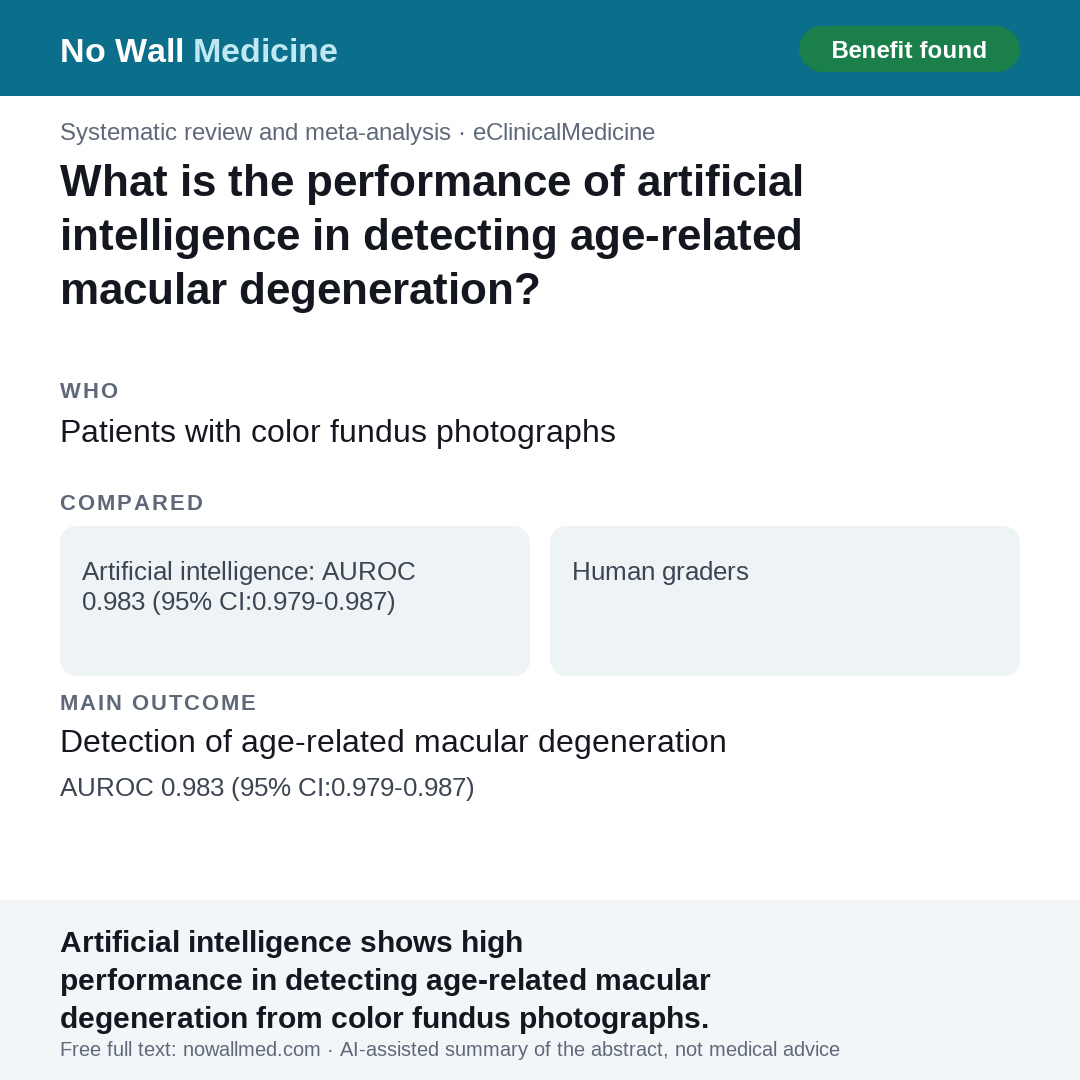
Clinical question: What is the performance of artificial intelligence in detecting age-related macular degeneration?
Why it matters: The performance of artificial intelligence in detecting age-related macular degeneration using color fundus photographs needed to be quantified.
Key points
- Researchers analyzed 19 studies involving artificial intelligence used to detect age-related macular degeneration in color fundus photographs, which are images of the back of the eye.
- The pooled analysis of 13 studies showed an area under the receiver operating characteristic curve of 0.983, a sensitivity of 0.88, and a specificity of 0.90.
- For studies using convolutional neural networks on the Age-Related Eye Disease Study database, the pooled sensitivity was 0.88 and the specificity was 0.91.
Headline and key points written with AI from the paper’s abstract, with every number checked against it. Read the paper before relying on them.
Was this summary helpful?
Cite this article
Dong L, Yang Q, Zhang RH, Wei WB. Artificial intelligence for the detection of age-related macular degeneration in color fundus photographs: A systematic review and meta-analysis. eClinicalMedicine. 2021. doi:10.1016/j.eclinm.2021.100875
Spotted a mistake? Suggest a correction
Top studies every Monday
The week’s key trials and guidelines in your specialties, plus any topics you follow. By email, free.
Get the weekly digest