Artificial intelligence shows potential for intermediate process measures but lacks evidence for hard clinical outcomes
Artificial intelligence in cardiovascular care: a systematic review and meta-analysis of randomised controlled trials
Systematic review and meta-analysis of randomized controlled trialsMixed results
What is the effectiveness of artificial intelligence in cardiovascular care?
Who
1,614,689
Patients receiving artificial intelligence interventions in cardiovascular care · 13 regions
Compared
Artificial intelligence interventions
Control
Main outcome
Effectiveness of artificial intelligence in cardiovascular care
Bottom line: Artificial intelligence shows potential benefits in intermediate process measures but evidence for hard clinical outcomes remains limited.
Limitation: High risk of bias, trial heterogeneity, inadequate reporting, and limited generalisability.
eClinicalMedicine · 2026-08-06Download image
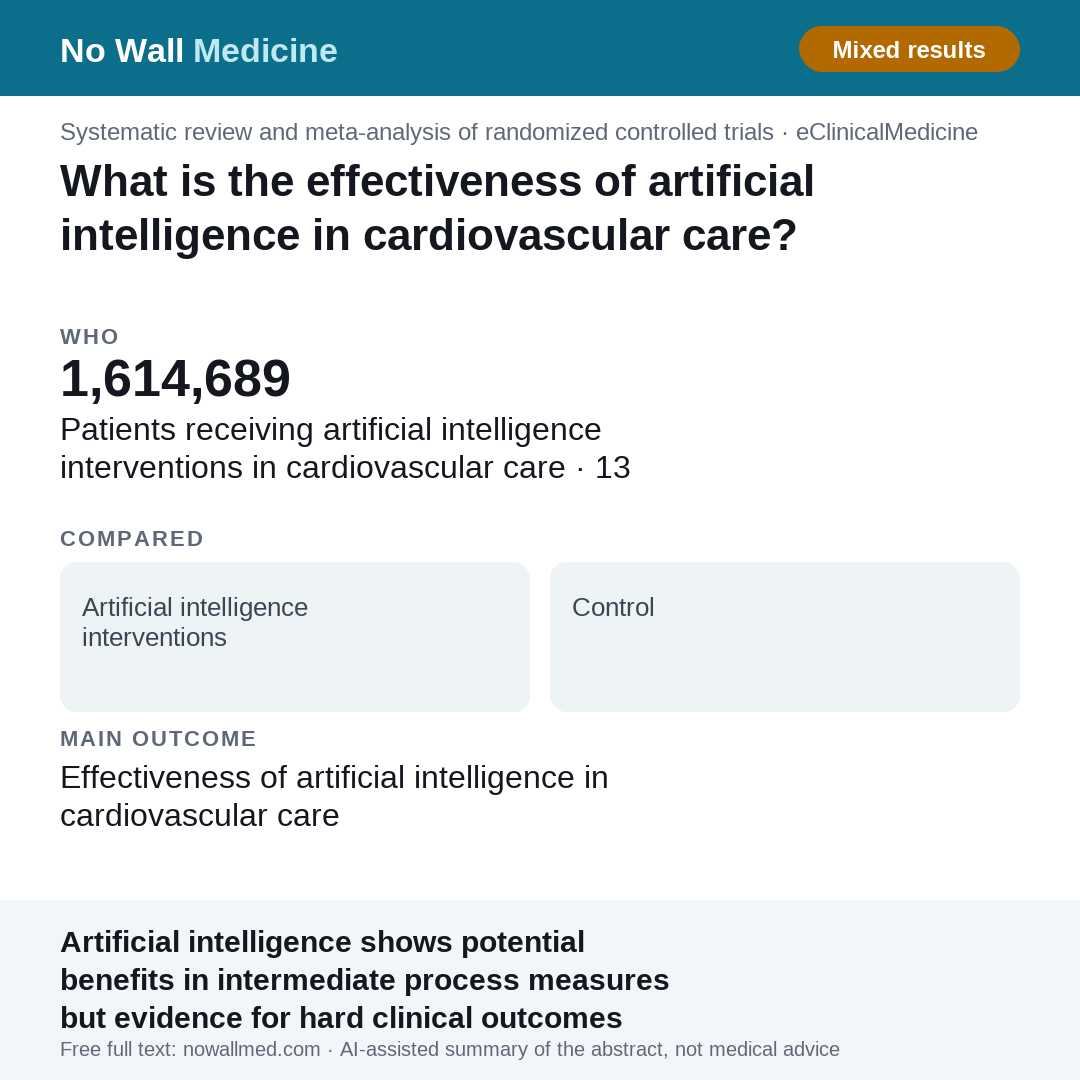
Clinical question: What is the effectiveness of artificial intelligence in cardiovascular care?
Why it matters: Evidence regarding the effectiveness of artificial intelligence in clinical cardiovascular practice remains inconsistent.
Key points
- Researchers analyzed 31 randomized controlled trials involving 1,685,717 patients to evaluate the effectiveness of artificial intelligence in cardiovascular care.
- The meta-analysis of 11 trials involving 1,614,689 patients showed potential benefits in intermediate process measures but limited evidence for hard clinical outcomes.
- Most included trials were published after 2021, were multicentre, and had short follow-up durations.
Limitation the authors note: The evidence is constrained by high risk of bias, trial heterogeneity, inadequate reporting of artificial intelligence-specific components, and limited generalisability.
Headline and key points written with AI from the paper’s abstract, with every number checked against it. Read the paper before relying on them.
Spotted a mistake? Suggest a correction
More in Cardiology
Clonal hematopoiesis mutations linked to higher atrial fibrillation risk in cancer populations
Association of Clonal Hematopoiesis Mutations With Incident Atrial Fibrillation: A Systematic Review and Meta-Analysis
Deep learning model detects aortic stenosis from finger-cuff pressure waveforms accurately
Aortic Valve Stenosis Screening Using Deep Learning on Noninvasive Arterial Pressure Waveforms
Spontaneous coronary artery dissection affects younger women more often than expected
Spontaneous coronary artery dissection: implications for women's health, clinical care, and future research
Early lipid-lowering strategies may reduce atherosclerotic cardiovascular disease risk
Lipid-Lowering Strategies in the Era of Early Atherosclerosis Detection: 2026 ACC Scientific Statement: A Report of the American College of Cardiology