Artificial intelligence models show accuracy in tracking motion and eye movements for microsurgery training
Artificial intelligence in microsurgery and supermicrosurgery training within plastic surgery: A systematic review
Systematic reviewBenefit found
What are the applications and future of artificial intelligence in microsurgery and supermicrosurgery training?
Who
Microsurgery and supermicrosurgery plastic surgery training
Compared
Automated skill classification: above 95 % accuracy
Eye tracking parameters
Instrument and hand tracking
Main outcome
Applications of artificial intelligence in microsurgery and supermicrosurgery training
Bottom line: Artificial intelligence models tracking motion and eye parameters enable objective, real-time monitoring of microsurgical proficiency and workload.
Limitation: All studies reported moderate risk of bias.
JPRAS Open · 2025-07-19Download image
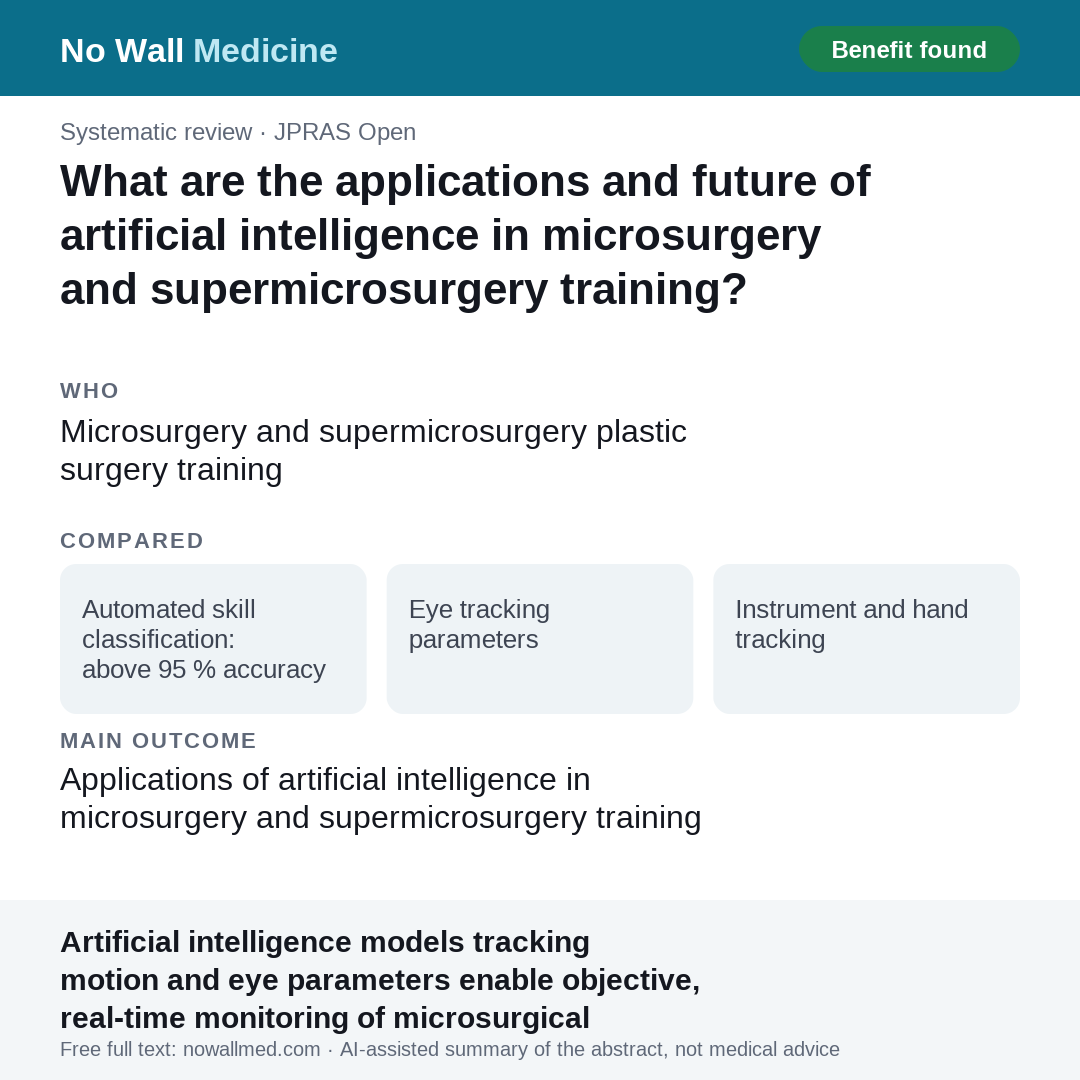
Clinical question: What are the applications and future of artificial intelligence in microsurgery and supermicrosurgery training?
Why it matters: Current simulation models for microsurgery may provide inadequate preparation and fidelity for trainees facing steep learning curves.
Key points
- Researchers reviewed five articles to evaluate how artificial intelligence can assist in training for microsurgery and supermicrosurgery, which are highly complex plastic surgery procedures.
- Two studies used surgical glove models with force sensors to classify microsurgical skills with an accuracy above 95%.
- Artificial intelligence models accurately analyzed eye tracking parameters like blink rate and pupil dilation, as well as instrument motion metrics like path length and velocity.
Limitation the authors note: All studies included in this systematic review reported a moderate risk of bias.
Headline and key points written with AI from the paper’s abstract, with every number checked against it. Read the paper before relying on them.
Cite this article
Kiew CYK, Shah A, Hadjiandreou M, Pafitanis G. Artificial intelligence in microsurgery and supermicrosurgery training within plastic surgery: A systematic review. JPRAS Open. 2025. doi:10.1016/j.jpra.2025.07.010
Spotted a mistake? Suggest a correction
Top studies every Monday
The week’s key trials and guidelines in your specialties, plus any topics you follow. By email, free.
Get the weekly digest