Artificial intelligence analysis of arterial waveforms predicted major adverse outcomes in peripheral artery disease patients
Artificial Intelligence of Arterial Doppler Waveforms to Predict Major Adverse Outcomes Among Patients Evaluated for Peripheral Artery Disease
Randomized training, validation, and testing subsetsBenefit found
Can deep neural networks analyze Doppler waveforms to predict major adverse outcomes?
Who
10437
Patients undergoing ankle-brachial index testing
Compared
High prediction score
Low prediction score
Main outcome
Major adverse cardiac events, limb events, and all-cause death
Result: death hazard ratio 2.44 (95% CI 1.78-3.34)
Bottom line: Artificial intelligence analysis of Doppler waveforms independently predicts major adverse outcomes in patients with peripheral artery disease.
J Am Heart Assoc · 2024-01-19Download image
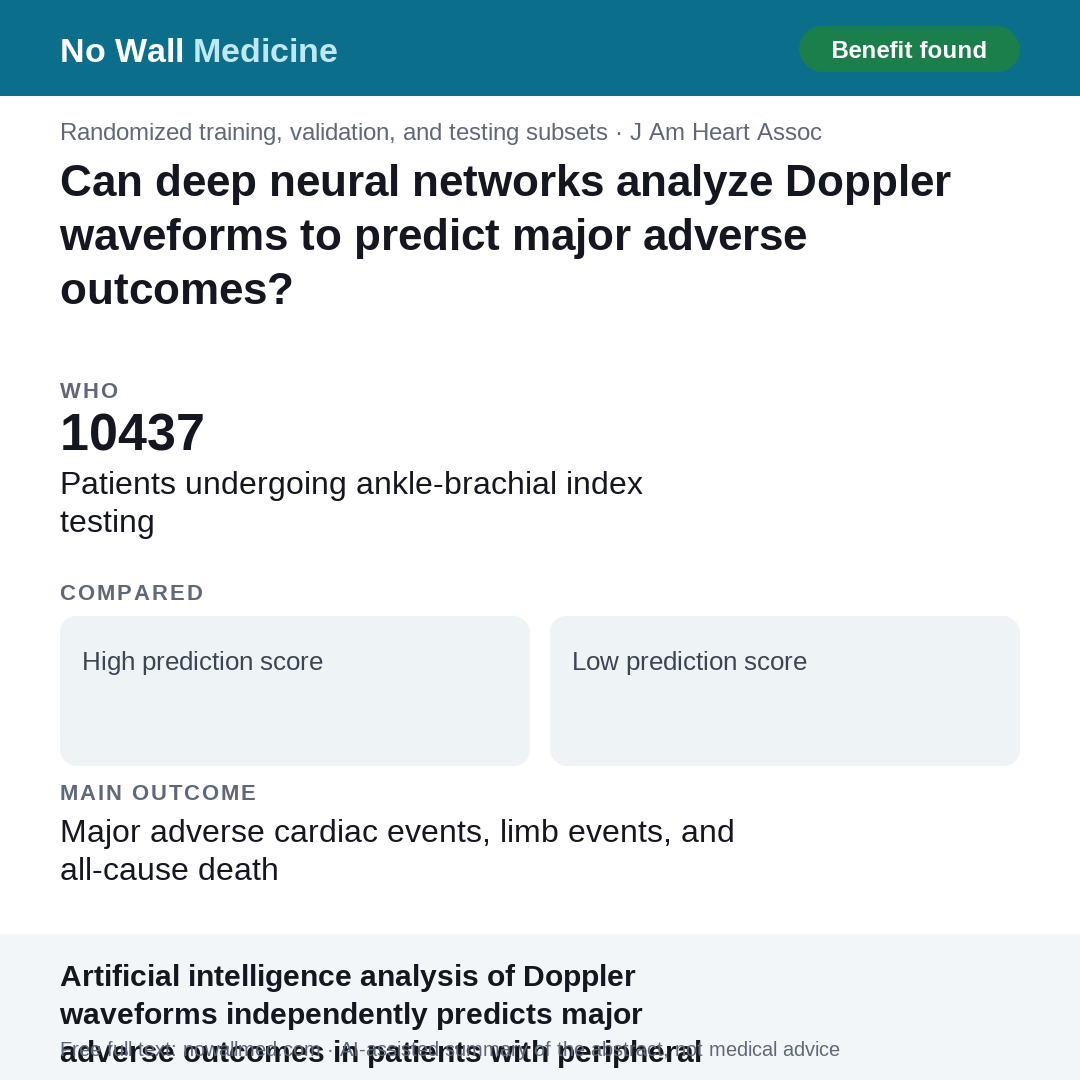
Clinical question: Can deep neural networks analyze Doppler waveforms to predict major adverse outcomes?
Why it matters: It is unknown if computer-assisted analysis of resting Doppler waveforms can accurately identify patients with peripheral artery disease at the highest risk for serious medical events.
Key points
- Researchers analyzed 10,437 patients undergoing ankle-brachial index testing, which is a non-invasive way to check blood flow in the legs.
- Deep neural network analysis of arterial waveforms was associated with a hazard ratio of 2.44 for death, 1.97 for major adverse cardiac events, and 11.03 for major adverse limb events at 5 years.
- The study included a test subset of 2,084 patients with a mean age of 65.8±14.8 years.
Headline and key points written with AI from the paper’s abstract, with every number checked against it. Read the paper before relying on them.
Topics
Cite this article
McBane RD, Murphree DH, Liedl D, Lopez-Jimenez F, Attia IZ, Arruda-Olson AM. Artificial Intelligence of Arterial Doppler Waveforms to Predict Major Adverse Outcomes Among Patients Evaluated for Peripheral Artery Disease. J Am Heart Assoc. 2024. doi:10.1161/JAHA.123.031880
Spotted a mistake? Suggest a correction
Top studies every Monday
The week’s key trials and guidelines in your specialties, plus any topics you follow. By email, free.
Get the weekly digest