Higher lymphocyte and endothelial cell levels in tumor areas linked to better responses in lung cancer
Artificial intelligence-powered spatial analysis of tumor microenvironment in patients with non-small cell lung cancer with acquired resistance to EGFR tyrosine kinase inhibitor
Observational study using artificial intelligence spatial analysisBenefit found
How does the tumor microenvironment change after EGFR tyrosine kinase inhibitor resistance?
Who
143
Non-small cell lung cancer patients with acquired resistance to EGFR tyrosine kinase inhibitors
Compared
Post-tyrosine kinase inhibitor samples: reduced tumor-infiltrating lymphocytes and increased endothelial cells
Pre-tyrosine kinase inhibitor samples
Main outcome
dynamic changes in the tumor microenvironment and predictive efficacy of treatment
Bottom line: Higher tumor-infiltrating lymphocytes or endothelial cells in cancer areas associate with favorable responses to subsequent immune-checkpoint inhibitor-based treatment.
J Immunother Cancer · 2025-10-31Download image
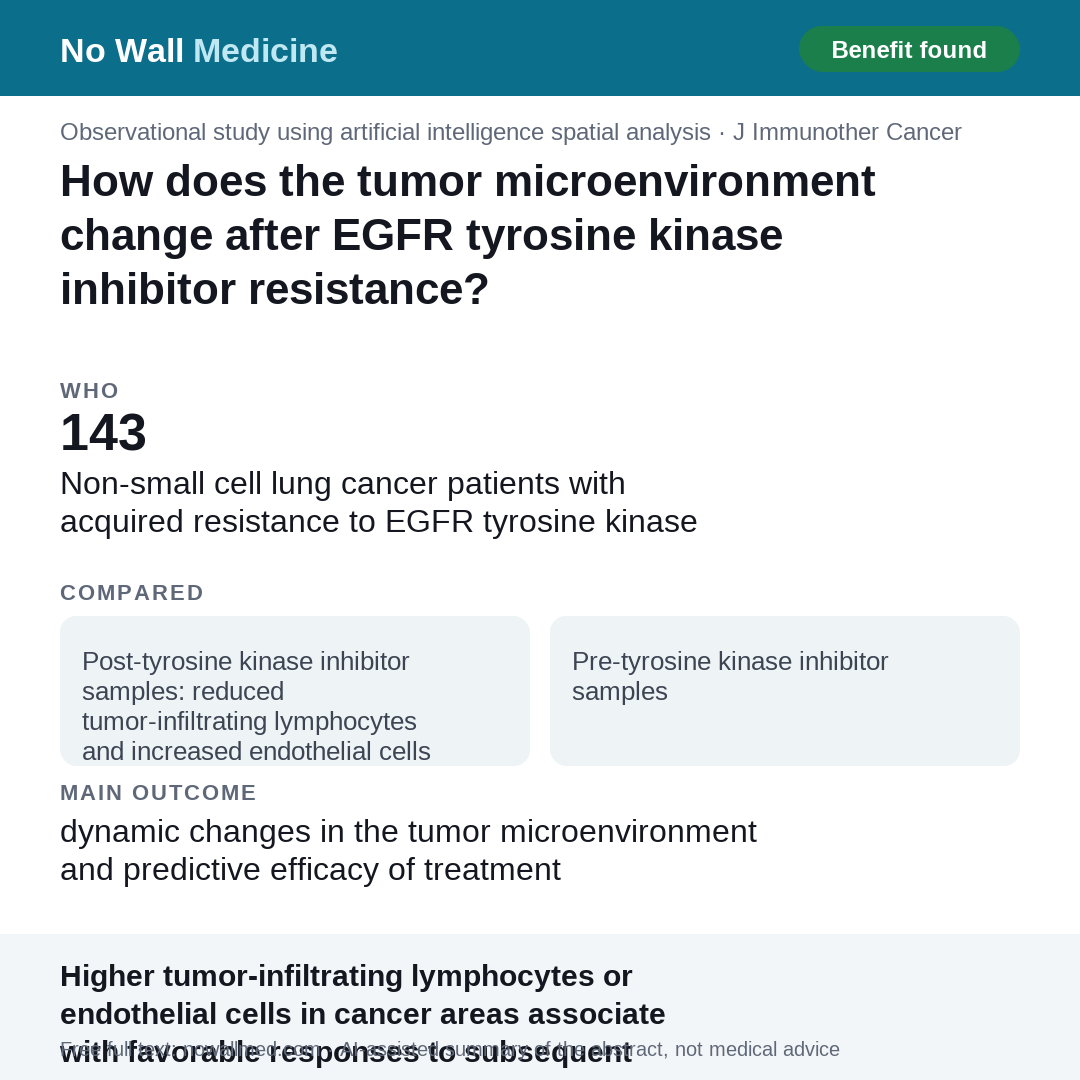
Clinical question: How does the tumor microenvironment change after EGFR tyrosine kinase inhibitor resistance?
Why it matters: The study addresses how the tumor microenvironment changes after resistance to epidermal growth factor receptor tyrosine kinase inhibitors develops and how these changes predict response to immune-checkpoint inhibitor treatments.
Key points
- Researchers used artificial intelligence to analyze 143 non-small cell lung cancer samples from patients who developed resistance to epidermal growth factor receptor tyrosine kinase inhibitors.
- Higher levels of tumor-infiltrating lymphocytes and endothelial cells in cancer areas were associated with better overall response rates and progression-free survival.
- In the ATTLAS trial cohort, higher lymphocyte levels were associated with clinical benefits from atezolizumab plus bevacizumab, paclitaxel, and carboplatin.
Headline and key points written with AI from the paper’s abstract, with every number checked against it. Read the paper before relying on them.
Abstract
Purpose
This study evaluated the dynamic changes in the tumor microenvironment (TME) in patients with non-small cell lung cancer (NSCLC) and acquired resistance to epidermal growth factor receptor (EGFR)-tyrosine kinase inhibitors (TKIs) using an artificial intelligence (AI)-powered spatial TME analyzer. We then assessed the predictive efficacy of immune-checkpoint inhibitors (ICIs)-based treatment. Experimental design
An AI-powered whole-slide image analyzer was used to segment cancer areas (CAs) and cancer stroma and to identify tumor-infiltrating lymphocytes (TILs), tertiary lymphoid structures, fibroblasts, and endothelial cells (ECs) in the tumor tissue. We analyzed 143 NSCLC samples after resistance to EGFR-TKIs from two cohorts: (1) 89 patients treated with ICI monotherapy and (2) 54 patients from the ATTLAS phase III trial comparing atezolizumab plus bevacizumab, paclitaxel, and carboplatin (ABCP) versus pemetrexed plus carboplatin. Results
Post-TKI samples showed reduced TILs in the CA (p=0.045) and increased ECs in the CA (p=0.005) compared with pre-TKI samples. These changes differed according to EGFR mutation subtype. Higher TILs in CA were associated with a better overall response rate (ORR) and progression-free survival (PFS). Similarly, higher EC levels in CA correlated with improved ORR and PFS. In the ATTLAS cohort, these factors were associated with clinical benefits from ABCP, with a significant association with TILs and a marginal association with ECs. Conclusion
Our findings suggest that EGFR-TKIs affect the immune landscape of patients with EGFR-mutated NSCLC. Higher TILs or ECs in the CA were significantly associated with a favorable response to subsequent ICI-based treatment. Trial registration number
NCT03991403.
Abstract reproduced under the article’s CC BY NC licence.
Topics
Cite this article
Bang YH, Park GH, Oh JW, Hwang S, Jeong JG, Lee B. Artificial intelligence-powered spatial analysis of tumor microenvironment in patients with non-small cell lung cancer with acquired resistance to EGFR tyrosine kinase inhibitor. J Immunother Cancer. 2025. doi:10.1136/jitc-2025-012374
Spotted a mistake? Suggest a correction