Artificial Intelligence Use in Academic Applicant Screening: A Systematic Review
Systematic reviewMixed results
How does artificial intelligence perform in academic applicant screening?
Who
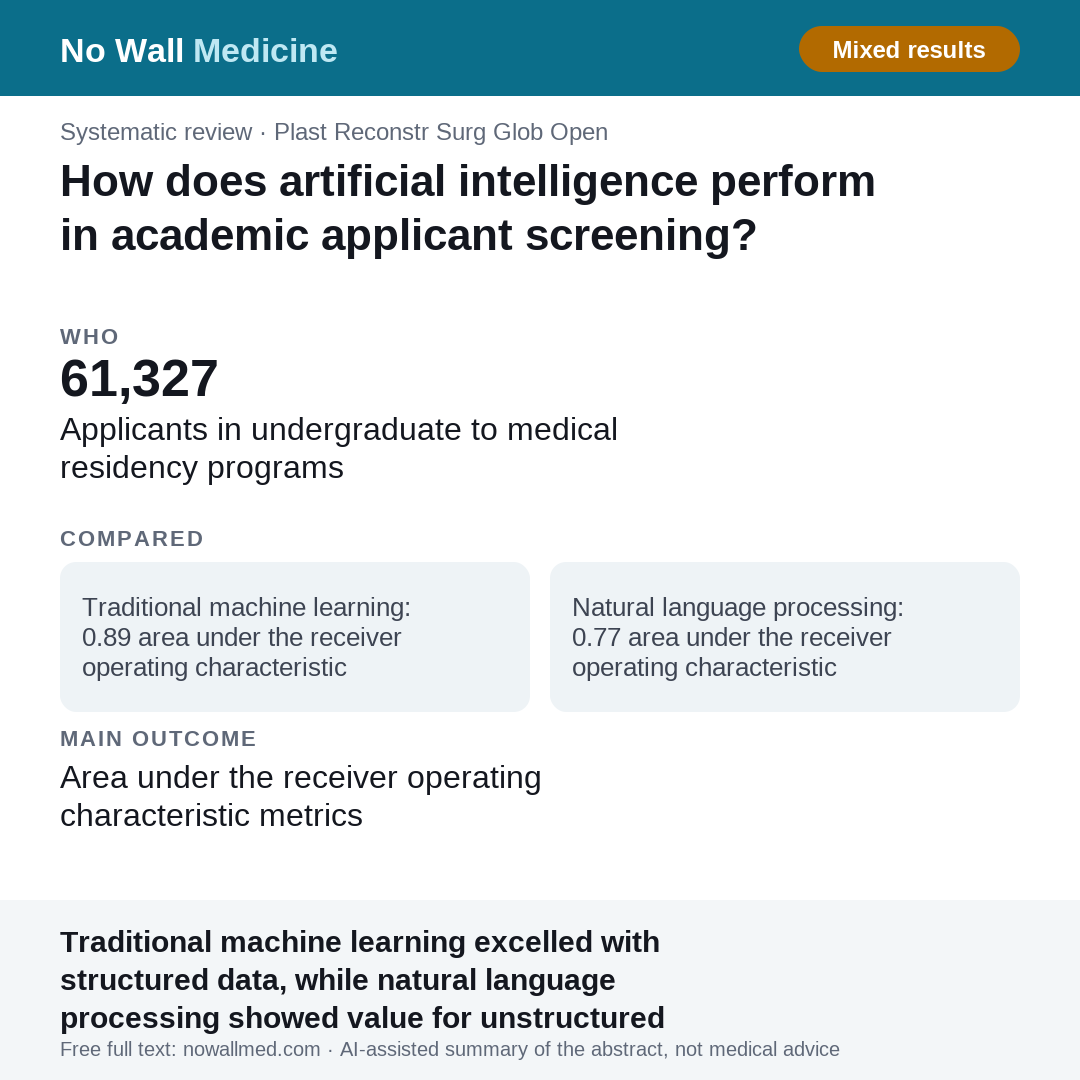
61,327
Applicants in undergraduate to medical residency programs
Compared
Traditional machine learning: 0.89 area under the receiver operating characteristic
Natural language processing: 0.77 area under the receiver operating characteristic
Main outcome
Area under the receiver operating characteristic metrics
Bottom line: Traditional machine learning excelled with structured data, while natural language processing showed value for unstructured data.
Limitation: Ethical concerns including bias were reported in 50% of studies.
Plast Reconstr Surg Glob Open · 2025-10-23Download image
Clinical question: How does artificial intelligence perform in academic applicant screening?
Abstract
Background
Escalating application volumes challenge holistic admissions review; artificial intelligence (AI) offers potential screening efficiencies. This systematic review examined AI algorithm use in academic admissions, categorizing types and evaluating objectives, performance, and ethical considerations. Methods
A systematic search of 5 databases through October 2024 identified original research on AI screening in undergraduate to medical residency programs. Data extraction covered study characteristics, AI types, performance metrics, and ethical considerations. Bias risk was assessed using the Newcastle-Ottawa Scale, and objective outcomes were compared statistically. Results
Eighteen studies (61,327 applicants) were included. The primary uses of AI were interview selection (n = 7), admissions decisions (n = 4), and reviewer scoring (n = 2). Algorithms included traditional machine learning (TML) and natural language processing (NLP). In the subset of studies reporting area under the receiver operating characteristic metrics, TML models averaged 0.89 versus 0.77 for NLP models. Ethical concerns, notably bias, were reported in 50% of studies. Conclusions
TML algorithms excelled with structured data; NLP showed value for unstructured data despite challenges (eg, transparency and data needs). Ethical concerns highlight the need for transparency and bias mitigation in AI adoption. Findings emphasize continued research to address ethical and methodological challenges.
Cite this article
Jiang T, Er S, Heron MJ, Zhu KJ, Yang R. Artificial Intelligence Use in Academic Applicant Screening: A Systematic Review. Plast Reconstr Surg Glob Open. 2025. doi:10.1097/GOX.0000000000007177
Spotted a mistake? Suggest a correction