Artificial intelligence doctors performed similarly to human doctors in virtual reality sepsis training for nursing students
Artificial Intelligence Versus Human-Controlled Doctor in Virtual Reality Simulation for Sepsis Team Training: Randomized Controlled Study
Randomized controlled trialNo clear difference
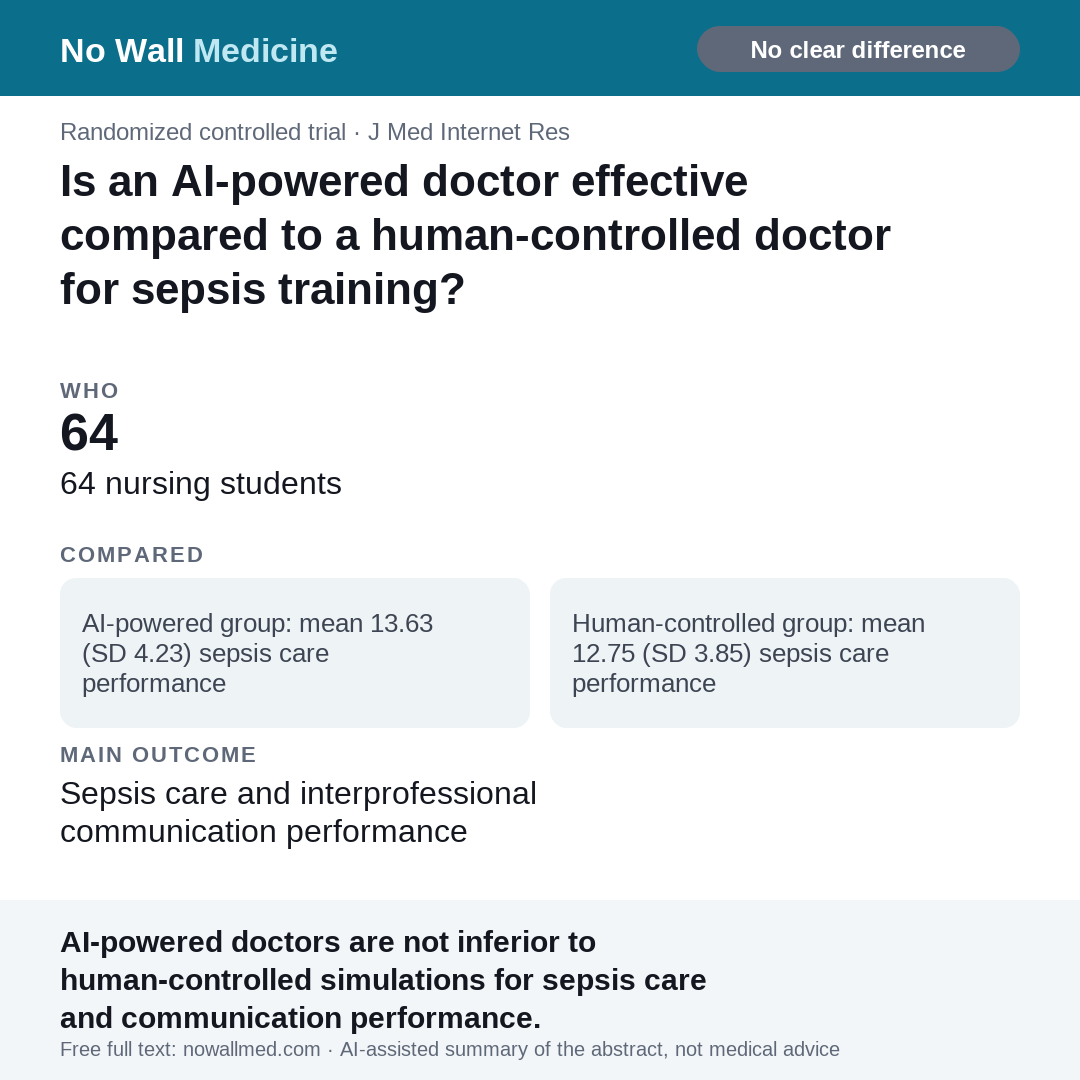
Is an AI-powered doctor effective compared to a human-controlled doctor for sepsis training?
Who
64
64 nursing students
Compared
AI-powered group: mean 13.63 (SD 4.23) sepsis care performance
Human-controlled group: mean 12.75 (SD 3.85) sepsis care performance
Main outcome
Sepsis care and interprofessional communication performance
Bottom line: AI-powered doctors are not inferior to human-controlled simulations for sepsis care and communication performance.
Limitation: Future studies should examine how to best blend AI-powered training with human-controlled simulation.
J Med Internet Res · 2023-07-26Download image
Clinical question: Is an AI-powered doctor effective compared to a human-controlled doctor for sepsis training?
Why it matters: Scaling sepsis team training is difficult because of unequal cohort sizes between medical and nursing students during virtual reality simulations.
Key points
- Researchers randomized 64 nursing students to train with either an artificial intelligence-powered doctor or a human-controlled doctor using virtual reality simulation.
- The artificial intelligence group had higher sepsis knowledge scores (mean 9.06, SD 1.78) than the human-controlled group (mean 7.75, SD 2.08), but sepsis care performance showed no significant difference between groups.
- The human-controlled group reported significantly higher self-efficacy in interprofessional communication (mean 69.6, SD 14.4) than the artificial intelligence group (mean 60.1, SD 13.3).
Headline and key points written with AI from the paper’s abstract, with every number checked against it. Read the paper before relying on them.
Topics
Cite this article
Liaw SY, Tan JZ, Bin Rusli KD, Ratan R, Zhou W, Lim S. Artificial Intelligence Versus Human-Controlled Doctor in Virtual Reality Simulation for Sepsis Team Training: Randomized Controlled Study. J Med Internet Res. 2023. doi:10.2196/47748
Spotted a mistake? Suggest a correction
Top studies every Monday
The week’s key trials and guidelines in your specialties, plus any topics you follow. By email, free.
Get the weekly digest