Researchers establish minimal clinically important difference values for the Diabetes Distress Scale-17
Ascertainment of Minimal Clinically Important Differences in the Diabetes Distress Scale-17: A Secondary Analysis of a Randomized Clinical Trial
Secondary analysis of a randomized clinical trialBenefit found
What are the minimal clinically important difference values for the Diabetes Distress Scale-17?
Who
248
Adults with uncontrolled type 2 diabetes · Department of Veterans Affairs clinics in three states
Compared
Empowering Patients in Chronic Care: 51.22% improved
Enhanced usual care: 32.00% improved
Main outcome
Minimal clinically important difference for the Diabetes Distress Scale-17
Result: MCID for DDS-17 was 0.25
Bottom line: The minimal clinically important difference for the Diabetes Distress Scale-17 is 0.25.
JAMA Netw Open · 2023-11-01Download image
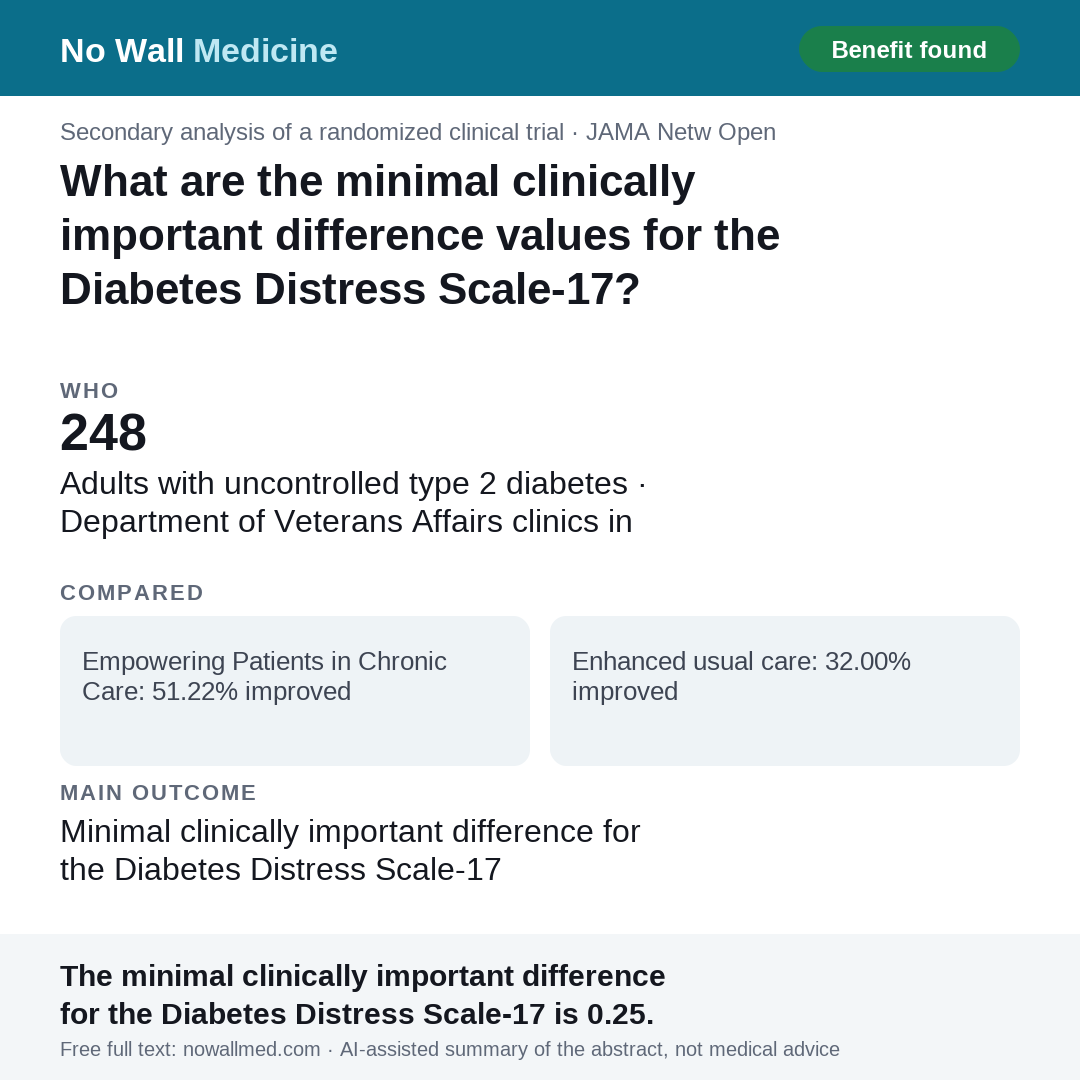
Clinical question: What are the minimal clinically important difference values for the Diabetes Distress Scale-17?
Why it matters: There are no agreed-on minimal clinically important difference values for the Diabetes Distress Scale-17, which is a common measure of diabetes distress.
In absolute numbers
Empowering Patients in Chronic Care: 51.22% · Enhanced usual care: 32% → a difference of 19.2 percentage points, so about 6 people would need the treatment for 1 more to benefit (number needed to treat) over the trial’s follow-up.
Worked out by us from the two group results above, not reported by the authors. Check the paper for the exact outcome and timing.
Key points
- The study analyzed 248 adults with uncontrolled type 2 diabetes to determine meaningful change thresholds for the Diabetes Distress Scale-17 and its four subscales.
- The calculated minimal clinically important difference was 0.25 for the total scale, 0.38 for emotional and interpersonal distress, and 0.39 for physician and regimen distress.
- Participants in the EPICC group were more likely to reach the improvement category for total distress compared to the usual care group (51.22% vs 32.00%).
Headline and key points written with AI from the paper’s abstract, with every number checked against it. Read the paper before relying on them.
Topics
Cite this article
Banks J, Amspoker AB, Vaughan EM, Woodard L, Naik AD. Ascertainment of Minimal Clinically Important Differences in the Diabetes Distress Scale-17: A Secondary Analysis of a Randomized Clinical Trial. JAMA Netw Open. 2023. doi:10.1001/jamanetworkopen.2023.42950
Spotted a mistake? Suggest a correction
Top studies every Monday
The week’s key trials and guidelines in your specialties, plus any topics you follow. By email, free.
Get the weekly digest