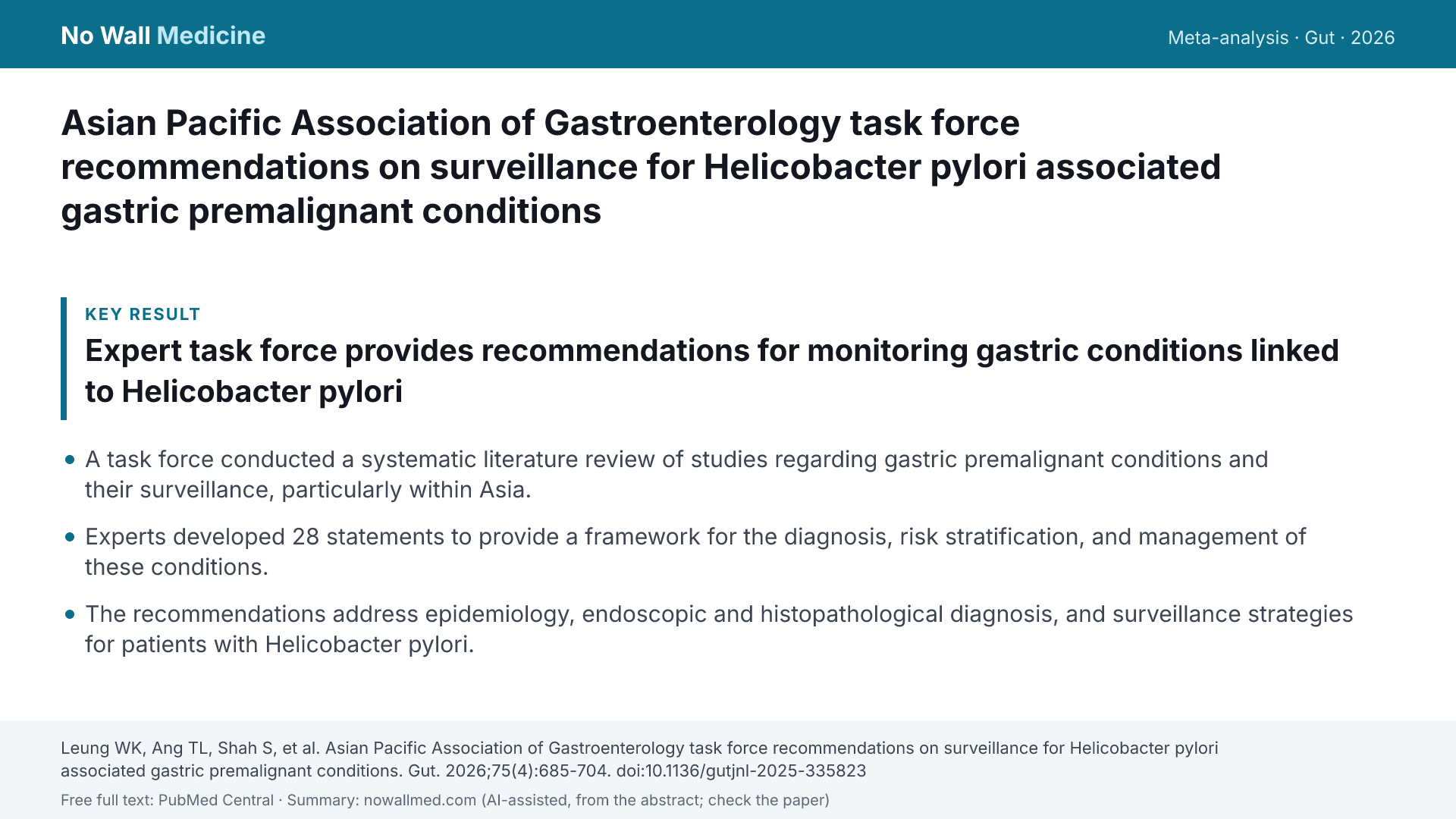
Expert task force provides recommendations for monitoring gastric conditions linked to Helicobacter pylori
Asian Pacific Association of Gastroenterology task force recommendations on surveillance for Helicobacter pylori associated gastric premalignant conditions
Why it matters: Clinicians in the Asia Pacific region require a structured, evidence-based framework for the early detection and management of gastric premalignant conditions.
Key points
- A task force conducted a systematic literature review of studies regarding gastric premalignant conditions and their surveillance, particularly within Asia.
- Experts developed 28 statements to provide a framework for the diagnosis, risk stratification, and management of these conditions.
- The recommendations address epidemiology, endoscopic and histopathological diagnosis, and surveillance strategies for patients with Helicobacter pylori.
Headline and key points written with AI from the paper’s abstract, with every number checked against it. Read the paper before relying on them.
Was this summary helpful?
Abstract
Background
The burden of gastric cancer remains substantial in Asia. Gastric premalignant conditions, including chronic atrophic gastritis, intestinal metaplasia and dysplasia, are important intermediate stages in the gastric carcinogenesis cascade. The sojourn time allows endoscopic surveillance to have a pivotal role in early detection and timely intervention. Objective
This task force was commissioned by the Asian Pacific Association of Gastroenterology to formulate recommendations for the surveillance and management of Helicobacter pylori associated gastric premalignant conditions in the region. Design
A systematic literature review was conducted across multiple databases, including PubMed, Cochrane Library and Embase, focusing on studies related to gastric premalignant conditions and their surveillance, particularly from Asia. The evidence quality and strength of recommendations were appraised using the Grading of Recommendations Assessment, Development and Evaluation (GRADE) system. Results
These recommendations address four key aspects of gastric premalignant condition surveillance: (1) epidemiology and risk factors; (2) endoscopic and histopathological diagnosis; (3) risk stratification and endoscopic surveillance strategies; and (4) management strategies. 28 statements were made after multiple rounds of voting by experts. The statements offer a comprehensive, evidence based framework designed to assist clinicians in the Asia Pacific region on the early detection and management of gastric premalignant conditions. Conclusion
These statements aim to provide a structured, evidence based surveillance framework for clinical practice in the Asia Pacific region, while also identifying priority areas for future research.
Abstract reproduced under the article’s CC BY NC licence.
Subject terms
Cite this article
Leung WK, Ang TL, Shah S, et al. Asian Pacific Association of Gastroenterology task force recommendations on surveillance for Helicobacter pylori associated gastric premalignant conditions. Gut. 2026. doi:10.1136/gutjnl-2025-335823
Spotted a mistake? Suggest a correction