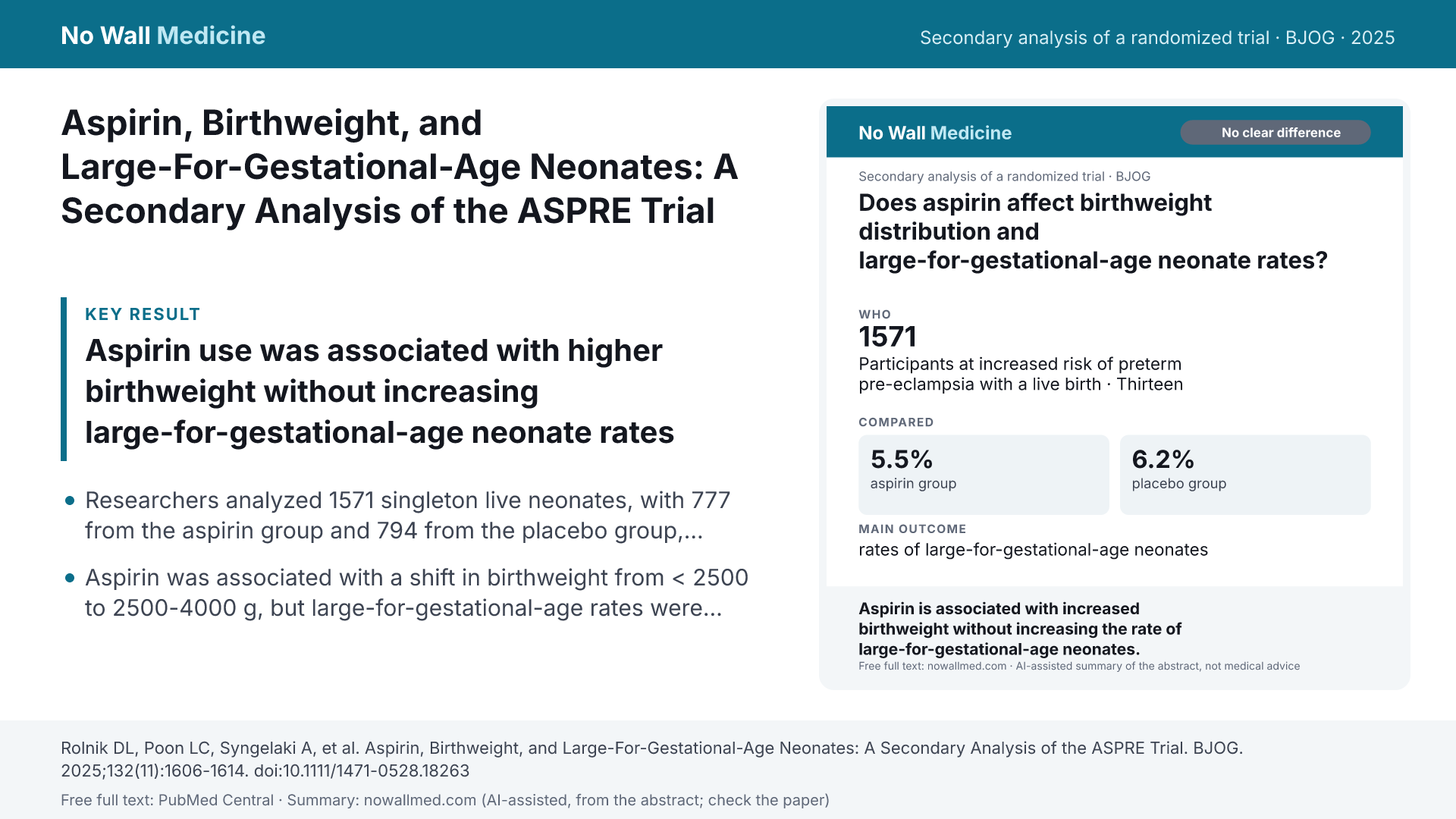
Aspirin use was associated with higher birthweight without increasing large-for-gestational-age neonate rates
Aspirin, Birthweight, and Large-For-Gestational-Age Neonates: A Secondary Analysis of the ASPRE Trial
Secondary analysis of a randomized trialNo clear difference
Does aspirin affect birthweight distribution and large-for-gestational-age neonate rates?
Who
1571
Participants at increased risk of preterm pre-eclampsia with a live birth · Thirteen hospitals in England, Spain, Belgium, Greece, Italy and Israel
Compared
5.5%aspirin group
6.2%placebo group
Main outcome
rates of large-for-gestational-age neonates
Bottom line: Aspirin is associated with increased birthweight without increasing the rate of large-for-gestational-age neonates.
BJOG · 2025-07-01Download image
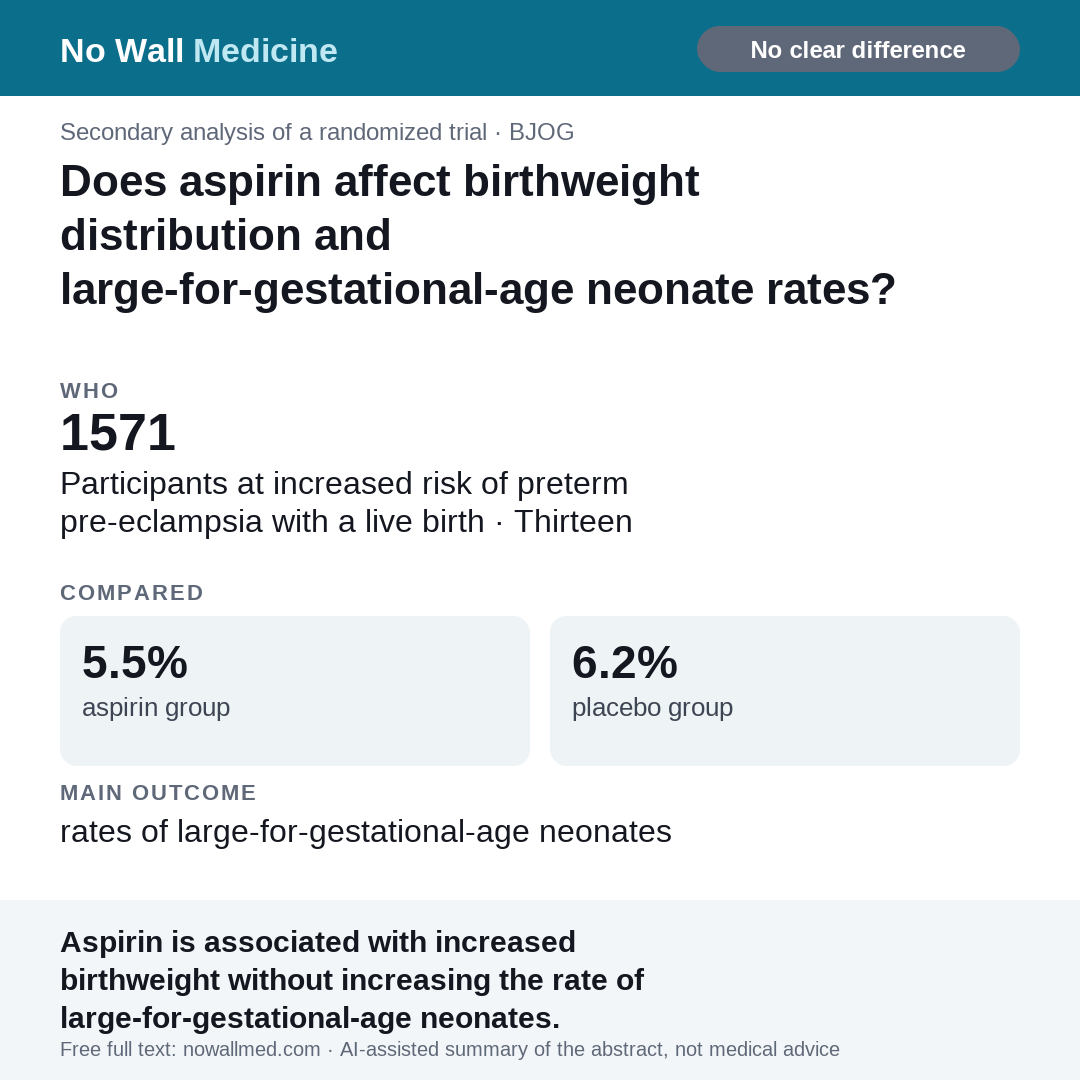
Clinical question: Does aspirin affect birthweight distribution and large-for-gestational-age neonate rates?
Key points
- Researchers analyzed 1571 singleton live neonates, with 777 from the aspirin group and 794 from the placebo group, to compare birthweight distributions.
- Aspirin was associated with a shift in birthweight from < 2500 to 2500-4000 g, but large-for-gestational-age rates were not significantly different (5.5% vs. 6.2%, p = 0.667).
- Maternal weight was positively associated with large-for-gestational-age neonates (adjusted odds ratio 1.040, 95% confidence interval 1.030-1.051, p < 0.001).
Headline and key points written with AI from the paper’s abstract, with every number checked against it. Read the paper before relying on them.
Was this summary helpful?
Subject terms
Headline, design, result, key points, caveat and citation as plain text.
Cite this article
Rolnik DL, Poon LC, Syngelaki A, et al. Aspirin, Birthweight, and Large-For-Gestational-Age Neonates: A Secondary Analysis of the ASPRE Trial. BJOG. 2025;132(11):1606-1614. doi:10.1111/1471-0528.18263
Spotted a mistake? Suggest a correction