COVID-19 infection fatality rates in developing countries were roughly 2 times higher than high-income countries
Assessing the burden of COVID-19 in developing countries: systematic review, meta-analysis and public policy implications
Systematic review and meta-analysisHarm found
What is the COVID-19 seroprevalence and infection fatality rate in developing countries?
Who
People in developing countries · Developing countries
Compared
Developing countries: median population infection fatality rate about 0.5%
High-income countries
Main outcome
Infection fatality rate and seroprevalence
Result: age-specific infection fatality rates were roughly 2 times higher
Bottom line: COVID-19 burden is higher in developing countries due to elevated transmission and limited healthcare access.
BMJ Glob Health · 2022-05-26Download image
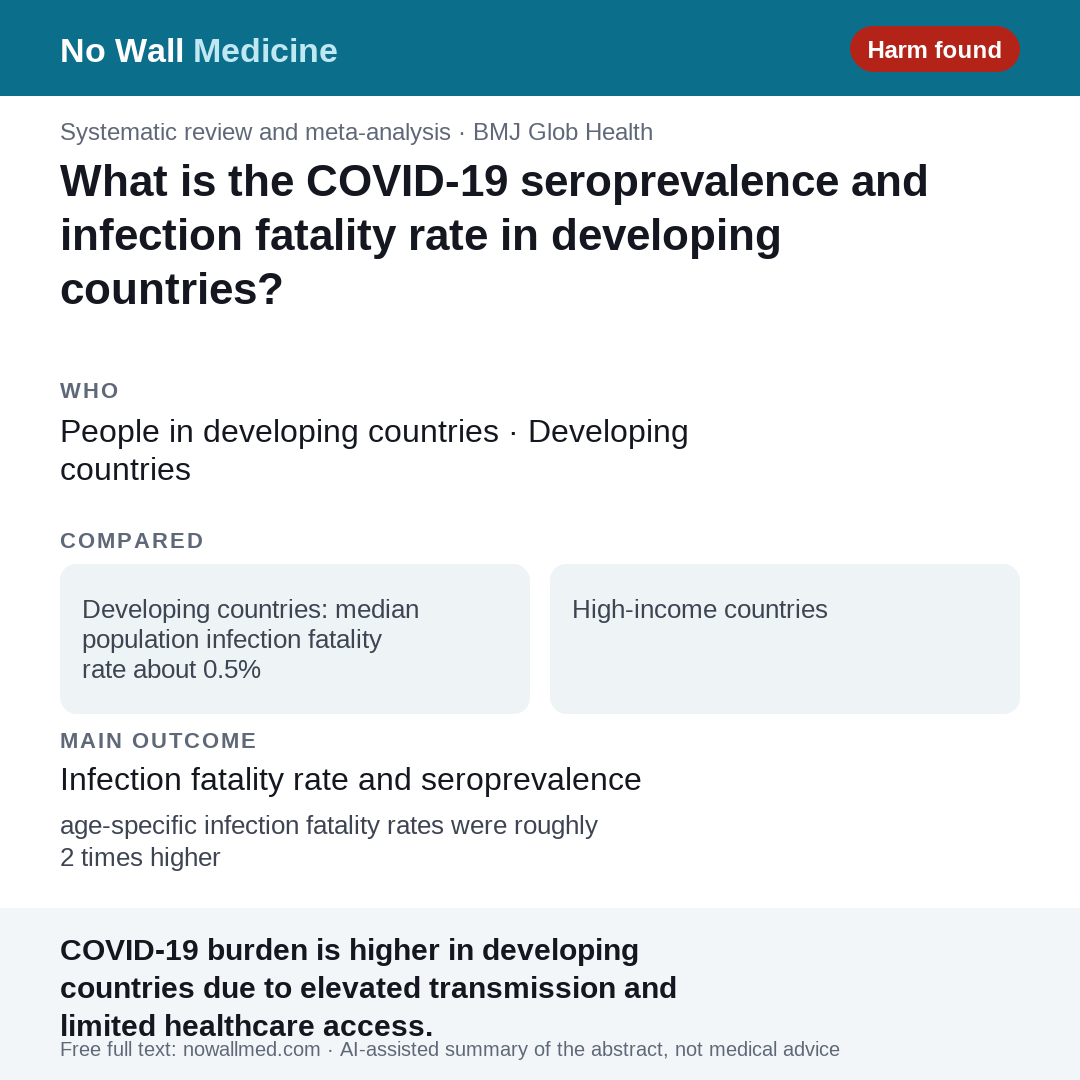
Clinical question: What is the COVID-19 seroprevalence and infection fatality rate in developing countries?
Why it matters: It was unknown if age-specific seroprevalence or infection fatality rates for COVID-19 in developing countries differed from those in high-income countries.
Key points
- Researchers performed a systematic review and meta-analysis of COVID-19 serology studies and case reports from developing countries using representative samples collected by February 2021.
- The median population infection fatality rate, which is the proportion of infected people who die, was about 0.5%, similar to high-income countries.
- Age-specific infection fatality rates were roughly 2 times higher in developing countries, while seroprevalence among older adults was similar to younger age cohorts.
Headline and key points written with AI from the paper’s abstract, with every number checked against it. Read the paper before relying on them.
Was this summary helpful?
Abstract
Introduction
The infection fatality rate (IFR) of COVID-19 has been carefully measured and analysed in high-income countries, whereas there has been no systematic analysis of age-specific seroprevalence or IFR for developing countries. Methods
We systematically reviewed the literature to identify all COVID-19 serology studies in developing countries that were conducted using representative samples collected by February 2021. For each of the antibody assays used in these serology studies, we identified data on assay characteristics, including the extent of seroreversion over time. We analysed the serology data using a Bayesian model that incorporates conventional sampling uncertainty as well as uncertainties about assay sensitivity and specificity. We then calculated IFRs using individual case reports or aggregated public health updates, including age-specific estimates whenever feasible. Results
In most locations in developing countries, seroprevalence among older adults was similar to that of younger age cohorts, underscoring the limited capacity that these nations have to protect older age groups.Age-specific IFRs were roughly 2 times higher than in high-income countries. The median value of the population IFR was about 0.5%, similar to that of high-income countries, because disparities in healthcare access were roughly offset by differences in population age structure. Conclusion
The burden of COVID-19 is far higher in developing countries than in high-income countries, reflecting a combination of elevated transmission to middle-aged and older adults as well as limited access to adequate healthcare. These results underscore the critical need to ensure medical equity to populations in developing countries through provision of vaccine doses and effective medications.
Abstract reproduced under the article’s CC BY NC licence.
Subject terms
Cite this article
Levin AT, Owusu-Boaitey N, Pugh S, Fosdick BK, Zwi AB, Malani A. Assessing the burden of COVID-19 in developing countries: systematic review, meta-analysis and public policy implications. BMJ Glob Health. 2022. doi:10.1136/bmjgh-2022-008477
Spotted a mistake? Suggest a correction
Top studies every Monday
The week’s key trials and guidelines in your specialties, plus any topics you follow. By email, free.
Get the weekly digest