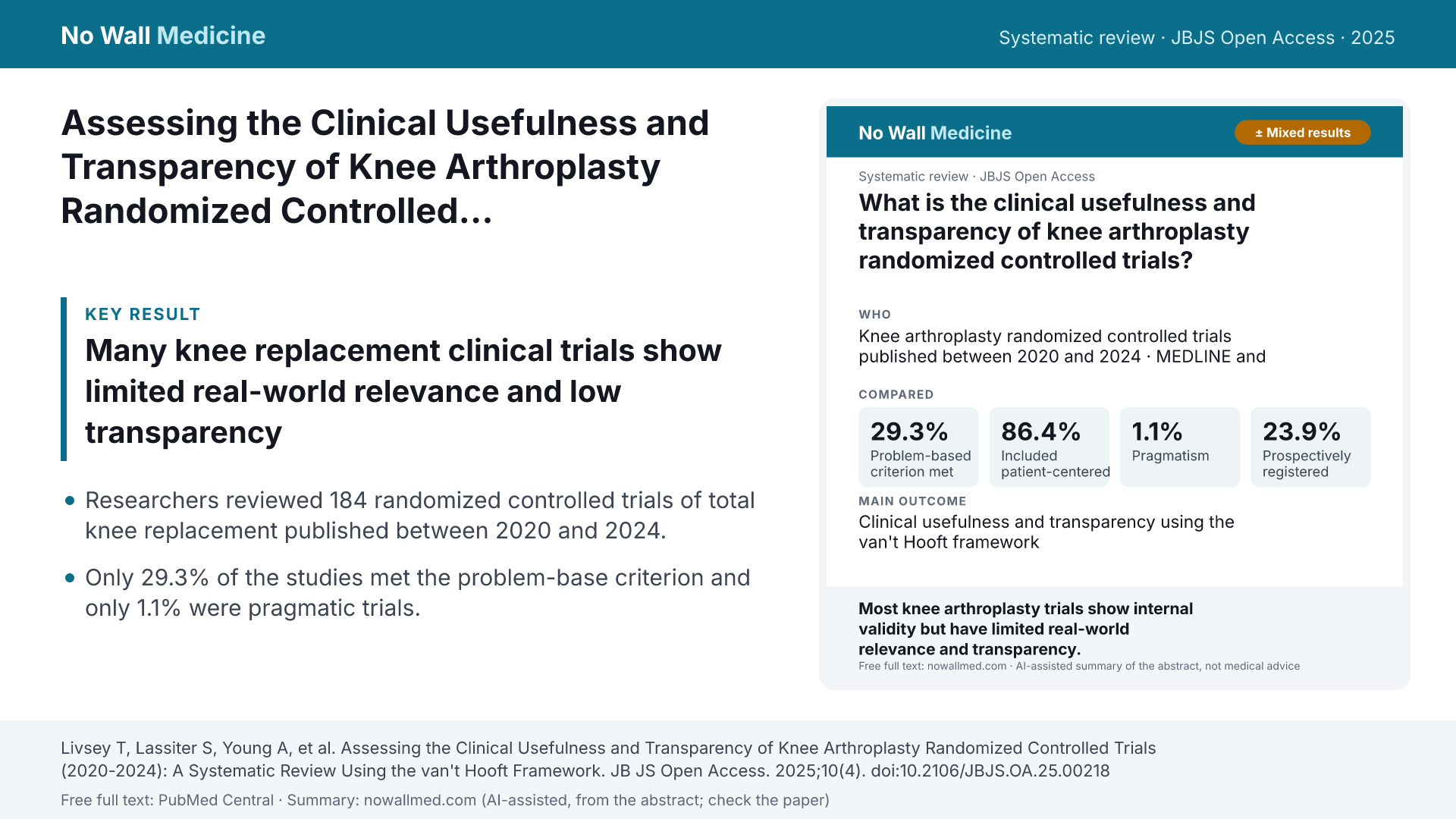
Many knee replacement clinical trials show limited real-world relevance and low transparency
Assessing the Clinical Usefulness and Transparency of Knee Arthroplasty Randomized Controlled Trials (2020-2024): A Systematic Review Using the van't Hooft Framework
Systematic reviewMixed results
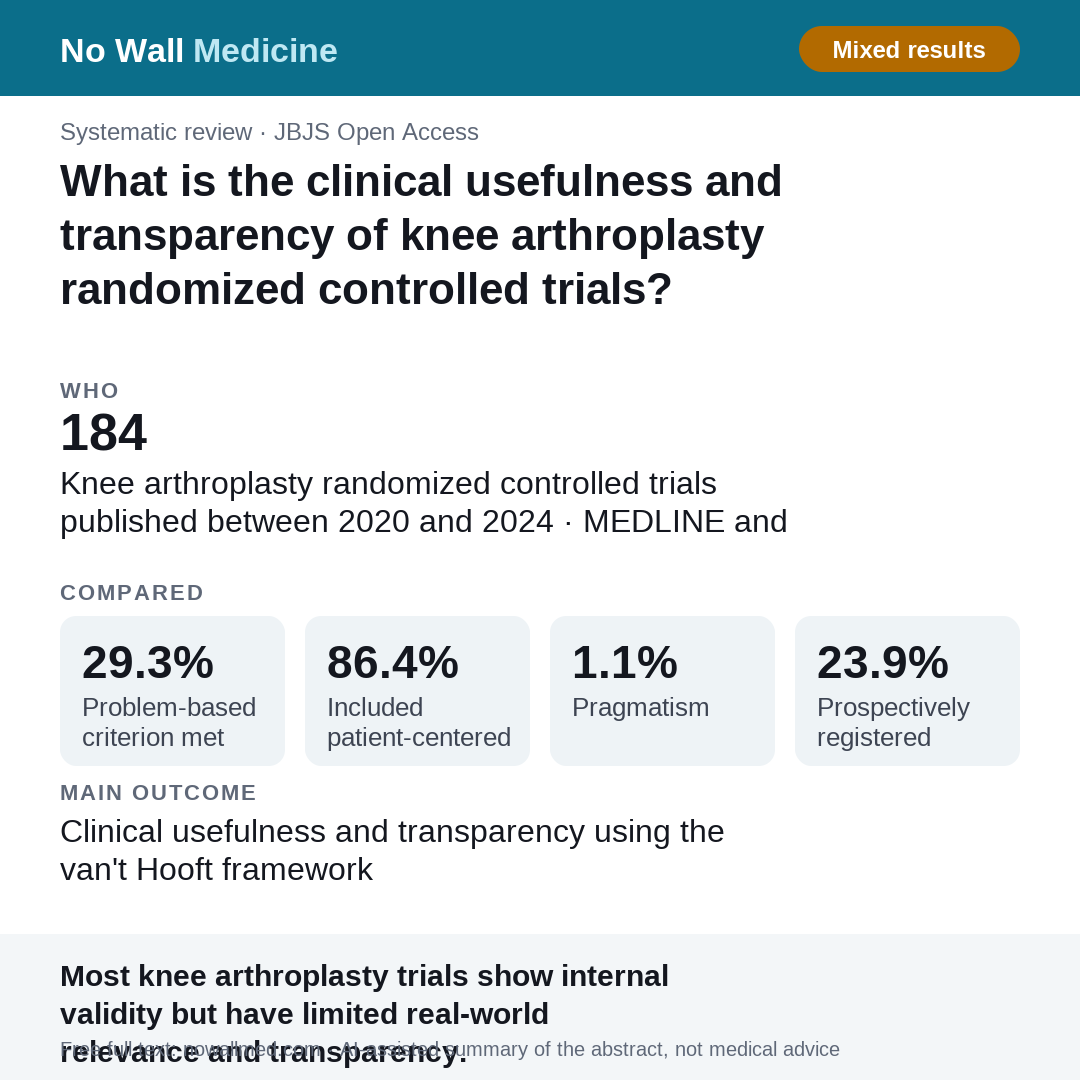
What is the clinical usefulness and transparency of knee arthroplasty randomized controlled trials?
Who
Knee arthroplasty randomized controlled trials published between 2020 and 2024 · MEDLINE and Embase
Compared
29.3%Problem-based criterion met
86.4%Included patient-centered outcomes
1.1%Pragmatism
23.9%Prospectively registered
Main outcome
Clinical usefulness and transparency using the van't Hooft framework
Result: r = 0.28, p < 0.001
Bottom line: Most knee arthroplasty trials show internal validity but have limited real-world relevance and transparency.
Limitation: Narrow eligibility, short follow-up, and poor transparency limit clinical impact.
JBJS Open Access · 2025-10-14Download image
Clinical question: What is the clinical usefulness and transparency of knee arthroplasty randomized controlled trials?
Why it matters: The clinical usefulness of randomized controlled trials for total knee replacement remains uncertain despite their importance for guiding treatment.
Key points
- Researchers reviewed 184 randomized controlled trials of total knee replacement published between 2020 and 2024.
- Only 29.3% of the studies met the problem-base criterion and only 1.1% were pragmatic trials.
- While 86.4% included patient-centered outcomes, most were secondary and only 4.9% provided raw data.
Limitation the authors note: Narrow eligibility, short follow-up, and poor transparency limit the clinical impact of these trials.
Headline and key points written with AI from the paper’s abstract, with every number checked against it. Read the paper before relying on them.
Was this summary helpful?
Cite this article
Livsey T, Lassiter S, Young A, et al. Assessing the Clinical Usefulness and Transparency of Knee Arthroplasty Randomized Controlled Trials (2020-2024): A Systematic Review Using the van't Hooft Framework. JBJS Open Access. 2025. doi:10.2106/JBJS.OA.25.00218
Spotted a mistake? Suggest a correction