Assessing whether isoniazid is essential during the first 14 days of tuberculosis therapy: a phase 2a, open-label, randomised controlled trial
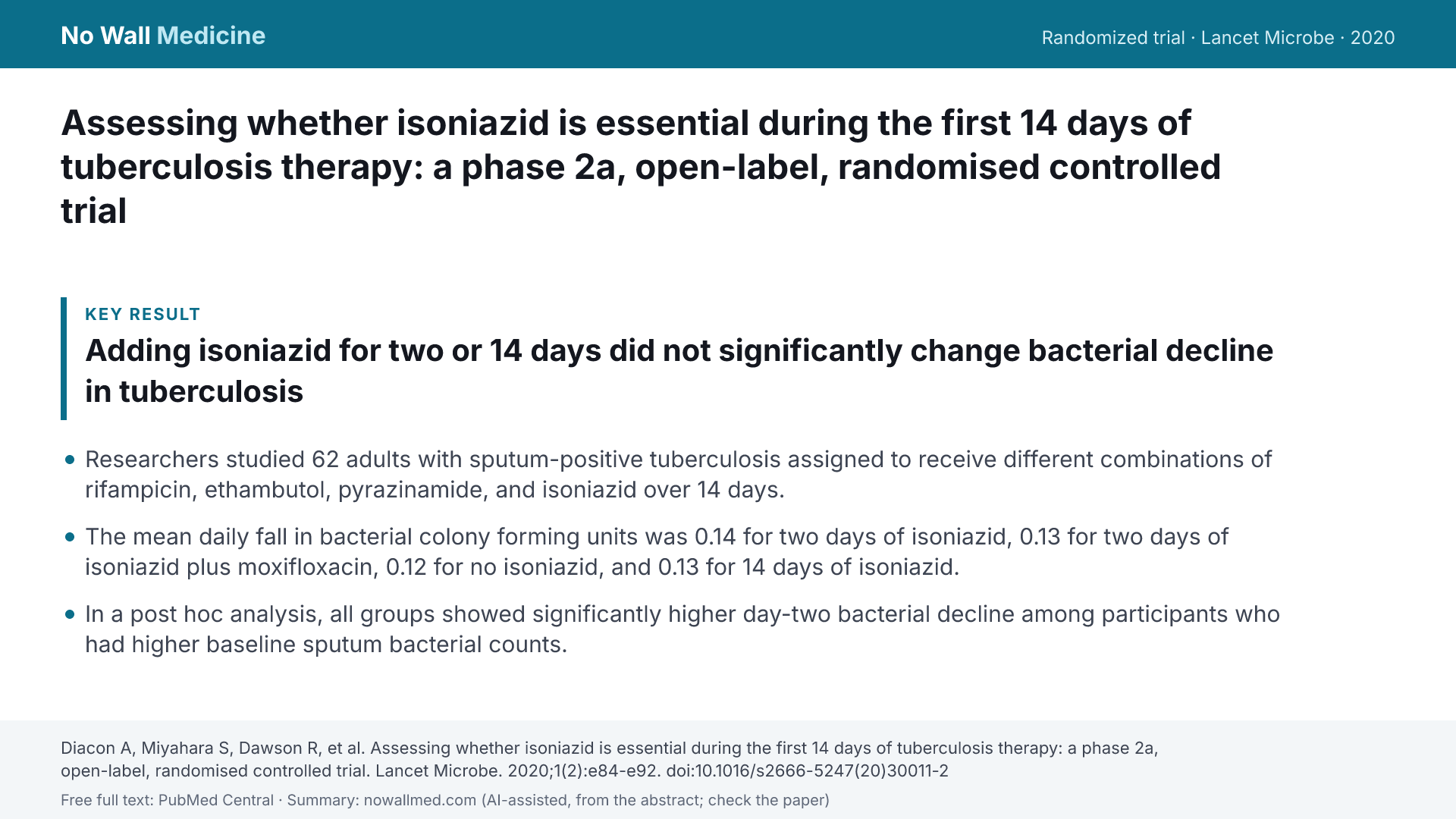
Key result: Adding isoniazid for two or 14 days did not significantly change bacterial decline in tuberculosis
Key points
- Researchers studied 62 adults with sputum-positive tuberculosis assigned to receive different combinations of rifampicin, ethambutol, pyrazinamide, and isoniazid over 14 days.
- The mean daily fall in bacterial colony forming units was 0.14 for two days of isoniazid, 0.13 for two days of isoniazid plus moxifloxacin, 0.12 for no isoniazid, and 0.13 for 14 days of isoniazid.
- In a post hoc analysis, all groups showed significantly higher day-two bacterial decline among participants who had higher baseline sputum bacterial counts.
Discussion prompts
- Would these patients look like yours? Who was left out?
- Is the main outcome one that matters to patients?
- Is the difference large enough to change what you do?
Cite: Diacon A, Miyahara S, Dawson R, et al. Assessing whether isoniazid is essential during the first 14 days of tuberculosis therapy: a phase 2a, open-label, randomised controlled trial. Lancet Microbe. 2020. doi:10.1016/s2666-5247(20)30011-2
Free full text: PubMed Central · Summary and visual abstract: nowallmed.com/a/assessing-whether-isoniazid-is-essential-during-the-first-14-days-of-uoz0te/ (AI-assisted from the abstract; check the paper before relying on it).