Assessment and diagnostic methods of internal nasal valve: Systematic review and meta-analysis
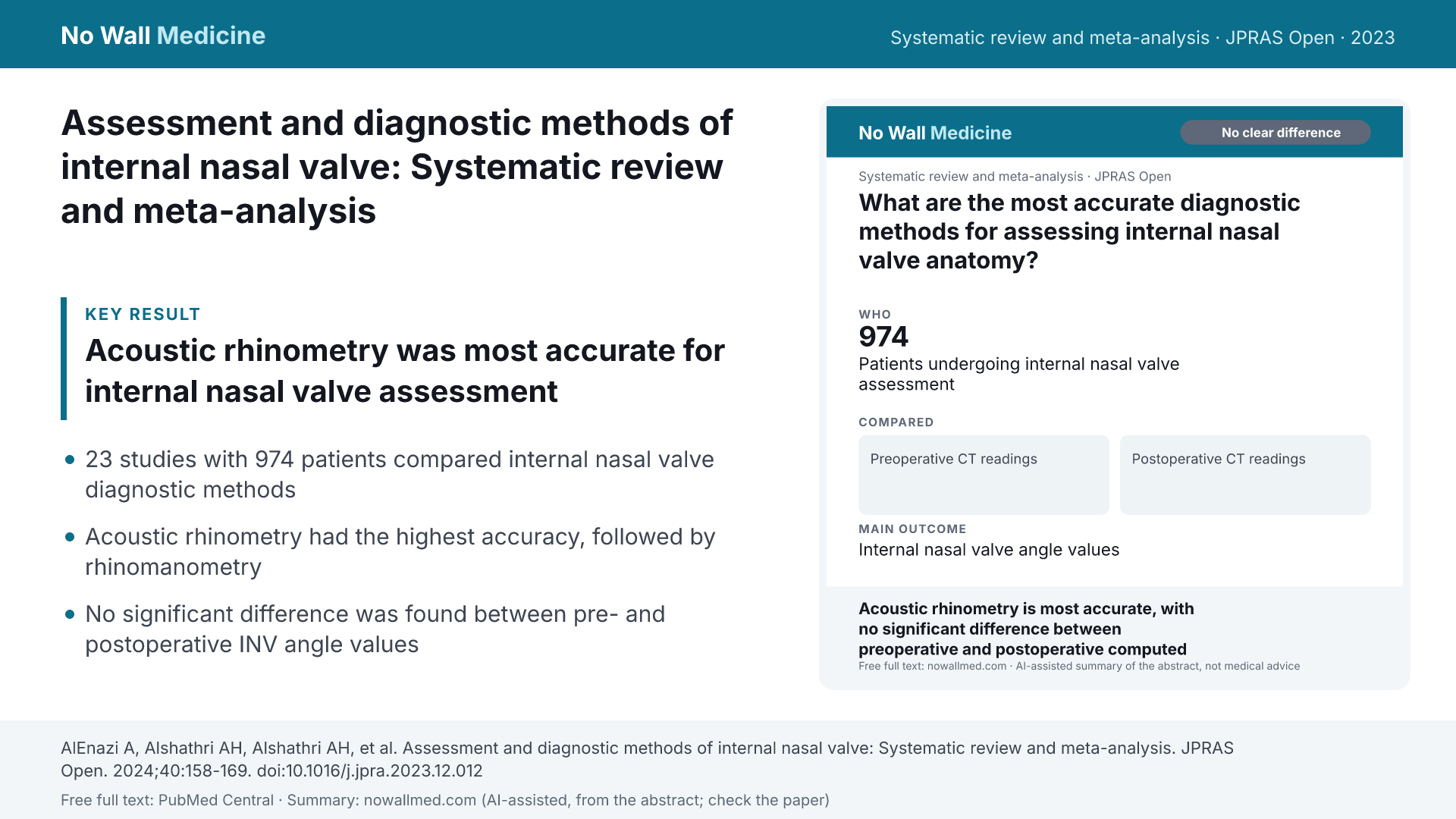
Key result: Acoustic rhinometry was most accurate for internal nasal valve assessment
Systematic review and meta-analysisNo clear difference
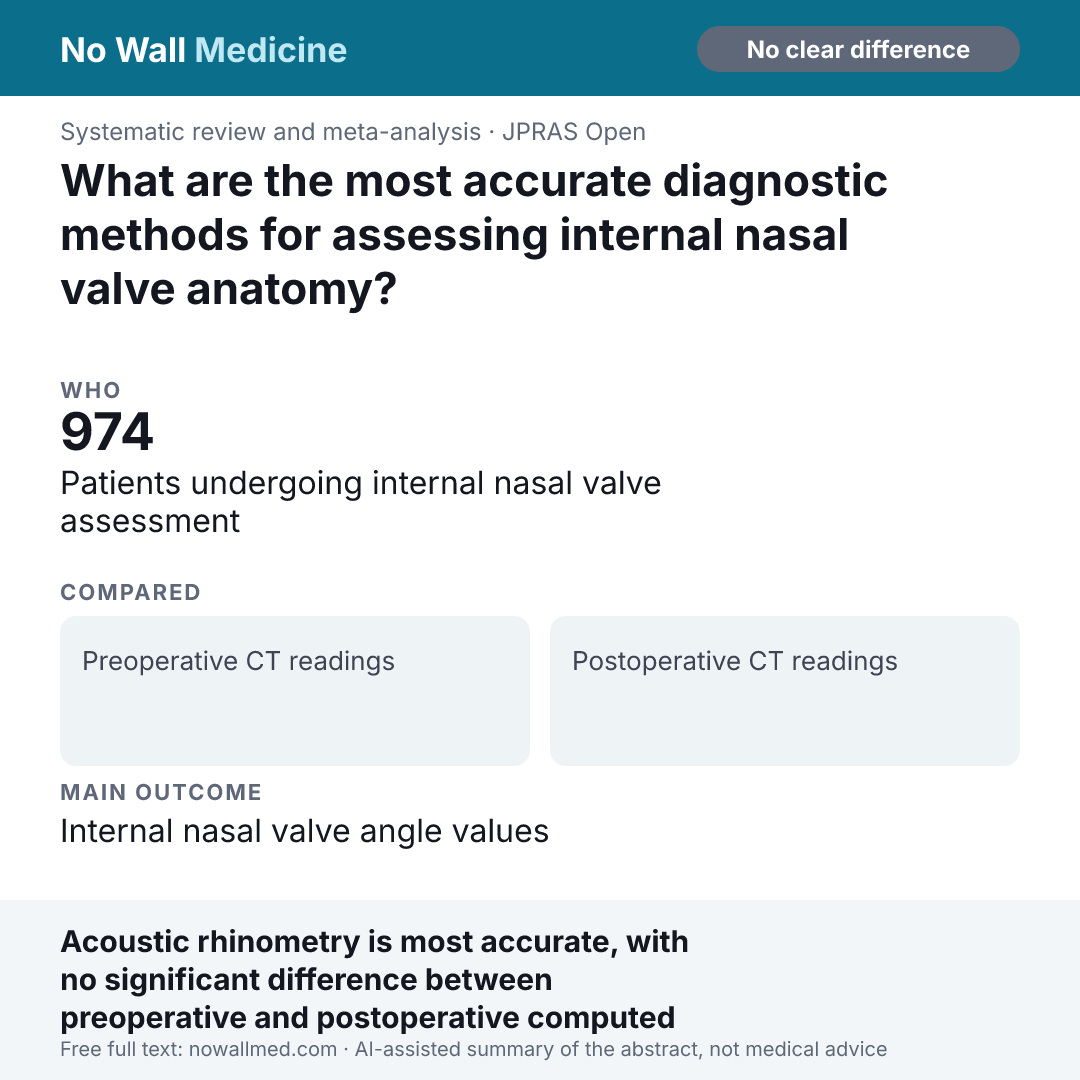
What are the most accurate diagnostic methods for assessing internal nasal valve anatomy?
Who
974
Patients undergoing internal nasal valve assessment
Compared
Preoperative CT readings
Postoperative CT readings
Main outcome
Internal nasal valve angle values
Result: mean difference -1.8 (95% CI -4.8 to 1.2)
Bottom line: Acoustic rhinometry is most accurate, with no significant difference between preoperative and postoperative computed tomography angle values.
JPRAS Open · 2023-12-23 · Save PNG
Key points
- 23 studies with 974 patients compared internal nasal valve diagnostic methods.
- Acoustic rhinometry had the highest accuracy, followed by rhinomanometry.
- No significant difference was found between pre- and postoperative INV angle values.
Discussion prompts
- Would these patients look like yours? Who was left out?
- Is the main outcome one that matters to patients?
- Is the difference large enough to change what you do?
Cite: AlEnazi A, Alshathri AH, Alshathri AH, et al. Assessment and diagnostic methods of internal nasal valve: Systematic review and meta-analysis. JPRAS Open. 2024;40:158-169. doi:10.1016/j.jpra.2023.12.012
Free full text: PubMed Central · Summary and visual abstract: nowallmed.com/a/assessment-and-diagnostic-methods-of-internal-nasal-valve-systematic-1tqq4nf/ (AI-assisted from the abstract; check the paper before relying on it).