Antihypertensive treatment was associated with increased risks of kidney injury, fainting, and low blood pressure
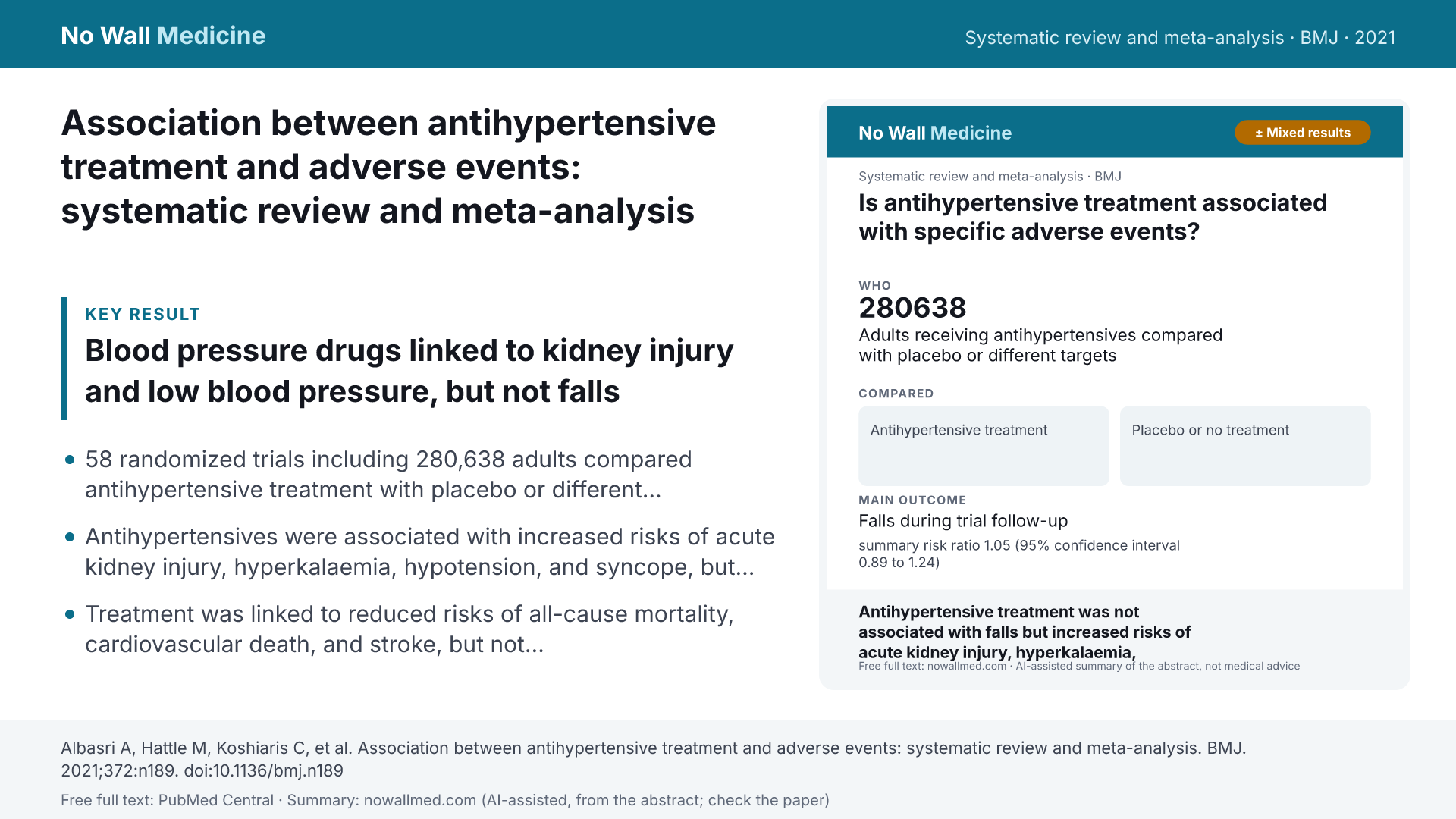
Association between antihypertensive treatment and adverse events: systematic review and meta-analysis
Systematic review and meta-analysisMixed results
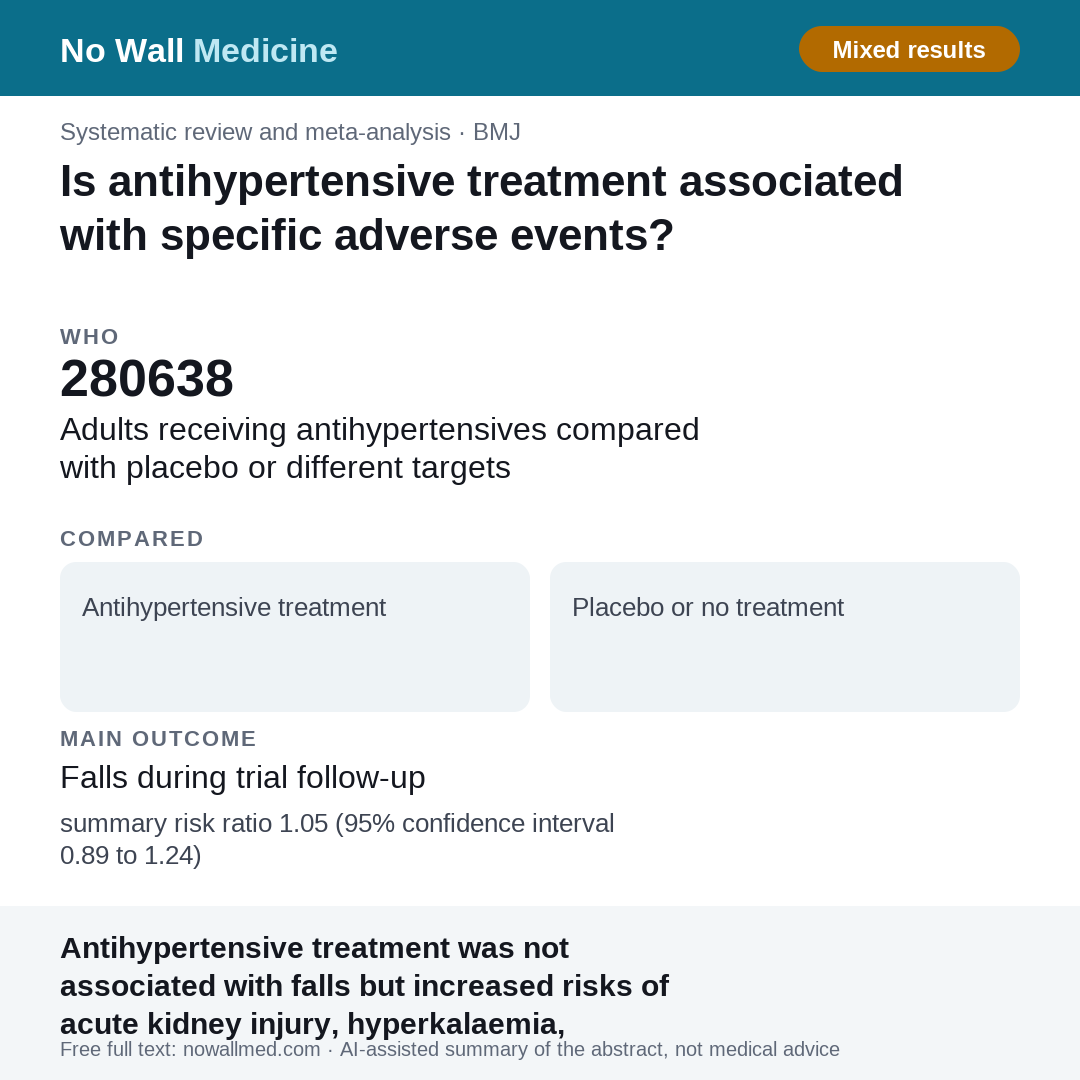
Is antihypertensive treatment associated with specific adverse events?
Who
280638
Adults receiving antihypertensives compared with placebo or different targets
Compared
Antihypertensive treatment
Placebo or no treatment
Main outcome
Falls during trial follow-up
Result: summary risk ratio 1.05 (95% confidence interval 0.89 to 1.24)
Bottom line: Antihypertensive treatment was not associated with falls but increased risks of acute kidney injury, hyperkalaemia, hypotension, and syncope.
BMJ · 2021-02-10Download image
Clinical question: Is antihypertensive treatment associated with specific adverse events?
Why it matters: The specific risks of various adverse events associated with blood pressure medication, such as falls or kidney injury, were not clearly defined.
Key points
- Researchers analyzed 58 randomized controlled trials involving 280,638 participants to examine how blood pressure medication relates to various adverse events.
- Antihypertensive treatment was associated with acute kidney injury (1.18), hyperkalaemia (1.89), hypotension (1.97), and syncope (1.28), but was not linked to falls (1.05).
- The treatment was associated with a reduced risk of all cause mortality, cardiovascular death, and stroke, but not of myocardial infarction.
Headline and key points written with AI from the paper’s abstract, with every number checked against it. Read the paper before relying on them.
Was this summary helpful?
Abstract
Objective
To examine the association between antihypertensive treatment and specific adverse events. Design
Systematic review and meta-analysis. Eligibility criteria
Randomised controlled trials of adults receiving antihypertensives compared with placebo or no treatment, more antihypertensive drugs compared with fewer antihypertensive drugs, or higher blood pressure targets compared with lower targets. To avoid small early phase trials, studies were required to have at least 650 patient years of follow-up. Information sources
Searches were conducted in Embase, Medline, CENTRAL, and the Science Citation Index databases from inception until 14 April 2020. Main outcome measures
The primary outcome was falls during trial follow-up. Secondary outcomes were acute kidney injury, fractures, gout, hyperkalaemia, hypokalaemia, hypotension, and syncope. Additional outcomes related to death and major cardiovascular events were extracted. Risk of bias was assessed using the Cochrane risk of bias tool, and random effects meta-analysis was used to pool rate ratios, odds ratios, and hazard ratios across studies, allowing for between study heterogeneity (τ2). Results
Of 15 023 articles screened for inclusion, 58 randomised controlled trials were identified, including 280 638 participants followed up for a median of 3 (interquartile range 2-4) years. Most of the trials (n=40, 69%) had a low risk of bias. Among seven trials reporting data for falls, no evidence was found of an association with antihypertensive treatment (summary risk ratio 1.05, 95% confidence interval 0.89 to 1.24, τ2=0.009). Antihypertensives were associated with an increased risk of acute kidney injury (1.18, 95% confidence interval 1.01 to 1.39, τ2=0.037, n=15), hyperkalaemia (1.89, 1.56 to 2.30, τ2=0.122, n=26), hypotension (1.97, 1.67 to 2.32, τ2=0.132, n=35), and syncope (1.28, 1.03 to 1.59, τ2=0.050, n=16). The heterogeneity between studies assessing acute kidney injury and hyperkalaemia events was reduced when focusing on drugs that affect the renin angiotensin-aldosterone system. Results were robust to sensitivity analyses focusing on adverse events leading to withdrawal from each trial. Antihypertensive treatment was associated with a reduced risk of all cause mortality, cardiovascular death, and stroke, but not of myocardial infarction. Conclusions
This meta-analysis found no evidence to suggest that antihypertensive treatment is associated with falls but found evidence of an association with mild (hyperkalaemia, hypotension) and severe adverse events (acute kidney injury, syncope). These data could be used to inform shared decision making between doctors and patients about initiation and continuation of antihypertensive treatment, especially in patients at high risk of harm because of previous adverse events or poor renal function. Registration
PROSPERO CRD42018116860.
Abstract reproduced under the article’s CC BY licence.
Subject terms
Cite this article
Albasri A, Hattle M, Koshiaris C, Dunnigan A, Paxton B, Fox SE. Association between antihypertensive treatment and adverse events: systematic review and meta-analysis. BMJ. 2021. doi:10.1136/bmj.n189
Spotted a mistake? Suggest a correction
Top studies every Monday
The week’s key trials and guidelines in your specialties, plus any topics you follow. By email, free.
Get the weekly digest