Association between bystander cardiopulmonary resuscitation initiation and patient's sex: a systematic review and meta-analysis
Systematic review and meta-analysisHarm found
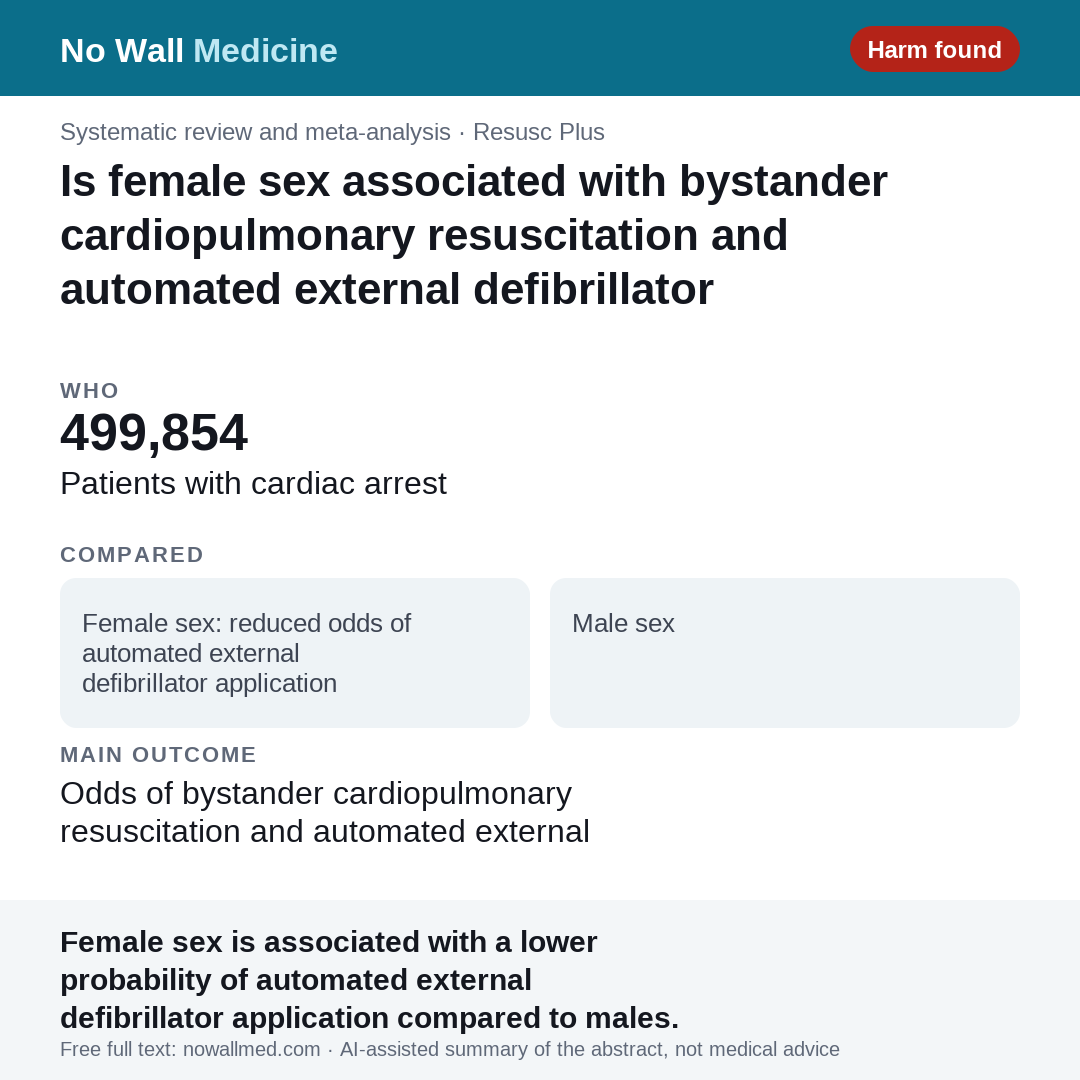
Is female sex associated with bystander cardiopulmonary resuscitation and automated external defibrillator application?
Who
499,854
Patients with cardiac arrest
Compared
Female sex: reduced odds of automated external defibrillator application
Male sex
Main outcome
Odds of bystander cardiopulmonary resuscitation and automated external defibrillator application
Result: odds ratio 0.79 (95% CI 0.66-0.94)
Bottom line: Female sex is associated with a lower probability of automated external defibrillator application compared to males.
Resusc Plus · 2025-02-28Download image
Clinical question: Is female sex associated with bystander cardiopulmonary resuscitation and automated external defibrillator application?
Abstract
Background and aim
The chain of survival, including cardiopulmonary resuscitation (CPR) and automated external defibrillation (AED), improves patients' outcomes in case of cardiac arrest. Socioeconomic status, race, and gender appear to be associated with the likelihood of receiving resuscitation. The aim of this systematic review and meta-analysis was to evaluate the association between female sex and the odds of bystander CPR initiation and AED application in patients with cardiac arrest, compared with male individuals. Methods
The protocol of this systematic review was prospectively registered in PROSPERO (CRD42024512024). PubMed, Scopus, and Cochrane were searched for studies describing the association between patient sex and the initiation of bystander CPR or the application of AED pads. Results
Fifteen observational cohort studies were included, for a total of 499,854 patients. The analysis from adjusted estimates of the primary outcome showed substantial heterogeneity (I 2 = 89%, very low certainty evidence) and was narratively summarised. Female sex was associated with reduced odds of AED pad application compared with males (OR 0.79; 95% CI 0.66-0.94; P = 0.008; I 2 = 45%; moderate certainty evidence). Conclusions
The evidence regarding the association between bystander CPR initiation and patient's sex is characterised by substantial heterogeneity. Female sex appears to be associated with a lower probability of AED pad application compared with males.
Cite this article
Catalisano G, Ippolito M, Spina N, Iozzo P, Galvano AN, Giarratano A. Association between bystander cardiopulmonary resuscitation initiation and patient's sex: a systematic review and meta-analysis. Resusc Plus. 2025. doi:10.1016/j.resplu.2025.100916
Spotted a mistake? Suggest a correction
Top studies every Monday
The week’s key trials and guidelines in your specialties, plus any topics you follow. By email, free.
Get the weekly digest