Association between cannabis use and symptom dimensions in schizophrenia spectrum disorders: an individual participant data meta-analysis on 3053 individuals
Individual participant data meta-analysisMixed results
How does cannabis use associate with schizophrenia spectrum disorder symptom dimensions?
Who
3053
Individuals with schizophrenia spectrum disorders
Compared
Cannabis use
Non-use
Main outcome
Positive and Negative Syndrome Scale subscores
Result: positive dimension aMD 0.34 (95% CI 0.03 to 0.66)
Bottom line: Cannabis use was associated with higher positive symptoms, lower negative symptoms, and higher excitement severity.
Limitation: Reported effect sizes are small and confidence intervals are wide.
Funded by: Le Vinatier Psychiatric Hospital
eClinicalMedicine · 2023-09-08Download image
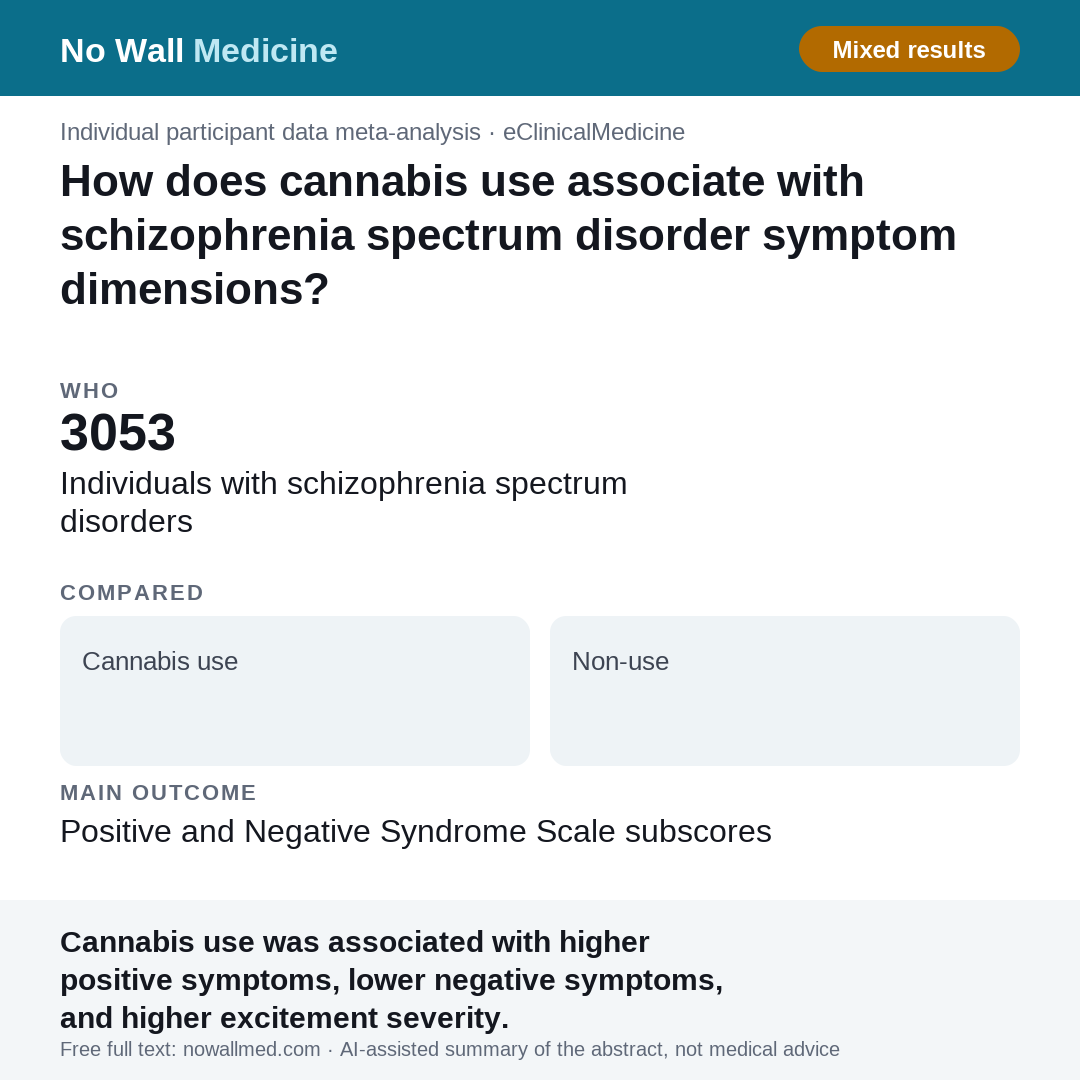
Clinical question: How does cannabis use associate with schizophrenia spectrum disorder symptom dimensions?
Abstract
Background
The association between cannabis use and positive symptoms in schizophrenia spectrum disorders is well documented, especially via meta-analyses. Yet, findings are inconsistent regarding negative symptoms, while other dimensions such as disorganization, depression, and excitement, have not been investigated. In addition, meta-analyses use aggregated data discarding important confounding variables which is a source of bias. Methods
PubMed, ScienceDirect and PsycINFO were used to search for publications from inception to September 27, 2022. We contacted the authors of relevant studies to extract raw datasets and perform an Individual Participant Data meta-analysis (IPDMA). Inclusion criteria were: psychopathology of individuals with schizophrenia spectrum disorders assessed by the Positive and Negative Syndrome Scale (PANSS); cannabis-users had to either have a diagnosis of cannabis use disorder or use cannabis at least twice a week. The main outcomes were the PANSS subscores extracted via the 3-factor (positive, negative and general) and 5-factor (positive, negative, disorganization, depression, excitement) structures. Preregistration is accessible via Prospero: ID CRD42022329172. Findings
Among the 1149 identified studies, 65 were eligible and 21 datasets were shared, totaling 3677 IPD and 3053 complete cases. The adjusted multivariate analysis revealed that relative to non-use, cannabis use was associated with higher severity of positive dimension (3-factor: Adjusted Mean Difference, aMD = 0.34, 95% Confidence Interval, CI = [0.03; 0.66]; 5-factor: aMD = 0.38, 95% CI = [0.08; 0.63]), lower severity of negative dimension (3-factor: aMD = -0.49, 95% CI [-0.90; -0.09]; 5-factor: aMD = -0.50, 95% CI = [-0.91; -0.08]), higher severity of excitement dimension (aMD = 0.16, 95% CI = [0.03; 0.28]). No association was found between cannabis use and disorganization (aMD = -0.13, 95% CI = [-0.42; 0.17]) or depression (aMD = -0.14, 95% CI = [-0.34; 0.06]). Interpretation
No causal relationship can be inferred from the current results. The findings could be in favor of both a detrimental and beneficial effect of cannabis on positive and negative symptoms, respectively. Longitudinal designs are needed to understand the role of cannabis is this association. The reported effect sizes are small and CIs are wide, the interpretation of findings should be taken with caution. Funding
This research did not receive any specific grant or funding. Primary financial support for authors was provided by Le Vinatier Psychiatric Hospital.
Cite this article
Argote M, Sescousse G, Brunelin J, Baudin G, Schaub MP, Rabin R. Association between cannabis use and symptom dimensions in schizophrenia spectrum disorders: an individual participant data meta-analysis on 3053 individuals. eClinicalMedicine. 2023. doi:10.1016/j.eclinm.2023.102199
Spotted a mistake? Suggest a correction
Top studies every Monday
The week’s key trials and guidelines in your specialties, plus any topics you follow. By email, free.
Get the weekly digest