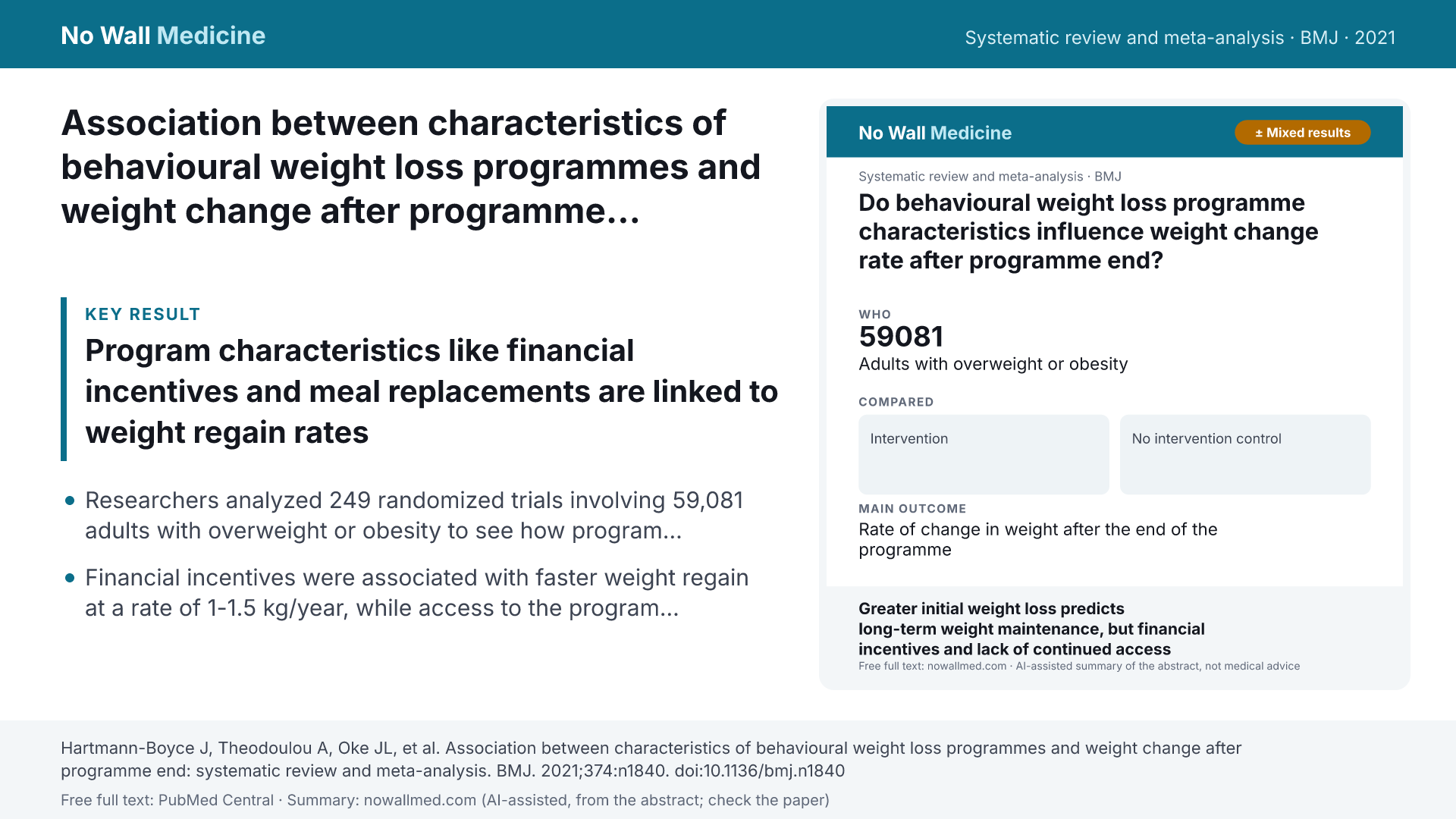
Program characteristics like financial incentives and meal replacements are linked to weight regain rates
Association between characteristics of behavioural weight loss programmes and weight change after programme end: systematic review and meta-analysis
Systematic review and meta-analysisMixed results
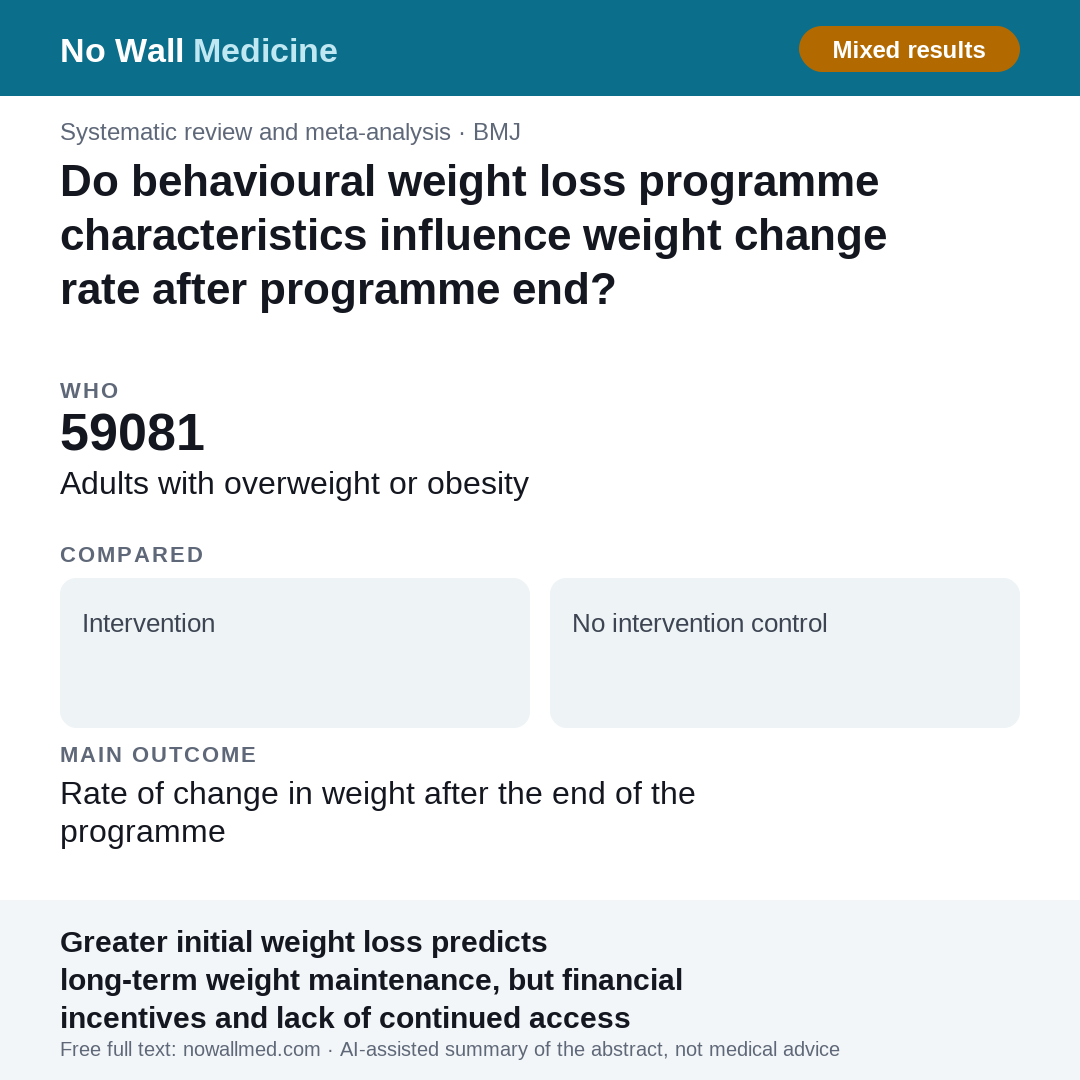
Do behavioural weight loss programme characteristics influence weight change rate after programme end?
Who
59081
Adults with overweight or obesity
Compared
Intervention
No intervention control
Main outcome
Rate of change in weight after the end of the programme
Result: 0.12-0.32 kg/year
Bottom line: Greater initial weight loss predicts long-term weight maintenance, but financial incentives and lack of continued access predict faster regain.
Limitation: Data were limited after five years after the end of the programme.
BMJ · 2021-08-17Download image
Clinical question: Do behavioural weight loss programme characteristics influence weight change rate after programme end?
Why it matters: It is unknown how specific features of behavioral weight loss programs influence the speed at which participants regain weight after their intervention ends.
Key points
- Researchers analyzed 249 randomized trials involving 59,081 adults with overweight or obesity to see how program features affect weight change after a program ends.
- Financial incentives were associated with faster weight regain at a rate of 1-1.5 kg/year, while access to the program outside the study was associated with slower regain.
- Each kilogram of weight lost during the program was associated with faster regain at a rate of 0.13-0.19 kg/year, though initial loss still related to lower weight for five years.
Limitation the authors note: The authors noted that 56% of the studies had an unclear risk of bias, 21% had a low risk, and 23% had a high risk of bias.
Headline and key points written with AI from the paper’s abstract, with every number checked against it. Read the paper before relying on them.
Was this summary helpful?
Abstract
Objective
To determine if the characteristics of behavioural weight loss programmes influence the rate of change in weight after the end of the programme. Design
Systematic review and meta-analysis. Data sources
Trial registries, 11 electronic databases, and forward citation searching (from database inception; latest search December 2019). Randomised trials of behavioural weight loss programmes in adults with overweight or obesity, reporting outcomes at ≥12 months, including at the end of the programme and after the end of the programme. Review methods
Studies were screened by two independent reviewers with discrepancies resolved by discussion. 5% of the studies identified in the searches met the inclusion criteria. One reviewer extracted the data and a second reviewer checked the data. Risk of bias was assessed with Cochrane's risk of bias tool (version 1). The rate of change in weight was calculated (kg/month; converted to kg/year for interpretability) after the end of the programme in the intervention versus control groups by a mixed model with a random intercept. Associations between the rate of change in weight and prespecified variables were tested. Results
Data were analysed from 249 trials (n=59 081) with a mean length of follow-up of two years (longest 30 years). 56% of studies (n=140) had an unclear risk of bias, 21% (n=52) a low risk, and 23% (n=57) a high risk of bias. Regain in weight was faster in the intervention versus the no intervention control groups (0.12-0.32 kg/year) but the difference between groups was maintained for at least five years. Each kilogram of weight lost at the end of the programme was associated with faster regain in weight at a rate of 0.13-0.19 kg/year. Financial incentives for weight loss were associated with faster regain in weight at a rate of 1-1.5 kg/year. Compared with programmes with no meal replacements, interventions involving partial meal replacements were associated with faster regain in weight but not after adjustment for weight loss during the programme. Access to the programme outside of the study was associated with slower regain in weight. Programmes where the intensity of the interaction reduced gradually were also associated with slower regain in weight in the multivariable analysis, although the point estimate suggested that the association was small. Other characteristics did not explain the heterogeneity in regain in weight. Conclusion
Faster regain in weight after weight loss was associated with greater initial weight loss, but greater initial weight loss was still associated with reduced weight for at least five years after the end of the programme, after which data were limited. Continued availability of the programme to participants outside of the study predicted a slower regain in weight, and provision of financial incentives predicted faster regain in weight; no other clear associations were found. Study registration
PROSPERO CRD42018105744.
Abstract reproduced under the article’s CC BY NC licence.
Subject terms
Cite this article
Hartmann-Boyce J, Theodoulou A, Oke JL, Butler AR, Scarborough P, Bastounis A. Association between characteristics of behavioural weight loss programmes and weight change after programme end: systematic review and meta-analysis. BMJ. 2021. doi:10.1136/bmj.n1840
Spotted a mistake? Suggest a correction