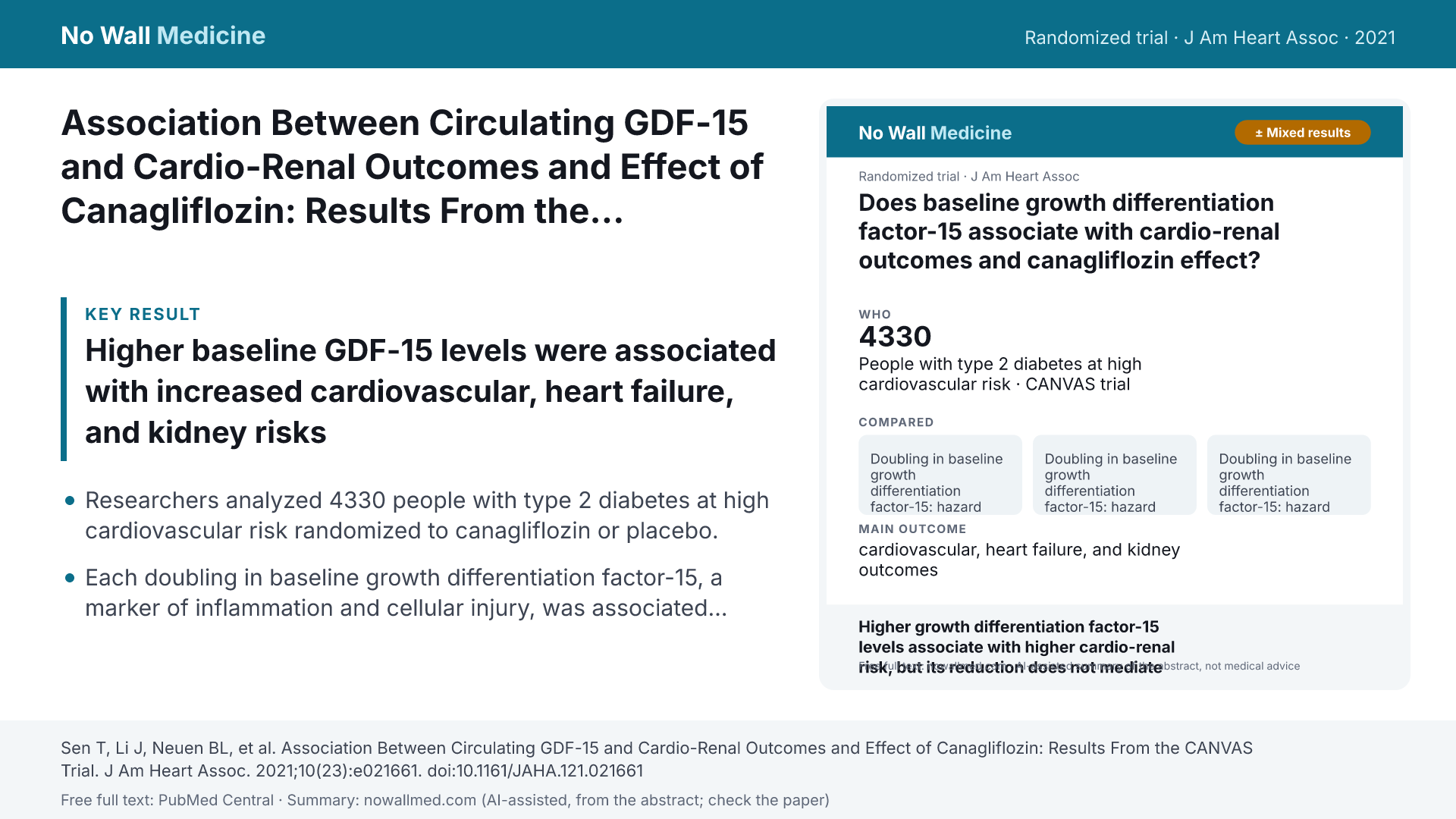
Higher baseline GDF-15 levels were associated with increased cardiovascular, heart failure, and kidney risks
Association Between Circulating GDF-15 and Cardio-Renal Outcomes and Effect of Canagliflozin: Results From the CANVAS Trial
Randomized trialMixed results
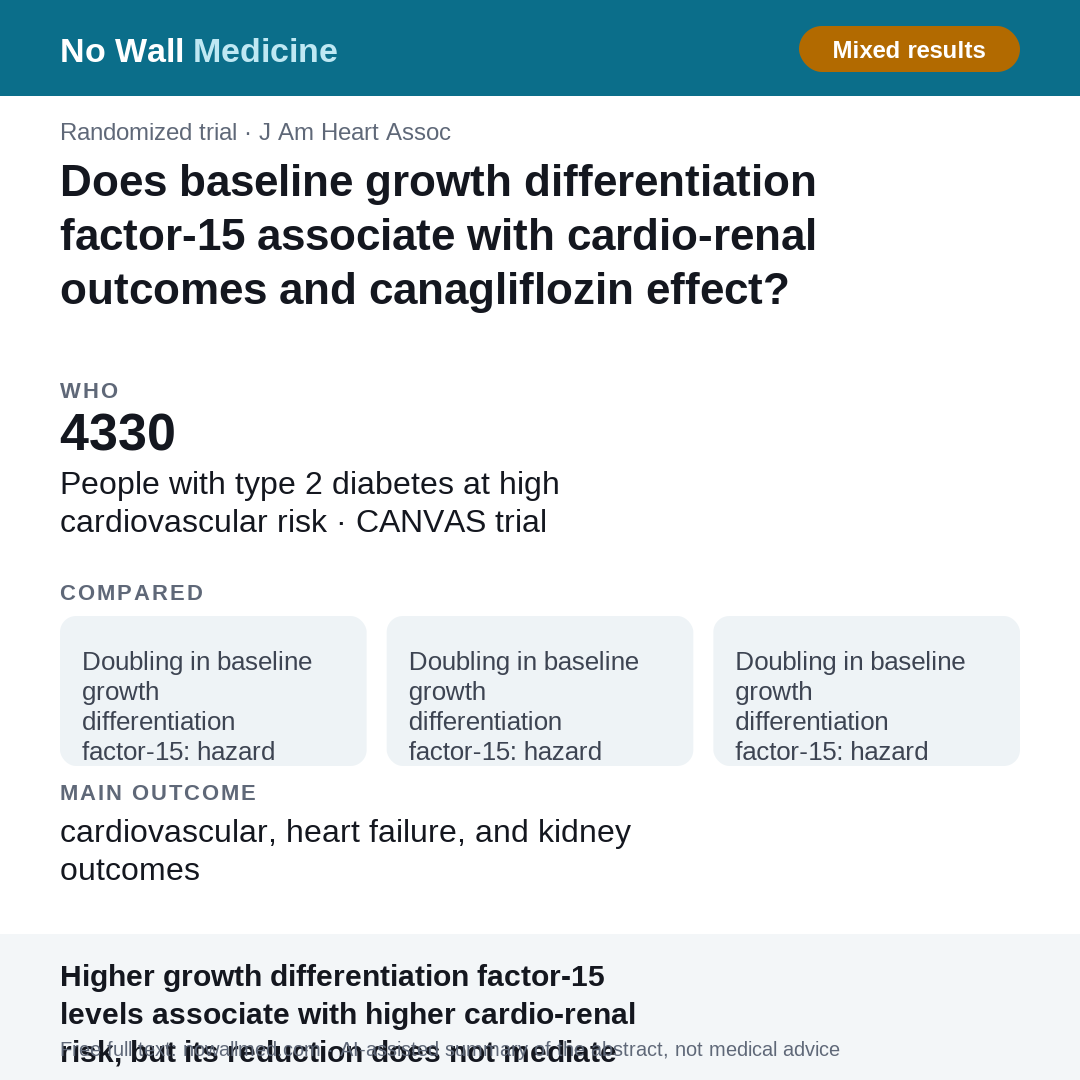
Does baseline growth differentiation factor-15 associate with cardio-renal outcomes and canagliflozin effect?
Who
4330
People with type 2 diabetes at high cardiovascular risk · CANVAS trial
Compared
Doubling in baseline growth differentiation factor-15: hazard ratio 1.2 (95% CI, 1.0‒1.3) for cardiovascular outcomes
Doubling in baseline growth differentiation factor-15: hazard ratio 1.5 (95% CI, 1.2‒2.0) for heart failure
Doubling in baseline growth differentiation factor-15: hazard ratio 1.5 (95% CI, 1.2‒2.0) for kidney outcomes
Main outcome
cardiovascular, heart failure, and kidney outcomes
Result: hazard ratio 1.2 (95% CI, 1.0‒1.3)
Bottom line: Higher growth differentiation factor-15 levels associate with higher cardio-renal risk, but its reduction does not mediate canagliflozin's protective effects.
Limitation: Analysis limited to 3549 participants with available samples
J Am Heart Assoc · 2021-12-02Download image
Clinical question: Does baseline growth differentiation factor-15 associate with cardio-renal outcomes and canagliflozin effect?
Why it matters: It was unknown if the inflammation marker growth differentiation factor-15 is associated with cardio-renal outcomes or if canagliflozin works through this specific pathway.
Key points
- Researchers analyzed 4330 people with type 2 diabetes at high cardiovascular risk randomized to canagliflozin or placebo.
- Each doubling in baseline growth differentiation factor-15, a marker of inflammation and cellular injury, was associated with a higher risk of cardiovascular (HR, 1.2), heart failure (HR, 1.5), and kidney (HR, 1.5) outcomes.
- Canagliflozin treatment modestly lowered growth differentiation factor-15, but this change did not mediate the drug's protective effects.
Headline and key points written with AI from the paper’s abstract, with every number checked against it. Read the paper before relying on them.
Was this summary helpful?
Subject terms
Cite this article
Sen T, Li J, Neuen BL, et al. Association Between Circulating GDF-15 and Cardio-Renal Outcomes and Effect of Canagliflozin: Results From the CANVAS Trial. J Am Heart Assoc. 2021. doi:10.1161/JAHA.121.021661
Spotted a mistake? Suggest a correction