Financial conflicts of interest were associated with more favourable medical recommendations in various professional documents
Association between conflicts of interest and favourable recommendations in clinical guidelines, advisory committee reports, opinion pieces, and narrative reviews: systematic review
Systematic reviewBenefit found
Are conflicts of interest associated with favourable recommendations in medical documents?
Who
Clinical guidelines, advisory committee reports, opinion pieces, and narrative reviews
Compared
Documents with financial conflicts of interest
Documents with no conflicts of interest
Main outcome
Favourable recommendations of drugs or devices
Result: relative risk 1.26 (95% confidence interval 1.09 to 1.44)
Bottom line: Financial conflicts of interest are associated with favourable recommendations in clinical guidelines, advisory committee reports, opinion pieces, and narrative reviews.
Limitation: Risk of confounding in included studies and statistical imprecision of individual analyses.
BMJ · 2020-12-09Download image
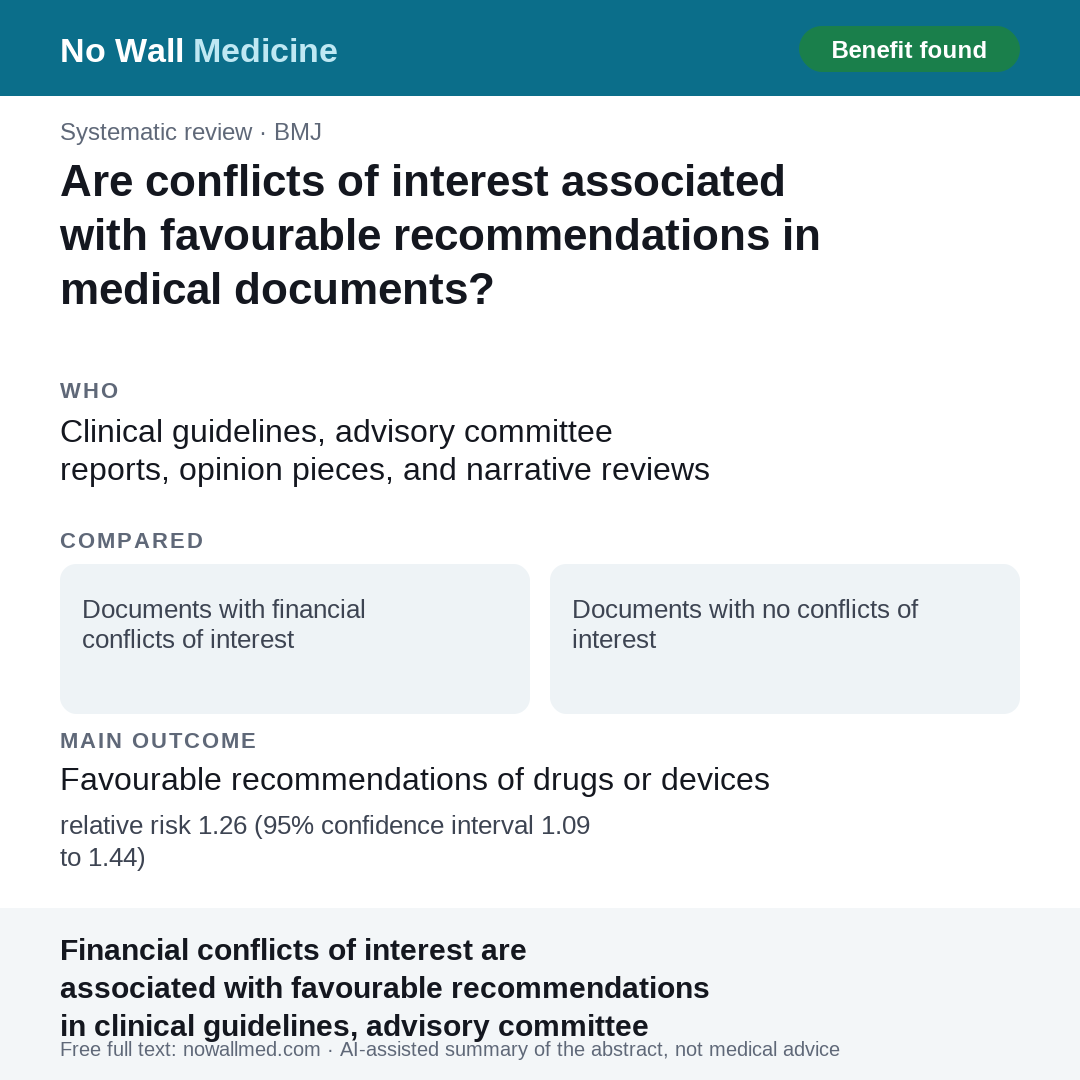
Clinical question: Are conflicts of interest associated with favourable recommendations in medical documents?
Why it matters: It was unknown if financial conflicts of interest are associated with more favourable recommendations for drugs or devices in clinical guidelines and other medical documents.
Key points
- Researchers analyzed 21 studies involving 106 clinical guidelines, 1809 advisory committee reports, 340 opinion pieces, and 497 narrative reviews.
- When combining all document types, financial conflicts of interest were associated with a relative risk of 1.26 for favourable recommendations.
- Individual analyses for clinical guidelines, advisory committee reports, opinion pieces, and narrative reviews showed similar trends but lacked statistical significance.
Limitation the authors note: The review was limited by the risk of confounding in included studies and statistical imprecision in individual analyses of each document type.
Headline and key points written with AI from the paper’s abstract, with every number checked against it. Read the paper before relying on them.
Was this summary helpful?
Abstract
Objective
To investigate the association between conflicts of interest and favourable recommendations in clinical guidelines, advisory committee reports, opinion pieces, and narrative reviews. Design
Systematic review. Eligibility criteria
Studies that compared the association between conflicts of interest and favourable recommendations of drugs or devices (eg, recommending a drug) in clinical guidelines, advisory committee reports, opinion pieces (eg, editorials), or narrative reviews. Data sources
PubMed, Embase, Cochrane Methodology Register (from inception to February 2020), reference lists, Web of Science, and grey literature. Data extraction and analysis
Two authors independently extracted data and assessed the methodological quality of the studies. Pooled relative risks and 95% confidence intervals were estimated using random effects models (relative risk >1 indicates that documents with conflicts of interest more often had favourable recommendations than documents with no conflicts of interest). Financial and non-financial conflicts of interest were analysed separately, and the four types of documents were analysed separately (preplanned) and combined (post hoc). Results
21 studies that analysed 106 clinical guidelines, 1809 advisory committee reports, 340 opinion pieces, and 497 narrative reviews were included. Unpublished data were received for 11 studies (eight full datasets and three summary datasets). 15 studies showed risk of confounding because the compared documents could differ in factors other than conflicts of interest (eg, different drugs used for different populations). The relative risk for associations between financial conflicts of interest and favourable recommendations for clinical guidelines was 1.26 (95% confidence interval 0.93 to 1.69; four studies of 86 clinical guidelines), for advisory committee reports was 1.20 (0.99 to 1.45; four studies of 629 advisory committee reports), for opinion pieces was 2.62 (0.91 to 7.55; four studies of 284 opinion pieces), and for narrative reviews was 1.20 (0.97 to 1.49; four studies of 457 narrative reviews). An analysis of all four types of documents combined supported these findings (1.26, 1.09 to 1.44). In one study that investigated specialty interests, the association between including radiologists as authors of guidelines and recommending routine breast cancer was: relative risk 2.10, 95% confidence interval 0.92 to 4.77; 12 clinical guidelines). Conclusions
We interpret our findings to indicate that financial conflicts of interest are associated with favourable recommendations of drugs and devices in clinical guidelines, advisory committee reports, opinion pieces, and narrative reviews. Limitations of this review were risk of confounding in the included studies and the statistical imprecision of individual analyses of each document type. It is not certain whether non-financial conflicts of interest influence recommendations. Systematic review registration
Cochrane Methodology Review Protocol MR000040.
Abstract reproduced under the article’s CC BY NC licence.
Subject terms
Cite this article
Nejstgaard CH, Bero L, Hróbjartsson A, Jørgensen AW, Jørgensen KJ, Le M. Association between conflicts of interest and favourable recommendations in clinical guidelines, advisory committee reports, opinion pieces, and narrative reviews: systematic review. BMJ. 2020. doi:10.1136/bmj.m4234
Spotted a mistake? Suggest a correction
Top studies every Monday
The week’s key trials and guidelines in your specialties, plus any topics you follow. By email, free.
Get the weekly digest