Fluid overload was associated with higher mortality and longer hospital stays in children with sepsis
Association between fluid overload and mortality in children with sepsis: a systematic review and meta-analysis
Systematic review and meta-analysisHarm found
Is fluid overload associated with mortality in children with sepsis?
Who
2312
Children with sepsis and more than 10% fluid overload
Compared
46%Children with fluid overload
26%Patients without overload
Main outcome
Mortality
Result: odds ratio 5.06 (95% CI 1.77 to 14.48)
Bottom line: Fluid overload is associated with higher mortality, mechanical ventilation, and longer hospital stays in children with sepsis.
Limitation: All included studies were observational.
BMJ Paediatr Open · 2023-11-22Download image
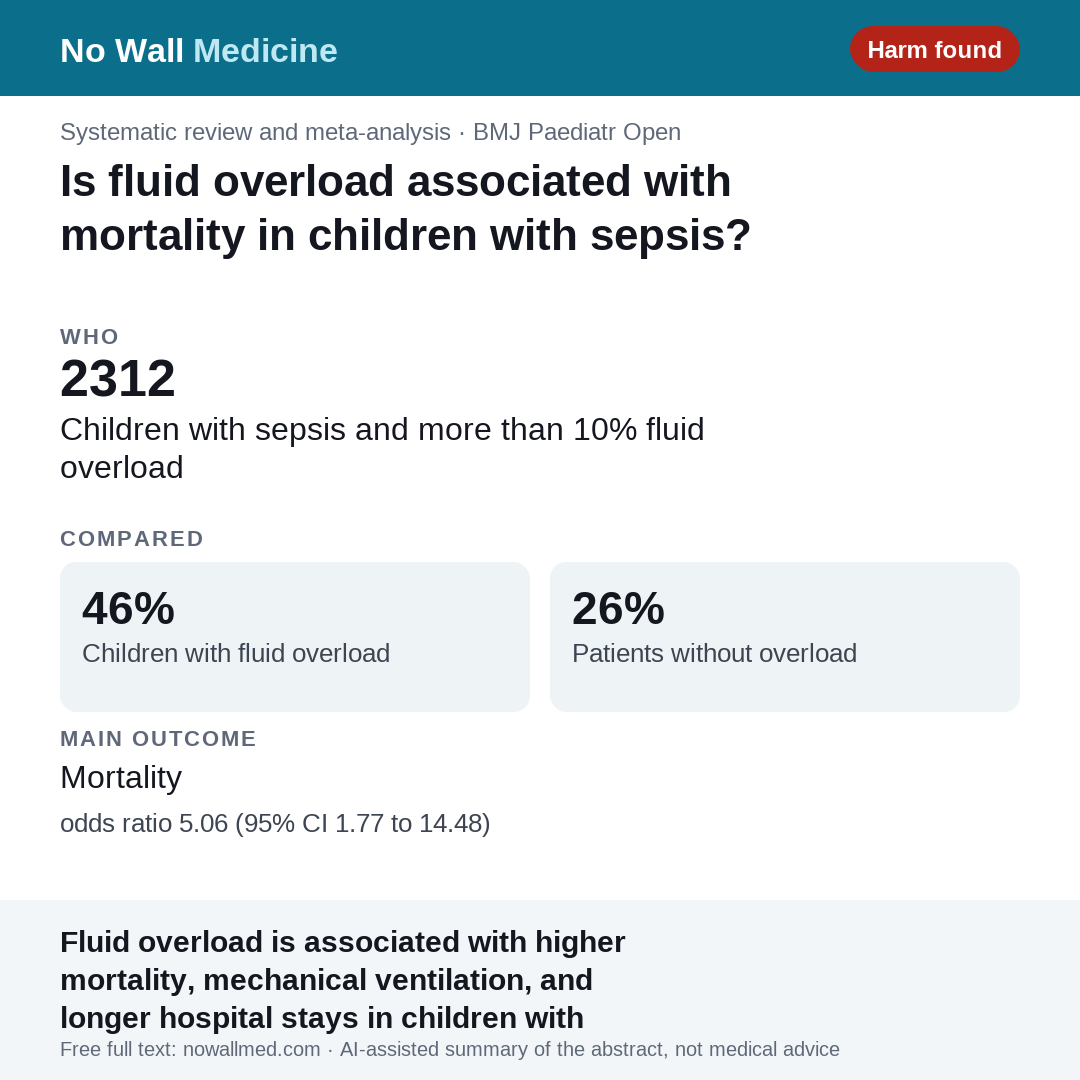
Clinical question: Is fluid overload associated with mortality in children with sepsis?
Why it matters: It was unknown how fluid overload, which can occur during fluid resuscitation, is associated with mortality and other complications in children with sepsis.
Key points
- Researchers analyzed 9 observational studies involving 2312 children to examine how fluid overload, defined as more than 10% excess fluid 24 hours after intensive care admission, relates to health outcomes.
- Children with fluid overload had a higher mortality rate of 46% compared to 26% in those without overload, and required mechanical ventilation more often at 83% versus 47%.
- Fluid overload was associated with a longer hospital stay of 8 days compared to 7 days, but was not linked to the risk of multiple organ dysfunction syndrome.
Limitation the authors note: All included studies were observational.
Headline and key points written with AI from the paper’s abstract, with every number checked against it. Read the paper before relying on them.
Abstract
Background
Sepsis is one of the main causes of morbidity and mortality worldwide. Fluid resuscitation is among the most common interventions and is associated with fluid overload (FO) in some patients. The objective of this systematic review and meta-analysis was to summarise the available evidence on the association between FO and morbimortality in children with sepsis. Methods
A systematic search was carried out in PubMed/Medline, Embase, Cochrane and Google Scholar up to December 2022 (PROSPERO 408148), including studies in children with sepsis which reported more than 10% FO 24 hours after admission to intensive care. The risk of bias was assessed using the Newcastle-Ottawa scale. Heterogeneity was assessed using I2, considering it absent if <25% and high if >75%. A sensitivity analysis was run to explore the impact of the methodological quality on the size of the effect. Mantel-Haenszel's model of random effects was used for the analysis. The primary outcome was to determine the risk of mortality associated with FO and the secondary outcomes were the need for mechanical ventilation (MV), multiple organ dysfunction syndrome (MODS) and length of hospital stay associated with FO. Results
A total of 9 studies (2312 patients) were included, all of which were observational. Children with FO had a higher mortality than patients without overload (46% vs 26%; OR 5.06; 95% CI 1.77 to 14.48; p<0.01). We found no association between %FO and the risk of MODS (OR: 0.97; 95% CI 0.13 to 7.12; p=0.98). Children with FO required MV more often (83% vs 47%; OR: 4.78; 95% CI 2.51 to 9.11; p<0.01) and had a longer hospital stay (8 days (RIQ 6.5-13.2) vs 7 days (RIQ 6.1-11.5); p<0.01). Conclusion
In children with sepsis, more than 10% FO 24 hours after intensive care admission is associated with higher mortality, the need for MV and length of hospital stay.
Abstract reproduced under the article’s CC BY NC licence.
Topics
Cite this article
Fernández-Sarmiento J, Sierra-Zuñiga MF, Salazar González MP, Lucena N, Soares Lanziotti V, Agudelo S. Association between fluid overload and mortality in children with sepsis: a systematic review and meta-analysis. BMJ Paediatr Open. 2023. doi:10.1136/bmjpo-2023-002094
Spotted a mistake? Suggest a correction
Top studies every Monday
The week’s key trials and guidelines in your specialties, plus any topics you follow. By email, free.
Get the weekly digest