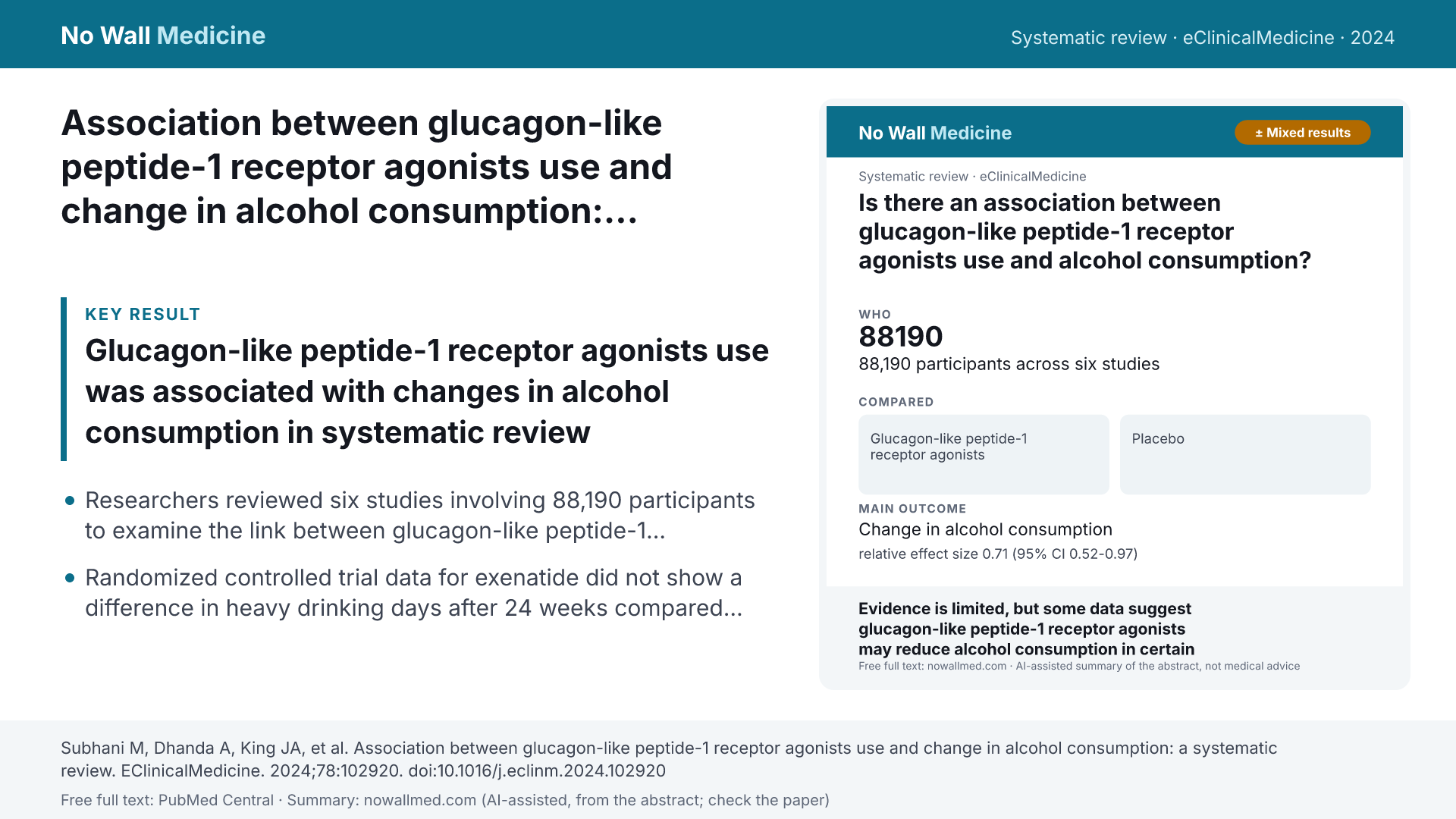
Glucagon-like peptide-1 receptor agonists use was associated with changes in alcohol consumption in systematic review
Association between glucagon-like peptide-1 receptor agonists use and change in alcohol consumption: a systematic review
Systematic reviewMixed results
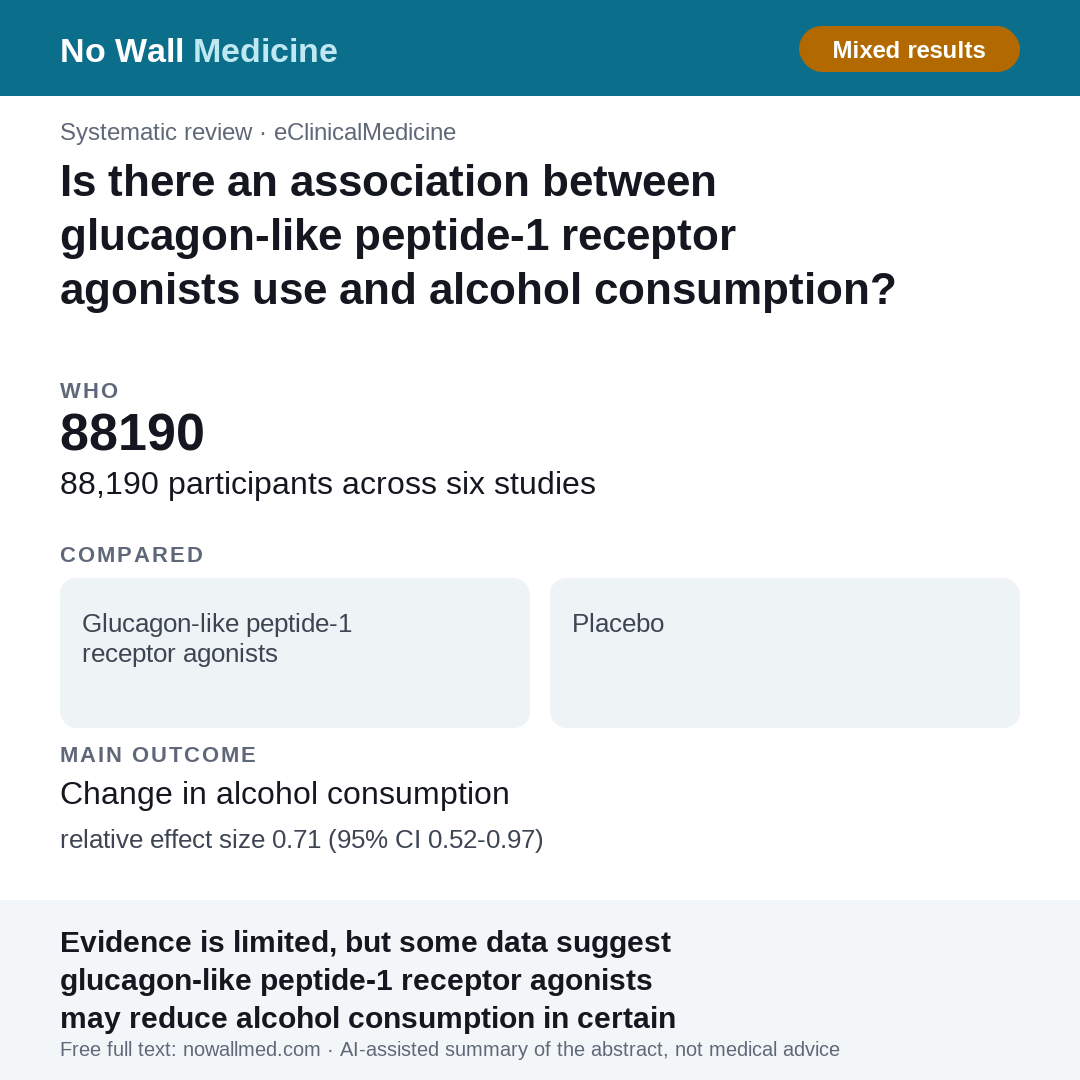
Is there an association between glucagon-like peptide-1 receptor agonists use and alcohol consumption?
Who
88190
88,190 participants across six studies
Compared
Glucagon-like peptide-1 receptor agonists
Placebo
Main outcome
Change in alcohol consumption
Result: relative effect size 0.71 (95% CI 0.52-0.97)
Bottom line: Evidence is limited, but some data suggest glucagon-like peptide-1 receptor agonists may reduce alcohol consumption in certain individuals.
Funded by: National Institute for Health and Care Research
eClinicalMedicine · 2024-11-14Download image
Clinical question: Is there an association between glucagon-like peptide-1 receptor agonists use and alcohol consumption?
Why it matters: It is unknown how glucagon-like peptide-1 receptor agonists affect alcohol consumption and related healthcare events.
Key points
- Researchers reviewed six studies involving 88,190 participants to examine the link between glucagon-like peptide-1 receptor agonists and alcohol use.
- Randomized controlled trial data for exenatide did not show a difference in heavy drinking days after 24 weeks compared to placebo (p = 0.37).
- In a secondary analysis of a trial, participants taking dulaglutide were 29% more likely to reduce alcohol intake compared to placebo (p = 0.04).
Limitation the authors note: The authors note that there is little high-quality evidence and findings across studies were heterogeneous.
Headline and key points written with AI from the paper’s abstract, with every number checked against it. Read the paper before relying on them.
Was this summary helpful?
Cite this article
Subhani M, Dhanda A, King JA, Warren FC, Creanor S, Davies MJ. Association between glucagon-like peptide-1 receptor agonists use and change in alcohol consumption: a systematic review. eClinicalMedicine. 2024. doi:10.1016/j.eclinm.2024.102920
Spotted a mistake? Suggest a correction
Top studies every Monday
The week’s key trials and guidelines in your specialties, plus any topics you follow. By email, free.
Get the weekly digest