Integrase strand transfer inhibitors were associated with lower diabetes risk in most HIV patients
Association between integrase strand transfer inhibitor use with insulin resistance and incident diabetes mellitus in persons living with HIV: a systematic review and meta-analysis
Systematic review and meta-analysisBenefit found
Are integrase strand transfer inhibitors associated with higher incident type 2 diabetes risk?
Who
72404
People living with HIV
Compared
Integrase strand transfer inhibitors: RR 0.80 (95% CI 0.67 to 0.96)
Other antiretroviral therapies
Main outcome
Incident type 2 diabetes mellitus
Result: RR 0.80 (95% CI 0.67 to 0.96)
Bottom line: Integrase strand transfer inhibitors were not associated with increased diabetes risk, except in African populations.
BMJ Open Diabetes Res Care · 2023-02-08Download image
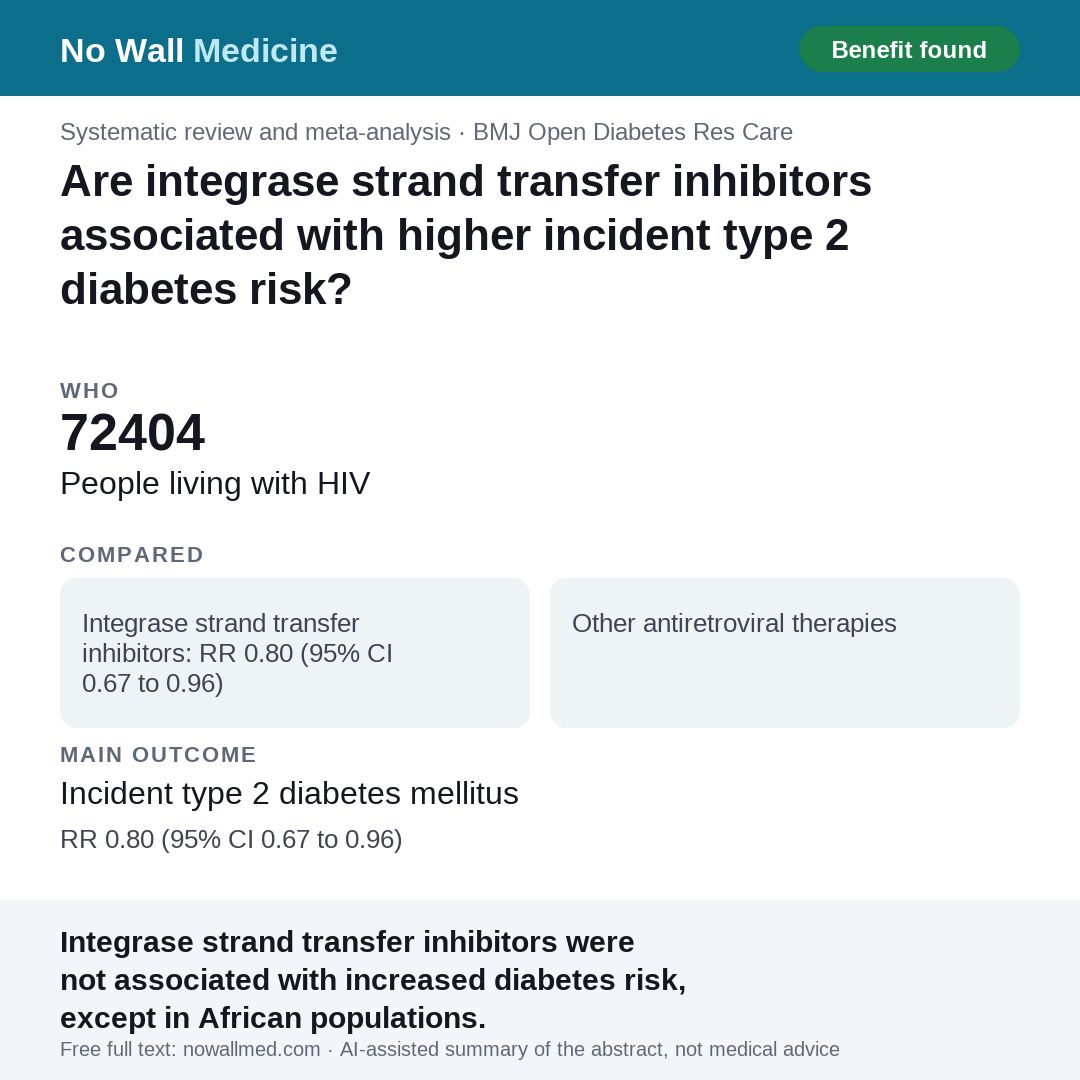
Clinical question: Are integrase strand transfer inhibitors associated with higher incident type 2 diabetes risk?
Why it matters: It was unknown whether integrase strand transfer inhibitors are associated with a higher risk of type 2 diabetes mellitus than other antiretroviral therapies.
Key points
- Researchers analyzed 16 studies involving 72,404 patients to compare diabetes risk between integrase strand transfer inhibitors and other antiretroviral therapies.
- Integrase strand transfer inhibitor use was associated with a 22% reduced risk of diabetes in 8 randomized controlled trials (RR 0.88, 95% CI 0.81 to 0.96).
- The risk was associated with a higher incidence of diabetes in African populations (RR 2.99, 95% CI 2.53 to 3.54).
Headline and key points written with AI from the paper’s abstract, with every number checked against it. Read the paper before relying on them.
Was this summary helpful?
Abstract
Whether integrase strand transfer inhibitors (INSTIs) are associated with a higher risk of incident type 2 diabetes mellitus (DM) than other antiretroviral therapies (ART) needs to be established.MEDLINE, Embase, Web of Science, and ClinicalTrials.gov registries were searched for studies published between 1 January 2000 and 15 June 2022. Eligible studies reported incident DM or mean changes in insulin resistance measured by Homeostatic Model for Insulin Resistance (HOMA-IR) in patients on INSTIs compared with other ARTs. We performed random-effects meta-analyses to obtain pooled relative risks (RRs) with 95% CIs.A total of 16 studies were pooled: 13 studies meta-analyzed for incident diabetes with a patient population of 72 404 and 3 for changes in HOMA-IR. INSTI therapy was associated with a lower risk of incident diabetes in 13 studies (RR 0.80, 95% CI 0.67 to 0.96, I2=29%), of which 8 randomized controlled trials demonstrated a 22% reduced risk (RR 0.88, 95% CI 0.81 to 0.96, I2=0%). INSTIs had a lower risk compared with non-nucleoside reverse transcriptase inhibitors (RR 0.75, 95% CI 0.63 to 0.89, I2=0%) but similar to protease inhibitor-based therapy (RR 0.78, 95% CI 0.61 to 1.01, I2=27%). The risk was lower in studies with longer follow-up (RR 0.70, 95% CI 0.53 to 0.94, I2=24%) and among ART-naïve patients (RR 0.78, 95% CI 0.65 to 0.94, I2=3%) but increased in African populations (RR 2.99, 95% CI 2.53 to 3.54, I2=0%).In conclusion, exposure to INSTIs was not associated with increased risk of DM, except in the African population. Stratified analyses suggested reduced risk among ART-naïve patients and studies with longer follow-up.International Prospective Register of Systematic Reviews (PROSPERO) registration number: CRD42021273040.
Abstract reproduced under the article’s CC BY NC licence.
Subject terms
Cite this article
Mulindwa F, Kamal H, Castelnuovo B, Byonanebye DM, Schwarz JM, Bollinger R. Association between integrase strand transfer inhibitor use with insulin resistance and incident diabetes mellitus in persons living with HIV: a systematic review and meta-analysis. BMJ Open Diabetes Res Care. 2023. doi:10.1136/bmjdrc-2022-003136
Spotted a mistake? Suggest a correction
Top studies every Monday
The week’s key trials and guidelines in your specialties, plus any topics you follow. By email, free.
Get the weekly digest