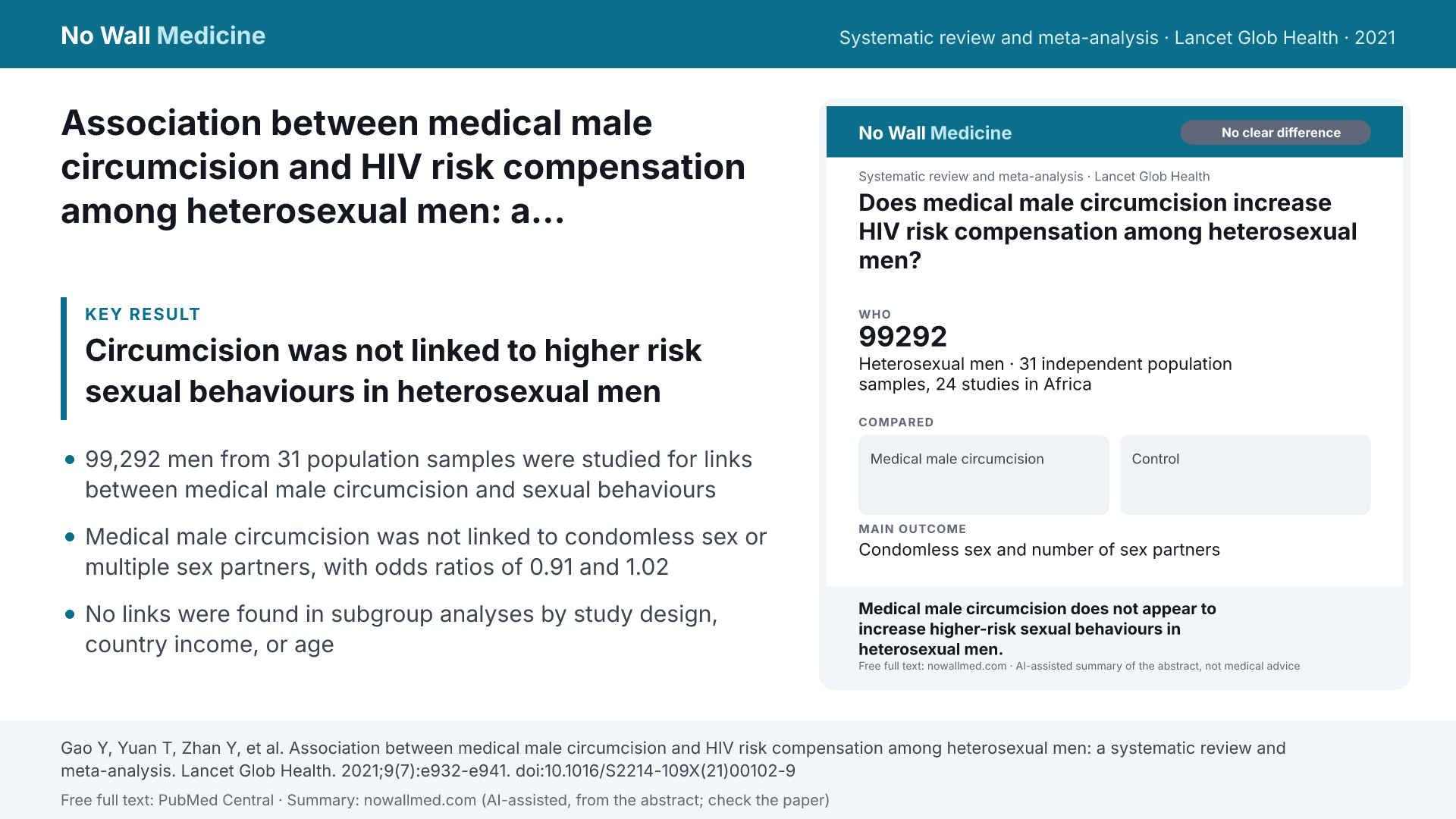
Circumcision was not linked to higher risk sexual behaviours in heterosexual men
Association between medical male circumcision and HIV risk compensation among heterosexual men: a systematic review and meta-analysis
Systematic review and meta-analysisNo clear difference
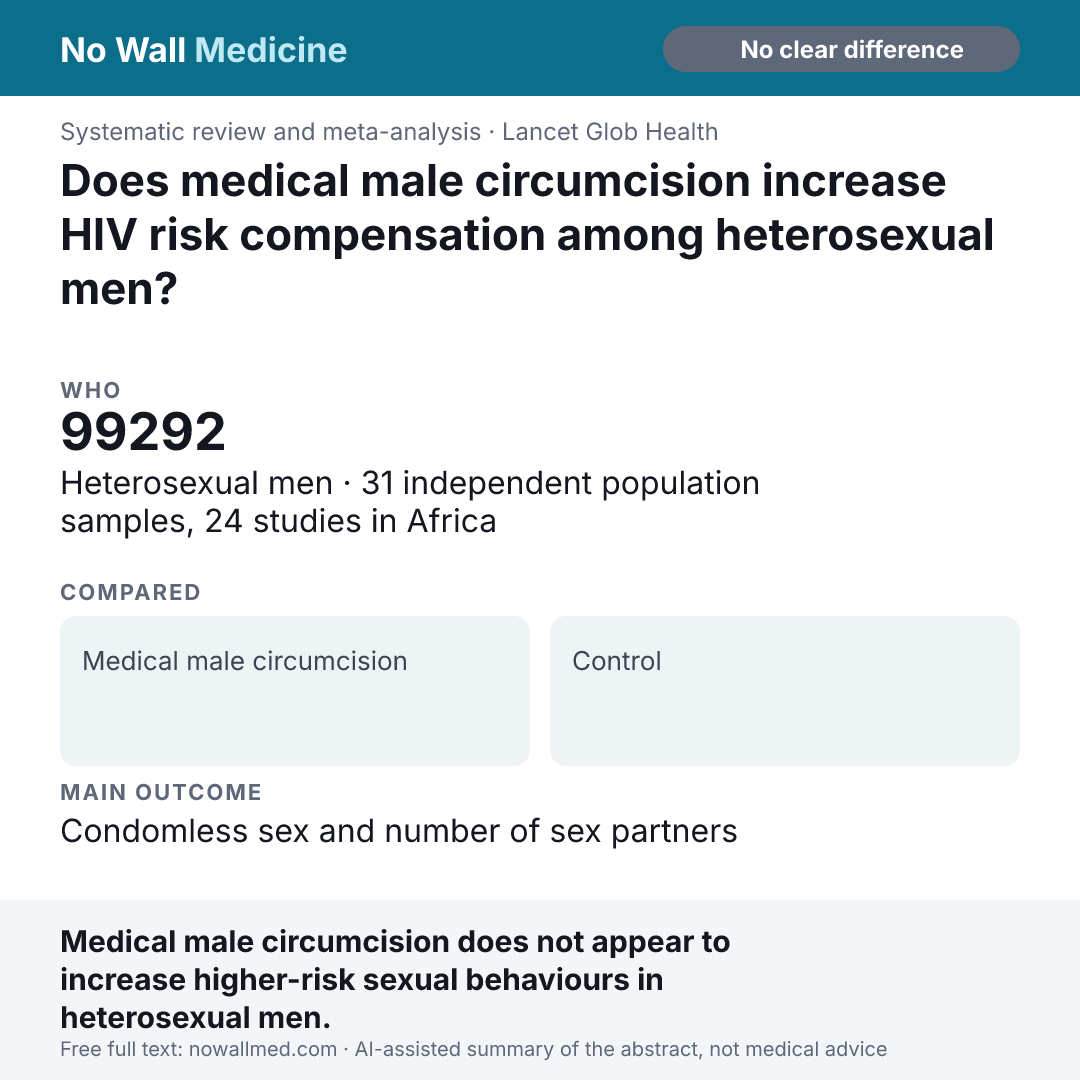
Does medical male circumcision increase HIV risk compensation among heterosexual men?
Who
99292
Heterosexual men · 31 independent population samples, 24 studies in Africa
Compared
Medical male circumcision
Control
Main outcome
Condomless sex and number of sex partners
Result: odds ratio 0.91 (95% CI 0.80-1.05) for condomless sex; 1.02 (95% CI 0.88-1.18) for multiple sex partners
Bottom line: Medical male circumcision does not appear to increase higher-risk sexual behaviours in heterosexual men.
Lancet Glob Health · 2021-04-30 · Funded by National Science and Technology Major Project of China
Limitation the authors note: The meta-analysis included mostly observational studies, with high heterogeneity between studies
Headline and visual abstract written with AI from the paper’s abstract, with every number checked against it. Read the paper before relying on them.
Was this summary helpful?
Abstract
Background
Medical male circumcision (MMC) reduces HIV infection among heterosexual men. There are concerns MMC might prompt higher-risk sexual behaviours because of lower self-perceived risk of HIV infection. We reviewed the published literature to examine associations between MMC and both condom use and number of sex partners among heterosexual men. Methods
In this systematic review and meta-analysis, we searched PubMed, Embase, and the Cochrane Library for studies published before Nov 15, 2020. Interventional and observational studies were included if they contained original quantitative data describing the association between MMC and condom use or number of sex partners among heterosexual men. We excluded data from men whose circumcisions were ritual or religious and data from men who have sex with men. We extracted odds ratios (ORs) and 95% CIs for the associations between MMC and condomless sex and MMC and multiple sex partners directly from the publications if available, selecting adjusted ORs when provided; when necessary, we calculated ORs and 95% CIs using original study data provided in the publication. We used the Mantel-Haenszel random effects model to calculate pooled ORs and 95% CIs. Findings
Our search yielded 3035 results, of which 471 were duplicates and 2537 did not meet the inclusion criteria. From the remaining 27 eligible studies, we identified 99 292 men from 31 independent population samples. 24 studies were done in Africa. We found no statistically significant associations between MMC and condomless sex (OR 0·91, 95% CI 0·80-1·05; k=30; I2=88·7%) or multiple sex partners (1·02, 0·88-1·18; k=27; I2=90·1%). No associations between MMC and condomless sex or multiple sexual partners were found in any subgroup analyses by study design, income of country, age, recruitment setting, circumcision assessment, circumcision prevalence, and risk of publication bias. Interpretation
The promotion of circumcision as an HIV preventive measure does not appear to increase higher-risk sexual behaviours in heterosexual men. Ongoing sexual health education should be maintained as a vital component of effective MMC programmes. Funding
National Science and Technology Major Project of China, the Fundamental Research Funds for the Central Universities, and the Shenzhen Science and Technology Innovation Commission Basic Research Program.
Abstract reproduced under the article’s CC BY NC ND licence.
Subject terms
Cite this article
Gao Y, Yuan T, Zhan Y, et al. Association between medical male circumcision and HIV risk compensation among heterosexual men: a systematic review and meta-analysis. Lancet Glob Health. 2021;9(7):e932-e941. doi:10.1016/S2214-109X(21)00102-9
Spotted a mistake? Suggest a correction