Higher neurofilament light chain levels linked to poor outcomes after traumatic brain injury
Association between neurofilament light chain concentrations and outcomes in patients with moderate to severe traumatic brain injury: a systematic review and meta-analysis
Systematic review and meta-analysisBenefit found
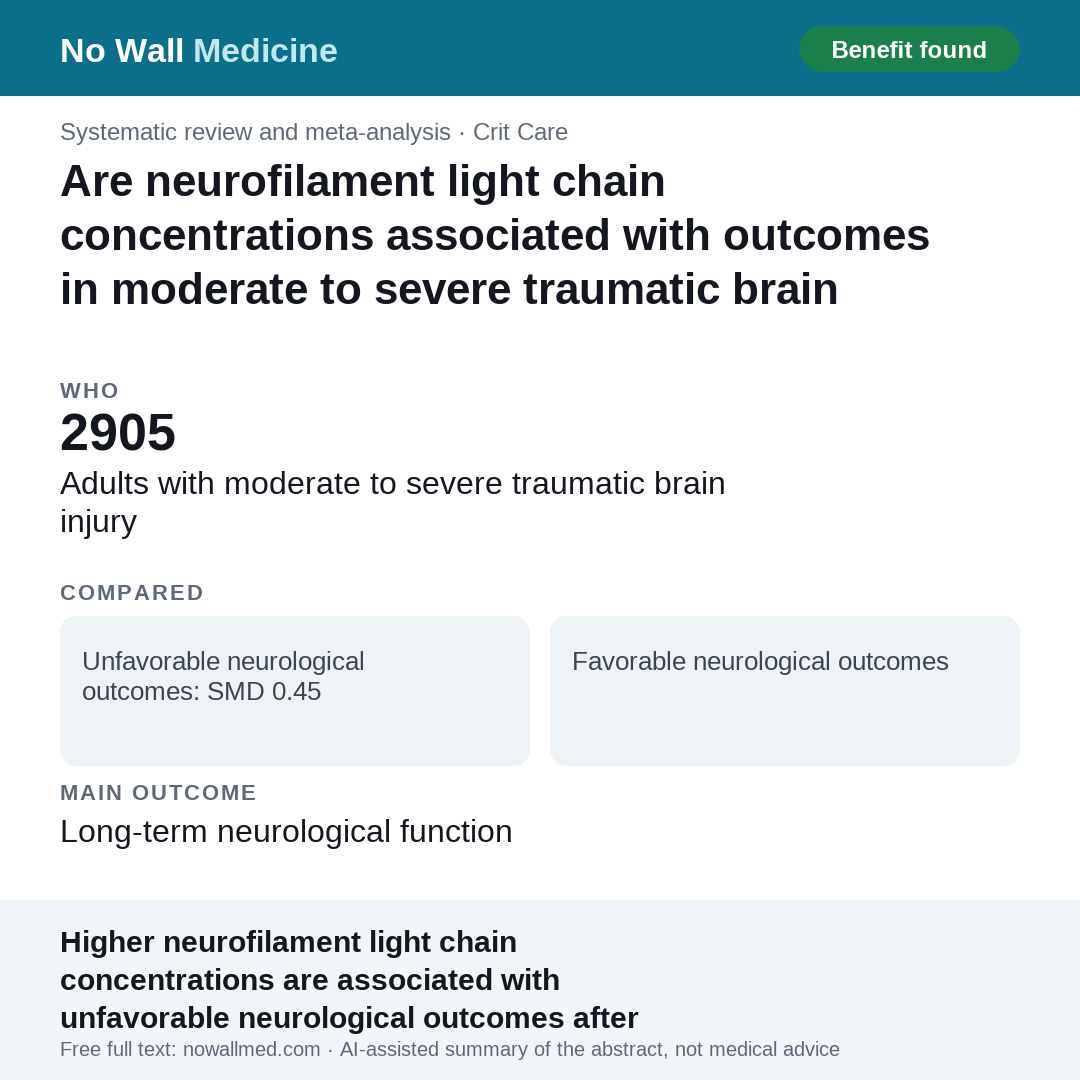
Are neurofilament light chain concentrations associated with outcomes in moderate to severe traumatic brain injury?
Who
2905
Adults with moderate to severe traumatic brain injury
Compared
Unfavorable neurological outcomes: SMD 0.45
Favorable neurological outcomes
Main outcome
Long-term neurological function
Result: SMD 0.45 (95% CI 0.33-0.56)
Bottom line: Higher neurofilament light chain concentrations are associated with unfavorable neurological outcomes after moderate-to-severe traumatic brain injury.
Limitation: Certainty of evidence was very low due to risk of bias, inconsistency, and imprecision.
Crit Care · 2026-05-04Download image
Clinical question: Are neurofilament light chain concentrations associated with outcomes in moderate to severe traumatic brain injury?
Why it matters: Doctors need accurate biomarkers to predict long-term neurological outcomes after traumatic brain injury
Key points
- Researchers studied 2,905 adults with moderate to severe traumatic brain injury.
- Higher neurofilament light chain concentrations were associated with unfavorable neurological outcomes.
- Higher levels were also linked to increased mortality, but with substantial heterogeneity across studies.
Limitation the authors note: The certainty of evidence was graded as very low due to risk of bias, inconsistency, and imprecision
Headline and key points written with AI from the paper’s abstract, with every number checked against it. Read the paper before relying on them.
Topics
Spotted a mistake? Suggest a correction