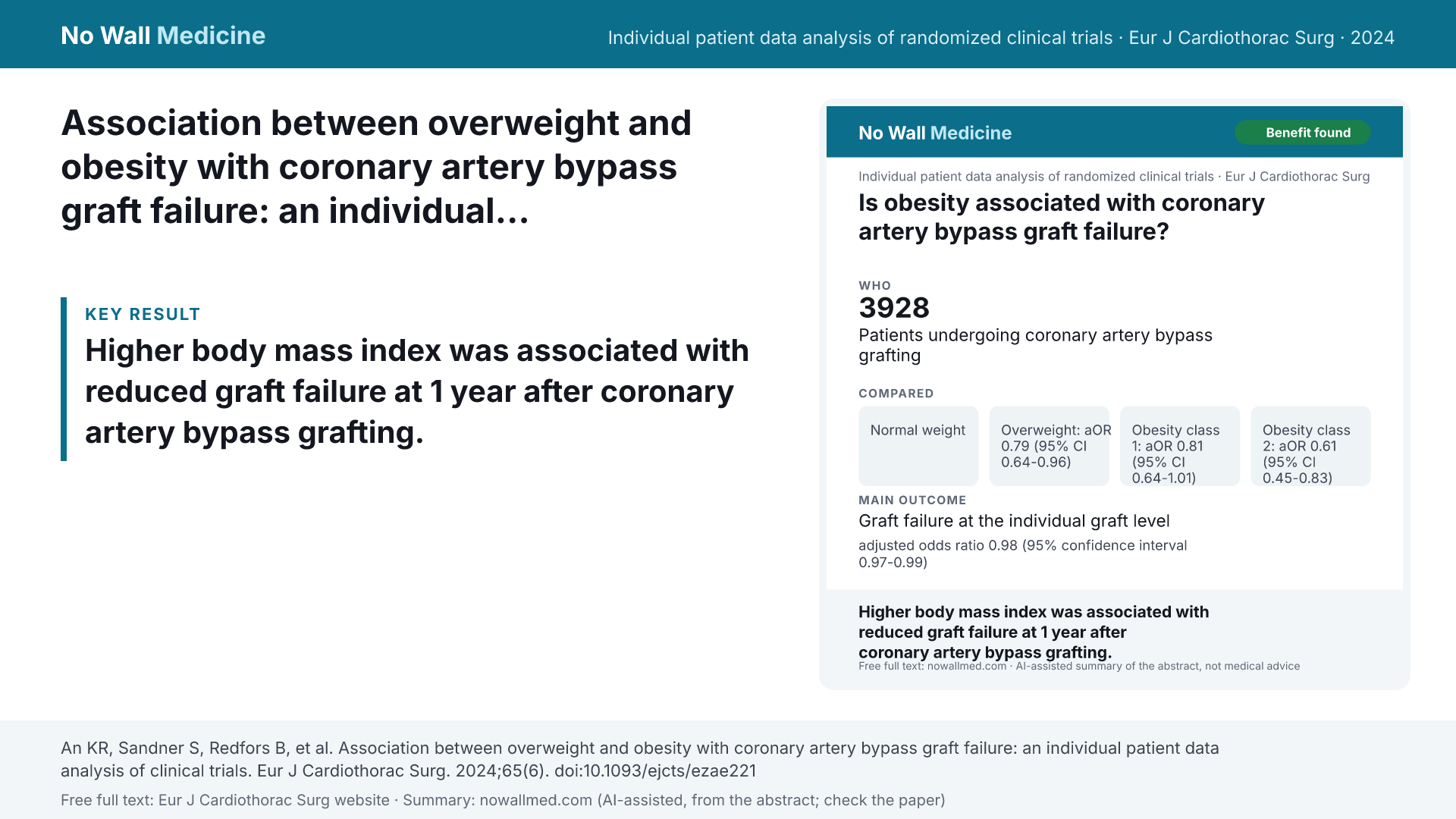
Association between overweight and obesity with coronary artery bypass graft failure: an individual patient data analysis of clinical trials
Individual patient data analysis of randomized clinical trialsBenefit found
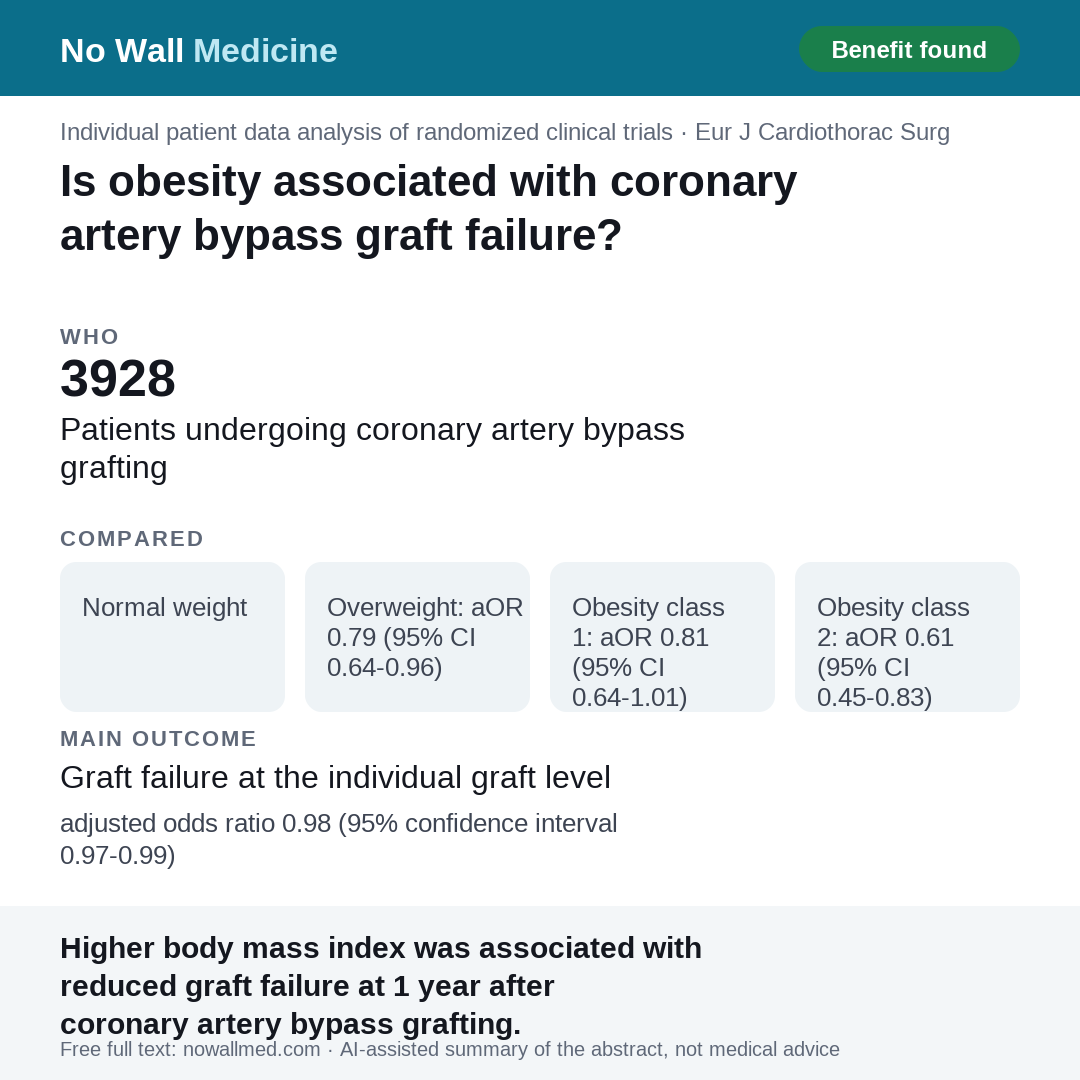
Is obesity associated with coronary artery bypass graft failure?
Who
3928
Patients undergoing coronary artery bypass grafting
Compared
Normal weight
Overweight: aOR 0.79 (95% CI 0.64-0.96)
Obesity class 1: aOR 0.81 (95% CI 0.64-1.01)
Obesity class 2: aOR 0.61 (95% CI 0.45-0.83)
Main outcome
Graft failure at the individual graft level
Result: adjusted odds ratio 0.98 (95% confidence interval 0.97-0.99)
Bottom line: Higher body mass index was associated with reduced graft failure at 1 year after coronary artery bypass grafting.
Eur J Cardiothorac Surg · 2024-06-03Download image
Clinical question: Is obesity associated with coronary artery bypass graft failure?
Abstract
Objectives
The association between obesity and graft failure after coronary artery bypass grafting has not been previously investigated. Methods
We pooled individual patient data from randomized clinical trials with systematic postoperative coronary imaging to evaluate the association between obesity and graft failure at the individual graft and patient levels. Penalized cubic regression splines and mixed-effects multivariable logistic regression models were performed. Results
Six trials comprising 3928 patients and 12 048 grafts were included. The median time to imaging was 1.03 (interquartile range 1.00-1.09) years. By body mass index (BMI) category, 800 (20.4%) patients were normal weight (BMI 18.5-24.9), 1668 (42.5%) were overweight (BMI 25-29.9), 983 (25.0%) were obesity class 1 (BMI 30-34.9), 344 (8.8%) were obesity class 2 (BMI 35-39.9) and 116 (2.9%) were obesity class 3 (BMI 40+). As a continuous variable, BMI was associated with reduced graft failure [adjusted odds ratio (aOR) 0.98 (95% confidence interval (CI) 0.97-0.99)] at the individual graft level. Compared to normal weight patients, graft failure at the individual graft level was reduced in overweight [aOR 0.79 (95% CI 0.64-0.96)], obesity class 1 [aOR 0.81 (95% CI 0.64-1.01)] and obesity class 2 [aOR 0.61 (95% CI 0.45-0.83)] patients, but not different compared to obesity class 3 [aOR 0.94 (95% CI 0.62-1.42)] patients. Findings were similar, but did not reach significance, at the patient level. Conclusions
In a pooled individual patient data analysis of randomized clinical trials, BMI and obesity appear to be associated with reduced graft failure at 1 year after coronary artery bypass grafting.
Subject terms
Cite this article
An KR, Sandner S, Redfors B, et al. Association between overweight and obesity with coronary artery bypass graft failure: an individual patient data analysis of clinical trials. Eur J Cardiothorac Surg. 2024. doi:10.1093/ejcts/ezae221
Spotted a mistake? Suggest a correction