Low perfusion index levels were associated with higher risk of kidney injury after major surgery
Association between peripheral perfusion index and postoperative acute kidney injury in major noncardiac surgery patients receiving continuous vasopressors: a post hoc exploratory analysis of the VEGA-1 trial
Post hoc exploratory analysis of a cluster-randomised trialBenefit found
Is intraoperative perfusion index associated with postoperative acute kidney injury in major noncardiac surgery?
Who
2534
Major noncardiac surgery patients receiving continuous vasopressor infusions · Multicentre
Compared
Area under perfusion index of 1%
Time-weighted average perfusion index
Main outcome
Postoperative acute kidney injury
Result: adjusted odds ratio 1.32 (95% CI 1.00-1.74) for area under 1% perfusion index
Bottom line: Lower time-weighted average perfusion index is associated with increased acute kidney injury and 30-day mortality.
Br J Anaesth · 2024-01-19Download image
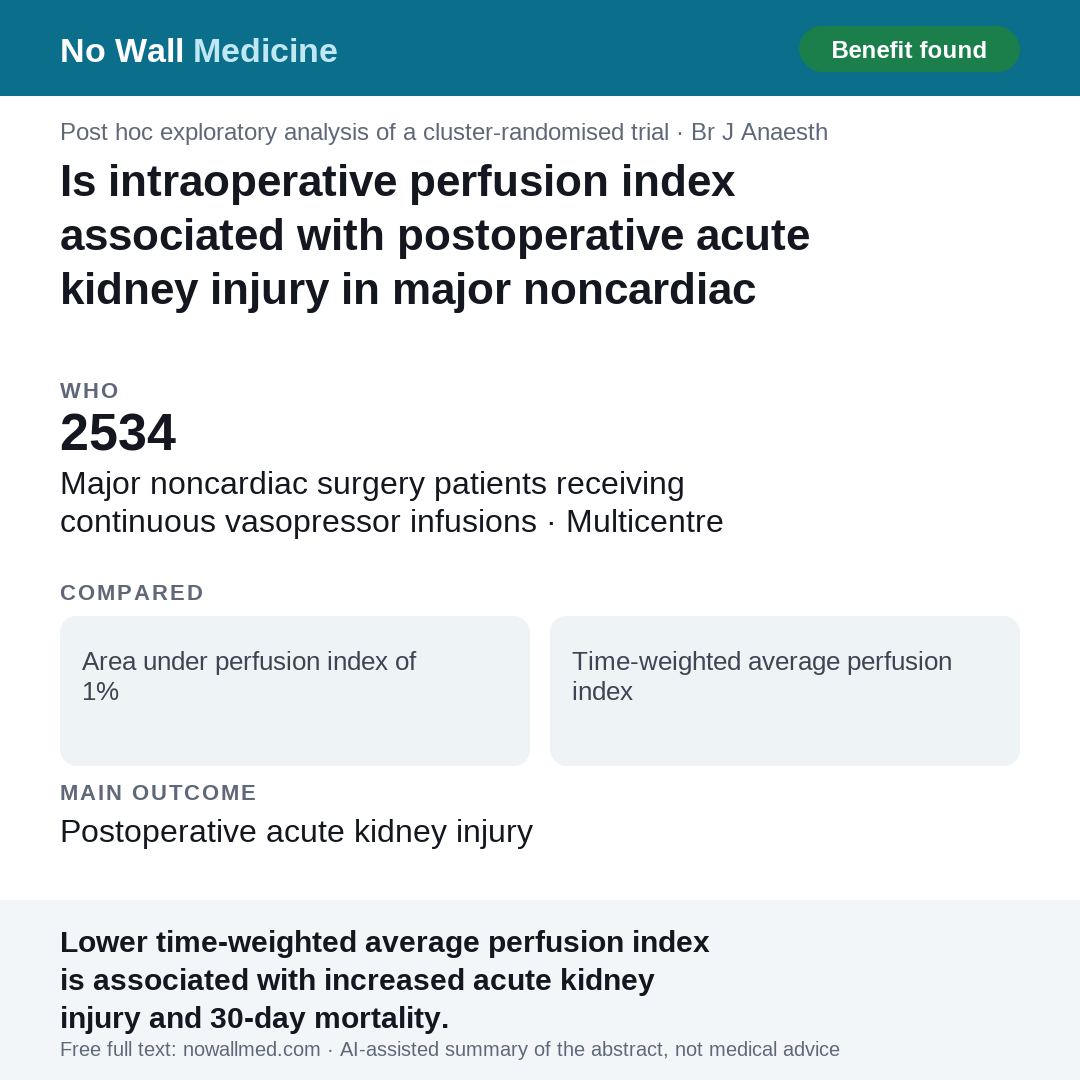
Clinical question: Is intraoperative perfusion index associated with postoperative acute kidney injury in major noncardiac surgery?
Why it matters: It was unknown if the peripheral perfusion index, a measure of blood flow to the skin, is associated with postoperative acute kidney injury in patients receiving continuous vasopressors.
Key points
- Researchers analyzed 2534 cases of patients undergoing major noncardiac surgery while receiving continuous vasopressor infusions, which are medications used to raise blood pressure.
- A perfusion index, which measures blood flow to the skin, below 1% was associated with an increased risk of acute kidney injury (aOR 1.32, 95% CI 1.00-1.74).
- A lower time-weighted average perfusion index was associated with acute kidney injury (aOR 0.82, 95% CI 0.74-0.91) and 30-day mortality (aOR 0.68, 95% CI 0.49-0.95).
Headline and key points written with AI from the paper’s abstract, with every number checked against it. Read the paper before relying on them.
Topics
Cite this article
Krone S, Bokoch MP, Kothari R, Fong N, Tallarico RT, Sturgess-DaPrato J. Association between peripheral perfusion index and postoperative acute kidney injury in major noncardiac surgery patients receiving continuous vasopressors: a post hoc exploratory analysis of the VEGA-1 trial. Br J Anaesth. 2024. doi:10.1016/j.bja.2023.11.054
Spotted a mistake? Suggest a correction
Top studies every Monday
The week’s key trials and guidelines in your specialties, plus any topics you follow. By email, free.
Get the weekly digest