Thicker popliteal artery walls were associated with faster knee cartilage loss in osteoarthritis patients
Association between popliteal artery wall thickness and structural progression in patients with symptomatic knee osteoarthritis
Prospective cohort studyHarm found
Is vascular disease linked to knee OA progression?
Who
176
Patients with symptomatic knee osteoarthritis
Compared
Higher wall thickness
Lower wall thickness
Main outcome
Knee cartilage volume loss
Result: 2.28-fold risk (95% CI 1.07, 4.83)
Bottom line: Thicker popliteal artery walls linked to faster knee OA progression
Rheumatology · 2022-08-17Download image
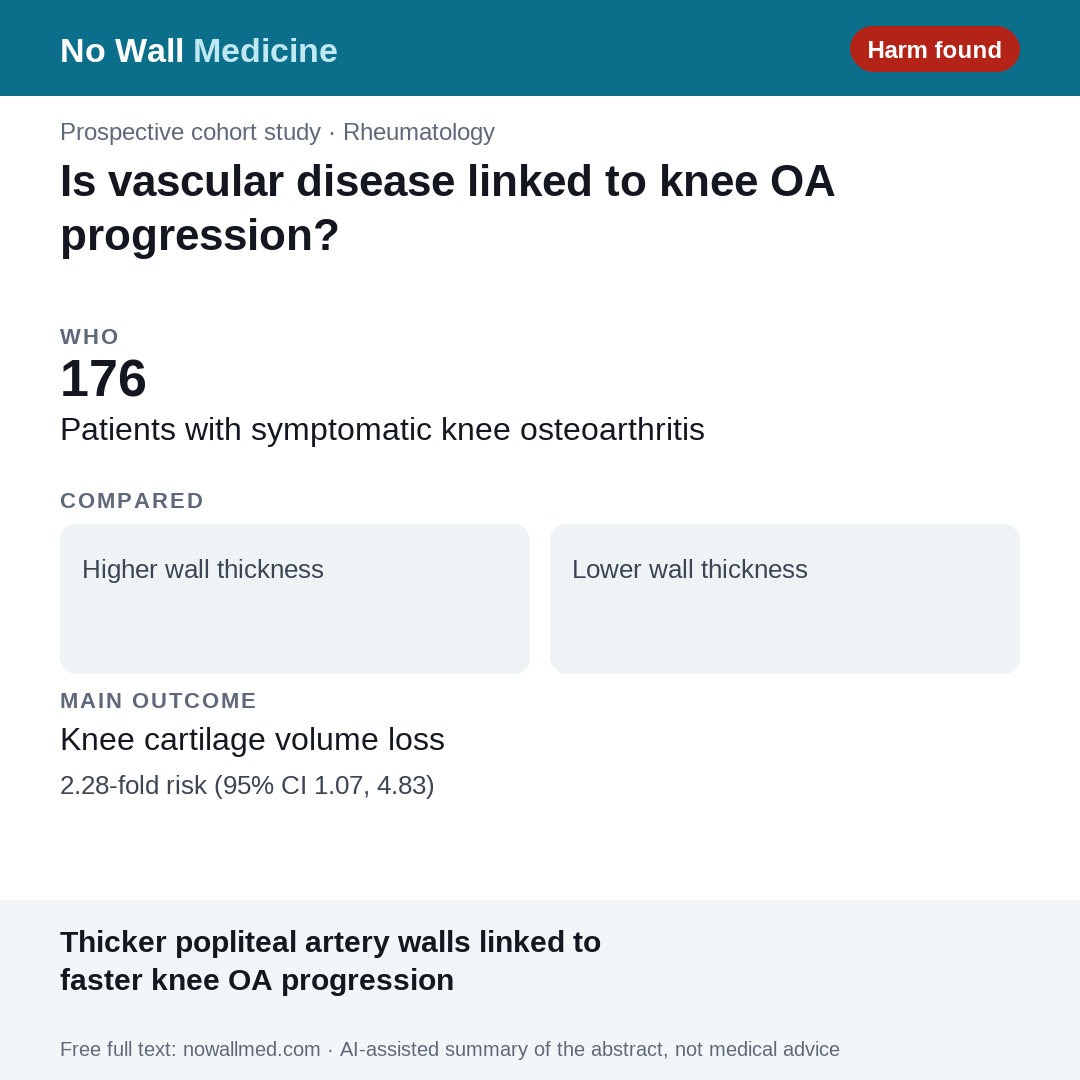
Clinical question: Is vascular disease linked to knee OA progression?
Why it matters: It is unknown if vascular disease, measured by popliteal artery wall thickness, is linked to the structural progression of knee osteoarthritis.
Key points
- Researchers studied 176 participants with symptomatic knee osteoarthritis using magnetic resonance imaging (MRI) to measure artery thickness and cartilage volume.
- Every 10% increase in popliteal artery wall thickness was associated with 120.8 mm3 lower medial tibial cartilage volume and 151.9 mm3 lower lateral tibial cartilage volume at baseline.
- A 10% increase in artery wall thickness was associated with a 2.28-fold risk of rapid medial tibial cartilage loss progression.
Headline and key points written with AI from the paper’s abstract, with every number checked against it. Read the paper before relying on them.
Was this summary helpful?
Subject terms
Cite this article
Wang Y, Pontoh EW, Hussain SM, Lim YZ, Jones G, Hill CL. Association between popliteal artery wall thickness and structural progression in patients with symptomatic knee osteoarthritis. Rheumatology. 2022. doi:10.1093/rheumatology/keac469
Spotted a mistake? Suggest a correction
Top studies every Monday
The week’s key trials and guidelines in your specialties, plus any topics you follow. By email, free.
Get the weekly digest